EMBRYOPSIDA Pirani & Prado
Gametophyte dominant, independent, multicellular, initially ±globular, not motile, branched; showing gravitropism; glycolate oxidase +, glycolate metabolism in leaf peroxisomes [glyoxysomes], acquisition of phenylalanine lysase* [PAL], flavonoid synthesis*, microbial terpene synthase-like genes +, triterpenoids produced by CYP716 enzymes, CYP73 and phenylpropanoid metabolism [development of phenolic network], xyloglucans in primary cell wall, side chains charged; plant poikilohydrous [protoplasm dessication tolerant], ectohydrous [free water outside plant physiologically important]; thalloid, leafy, with single-celled apical meristem, tissues little differentiated, rhizoids +, unicellular; chloroplasts several per cell, pyrenoids 0; centrioles/centrosomes in vegetative cells 0, microtubules with γ-tubulin along their lengths [?here], interphase microtubules form hoop-like system; metaphase spindle anastral, predictive preprophase band + [with microtubules and F-actin; where new cell wall will form], phragmoplast + [cell wall deposition centrifugal, from around the anaphase spindle], plasmodesmata +; antheridia and archegonia +, jacketed*, surficial; blepharoplast +, centrioles develop de novo, bicentriole pair coaxial, separate at midpoint, centrioles rotate, associated with basal bodies of cilia, multilayered structure + [4 layers: L1, L4, tubules; L2, L3, short vertical lamellae] (0), spline + [tubules from L1 encircling spermatid], basal body 200-250 nm long, associated with amorphous electron-dense material, microtubules in basal end lacking symmetry, stellate array of filaments in transition zone extended, axonemal cap 0 [microtubules disorganized at apex of cilium]; male gametes [spermatozoids] with a left-handed coil, cilia 2, lateral, asymmetrical; oogamy; sporophyte +*, multicellular, growth 3-dimensional*, cuticle +*, plane of first cell division transverse [with respect to long axis of archegonium/embryo sac], sporangium and upper part of seta developing from epibasal cell [towards the archegonial neck, exoscopic], with at least transient apical cell [?level], initially surrounded by and dependent on gametophyte, placental transfer cells +, in both sporophyte and gametophyte, wall ingrowths develop early; suspensor/foot +, cells at foot tip somewhat haustorial; sporangium +, single, terminal, dehiscence longitudinal; meiosis sporic, monoplastidic, MTOC [= MicroTubule Organizing Centre] associated with plastid, sporocytes 4-lobed, cytokinesis simultaneous, preceding nuclear division, quadripolar microtubule system +; wall development both centripetal and centrifugal, 1000 spores/sporangium, sporopollenin in the spore wall* laid down in association with trilamellar layers [white-line centred lamellae; tripartite lamellae]; plastid transmission maternal; nuclear genome [1C] <1.4 pg, main telomere sequence motif TTTAGGG, KNOX1 and KNOX2 [duplication] and LEAFY genes present, ethylene involved in cell elongation; chloroplast genome with close association between trnLUAA and trnFGAA genes [precursors for starch synthesis], tufA, minD, minE genes moved to nucleus; mitochondrial trnS(gcu) and trnN(guu) genes +.
Many of the bolded characters in the characterization above are apomorphies of more or less inclusive clades of streptophytes along the lineage leading to the embryophytes, not apomorphies of crown-group embryophytes per se.
All groups below are crown groups, nearly all are extant. Characters mentioned are those of the immediate common ancestor of the group, [] contains explanatory material, () features common in clade, exact status unclear.
POLYSPORANGIOPHYTA†
Sporophyte well developed, branched, branching dichotomous, potentially indeterminate; hydroids +; stomata on stem; sporangia several, terminal; spore walls not multilamellate [?here].
II. TRACHEOPHYTA / VASCULAR PLANTS
Sporophyte long lived, cells polyplastidic, photosynthetic red light response, stomata open in response to blue light; plant homoiohydrous [water content of protoplasm relatively stable]; control of leaf hydration passive; plant endohydrous [physiologically important free water inside plant]; PIN[auxin efflux facilitators]-mediated polar auxin transport; (condensed or nonhydrolyzable tannins/proanthocyanidins +); borate cross-linked rhamnogalactan II, xyloglucans with side chains uncharged [?level], in secondary walls of vascular and mechanical tissue; lignins +; roots +, often ≤1 mm across, root hairs and root cap +; stem apex multicellular [several apical initials, no tunica], with cytohistochemical zonation, plasmodesmata formation based on cell lineage; vascular development acropetal, tracheids +, in both protoxylem and metaxylem, G- and S-types; sieve cells + [nucleus degenerating]; endodermis +; stomata numerous, involved in gas exchange; leaves +, vascularized, spirally arranged, blades with mean venation density ca 1.8 mm/mm2 [to 5 mm/mm2], all epidermal cells with chloroplasts; sporangia in strobili, sporangia adaxial, columella 0; tapetum glandular; sporophyte-gametophyte junction lacking dead gametophytic cells, mucilage, ?position of transfer cells; MTOCs not associated with plastids, basal body 350-550 nm long, stellate array in transition region initially joining microtubule triplets; archegonia embedded/sunken [only neck protruding]; embryo suspensor +, shoot apex developing away from micropyle/archegonial neck [from hypobasal cell, endoscopic], root lateral with respect to the longitudinal axis of the embryo [plant homorhizic].
[MONILOPHYTA + LIGNOPHYTA]Sporophyte growth ± monopodial, branching spiral; roots endomycorrhizal [with Glomeromycota], lateral roots +, endogenous; G-type tracheids +, with scalariform-bordered pits; leaves with apical/marginal growth, venation development basipetal, growth determinate; sporangium dehiscence by a single longitudinal slit; cells polyplastidic, MTOCs diffuse, perinuclear, migratory; blepharoplasts +, paired, with electron-dense material, centrioles on periphery, male gametes multiciliate; nuclear genome [1C] 7.6-10 pg [mode]; chloroplast long single copy ca 30kb inversion [from psbM to ycf2]; mitochondrion with loss of 4 genes, absence of numerous group II introns; LITTLE ZIPPER proteins.
LIGNOPHYTA†
Sporophyte woody; stem branching axillary, buds exogenous; lateral root origin from the pericycle; cork cambium + [producing cork abaxially], vascular cambium bifacial [producing phloem abaxially and xylem adaxially].
SEED PLANTS† / SPERMATOPHYTA†
Growth of plant bipolar [plumule/stem and radicle/root independent, roots positively geotropic]; plants heterosporous; megasporangium surrounded by cupule [i.e. = unitegmic ovule, cupule = integument]; pollen lands on ovule; megaspore germination endosporic, female gametophyte initially retained on the plant, free-nuclear/syncytial to start with, walls then coming to surround the individual nuclei, process proceeding centripetally.
EXTANT SEED PLANTS
Plant evergreen; nicotinic acid metabolised to trigonelline, (cyanogenesis via tyrosine pathway); microbial terpene synthase-like genes 0; primary cell walls rich in xyloglucans and/or glucomannans, 25-30% pectin [Type I walls]; lignin chains started by monolignol dimerization [resinols common], particularly with guaiacyl and p-hydroxyphenyl [G + H] units [sinapyl units uncommon, no Maüle reaction]; roots often ≥1 mm across, stele diarch to pentarch, xylem and phloem originating on alternating radii, cork cambium deep seated, gravitropism response fast; stem apical meristem complex [with quiescent centre, etc.], plasmodesma density in SAM 1.6-6.2[mean]/μm2 [interface-specific plasmodesmatal network]; eustele +, protoxylem endarch, endodermis 0; wood homoxylous, tracheids and rays alone, tracheid/tracheid pits circular, bordered; mature sieve tube/cell lacking functioning nucleus, sieve tube plastids with starch grains; phloem fibres +; cork cambium superficial; leaf nodes 1:1, a single trace leaving the vascular sympodium; leaf vascular bundles amphicribral; guard cells the only epidermal cells with chloroplasts, stomatal pore with active opening in response to leaf hydration, control by abscisic acid, metabolic regulation of water use efficiency, etc.; branching by axillary buds, exogenous; prophylls two, lateral; leaves with petiole and lamina, development basipetal, lamina simple; sporangia borne on sporophylls; spores not dormant; microsporophylls aggregated in indeterminate cones/strobili; grains monosulcate, aperture in ana- position [distal], primexine + [involved in exine pattern formation with deposition of sporopollenin from tapetum there], exine and intine homogeneous, exine alveolar/honeycomb; ovules with parietal tissue [= crassinucellate], megaspore tetrad linear, functional megaspore single, chalazal, sporopollenin 0; gametophyte ± wholly dependent on sporophyte, development initially endosporic [apical cell 0, rhizoids 0, etc.]; male gametophyte with tube developing from distal end of grain, male gametes two, developing after pollination, with cell walls; embryo cellular ab initio, suspensor short-minute, embryonic axis straight [shoot and root at opposite ends], primary root/radicle produces taproot [= allorhizic], cotyledons 2; embryo ± dormant; chloroplast ycf2 gene in inverted repeat, trans splicing of five mitochondrial group II introns, rpl6 gene absent; ??whole nuclear genome duplication [ζ/zeta duplication event], 2C genome size (0.71-)1.99(-5.49) pg, two copies of LEAFY gene, PHY gene duplications [three - [BP [A/N + C/O]] - copies], 5.8S and 5S rDNA in separate clusters.
IID. ANGIOSPERMAE / MAGNOLIOPHYTA
Lignans, O-methyl flavonols, dihydroflavonols, triterpenoid oleanane, apigenin and/or luteolin scattered, [cyanogenesis in ANA grade?], lignin also with syringyl units common [G + S lignin, positive Maüle reaction - syringyl:guaiacyl ratio more than 2-2.5:1], hemicelluloses as xyloglucans; root cap meristem closed (open); pith relatively inconspicuous, lateral roots initiated immediately to the side of [when diarch] or opposite xylem poles; epidermis probably originating from inner layer of root cap, trichoblasts [differentiated root hair-forming cells] 0, hypodermis suberised and with Casparian strip [= exodermis]; shoot apex with tunica-corpus construction, tunica 2-layered; starch grains simple; primary cell wall mostly with pectic polysaccharides, poor in mannans; tracheid:tracheid [end wall] plates with scalariform pitting, multiseriate rays +, wood parenchyma +; sieve tubes enucleate, sieve plates with pores (0.1-)0.5-10< µm across, cytoplasm with P-proteins, not occluding pores of plate, companion cell and sieve tube from same mother cell; ?phloem loading/sugar transport; nodes 1:?; dark reversal Pfr → Pr; protoplasm dessication tolerant [plant poikilohydric]; stomata randomly oriented, brachyparacytic [ends of subsidiary cells ± level with ends of guard cells], outer stomatal ledges producing vestibule, reduction in stomatal conductance with increasing CO2 concentration; lamina formed from the primordial leaf apex, margins toothed, development of venation acropetal, overall growth ± diffuse, secondary veins pinnate, fine venation hierarchical-reticulate, (1.7-)4.1(-5.7) mm/mm2, vein endings free; flowers perfect, pedicellate, ± haplomorphic, protogynous; parts free, numbers variable, development centripetal; P = T, petal-like, each with a single trace, outer members not sharply differentiated from the others, not enclosing the floral bud; A many, filament not sharply distinguished from anther, stout, broad, with a single trace, anther introrse, tetrasporangiate, sporangia in two groups of two [dithecal], each theca dehiscing longitudinally by a common slit, ± embedded in the filament, walls with at least outer secondary parietal cells dividing, endothecium +, cells elongated at right angles to long axis of anther; tapetal cells binucleate; microspore mother cells in a block, microsporogenesis successive, walls developing by centripetal furrowing; pollen subspherical, tectum continuous or microperforate, ektexine columellate, endexine restricted to the apertural regions, thin, compact, intine in apertural areas thick, orbicules +, pollenkitt +; nectary 0; carpels present, superior, free, several, spiral, ascidiate [postgenital occlusion by secretion], stylulus at most short [shorter than ovary], hollow, cavity not lined by distinct epidermal layer, stigma ± decurrent, carinal, dry; suprastylar extragynoecial compitum +; ovules few [?1]/carpel, marginal, anatropous, bitegmic, micropyle endostomal, outer integument 2-3 cells across, often largely subdermal in origin, inner integument 2-3 cells across, often dermal in origin, parietal tissue 1-3 cells across, nucellar cap?; megasporocyte single, hypodermal, functional megaspore lacking cuticle; female gametophyte lacking chlorophyll, four-celled [one module, egg and polar nuclei sisters]; ovule not increasing in size between pollination and fertilization; pollen grains bicellular at dispersal, germinating in less than 3 hours, siphonogamy, pollen tube unbranched, growing towards the ovule, between cells, growth rate (ca 10-)80-20,000 µm h-1, tube apex of pectins, wall with callose, lumen with callose plugs, penetration of ovules via micropyle [porogamous], whole process takes ca 18 hours, distance to first ovule 1.1-2.1 mm; male gametophytes tricellular, gametes 2, lacking cell walls, ciliae 0, double fertilization +, ovules aborting unless fertilized; fruit indehiscent, P deciduous; mature seed much larger than fertilized ovule, small [<5 mm long], dry [no sarcotesta], exotestal; endosperm +, ?diploid [one polar nucleus + male gamete], cellular, development heteropolar [first division oblique, micropylar end initially with a single large cell, divisions uniseriate, chalazal cell smaller, divisions in several planes], copious, oily and/or proteinaceous, embryo short [<¼ length of seed]; plastid and mitochondrial transmission maternal; Arabidopsis-type telomeres [(TTTAGGG)n]; nuclear genome [2C] (0.57-)1.45(-3.71) [1 pg = 109 base pairs], ??whole nuclear genome duplication [ε/epsilon event]; ndhB gene 21 codons enlarged at the 5' end, single copy of LEAFY and RPB2 gene, knox genes extensively duplicated [A1-A4], AP1/FUL gene, palaeo AP3 and PI genes [paralogous B-class genes] +, with "DEAER" motif, SEP3/LOFSEP and three copies of the PHY gene, [PHYB [PHYA + PHYC]]; chloroplast IR expansions, chlB, -L, -N, trnP-GGG genes 0.
[NYMPHAEALES [AUSTROBAILEYALES [MONOCOTS [[CHLORANTHALES + MAGNOLIIDS] [CERATOPHYLLALES + EUDICOTS]]]]]: wood fibres +; axial parenchyma diffuse or diffuse-in-aggregates; pollen monosulcate [anasulcate], tectum reticulate-perforate [here?]; ?genome duplication; "DEAER" motif in AP3 and PI genes lost, gaps in these genes.
[AUSTROBAILEYALES [MONOCOTS [[CHLORANTHALES + MAGNOLIIDS] [CERATOPHYLLALES + EUDICOTS]]]]: phloem loading passive, via symplast, plasmodesmata numerous; vessel elements with scalariform perforation plates in primary xylem; essential oils in specialized cells [lamina and P ± pellucid-punctate]; tension wood + [reaction wood: with gelatinous fibres, G-fibres, on adaxial side of branch/stem junction]; anther wall with outer secondary parietal cell layer dividing; tectum reticulate; nucellar cap + [character lost where in eudicots?]; 12BP [4 amino acids] deletion in P1 gene.
[MONOCOTS [[CHLORANTHALES + MAGNOLIIDS] [CERATOPHYLLALES + EUDICOTS]]] / MESANGIOSPERMAE / core angiosperms: sesquiterpene synthase subfamily a [TPS-a] [?level], polyacetate derived anthraquinones + [?level]; outer epidermal walls of root elongation zone with cellulose fibrils oriented transverse to root axis; P more or less whorled, 3-merous [?here]; pollen tube growth intra-gynoecial; extragynoecial compitum 0; carpels plicate [?here]; embryo sac monosporic [spore chalazal], 8-celled, bipolar [Polygonum type], antipodal cells persisting; endosperm triploid.
Age. Y. Yang et al. (2020: Suppl. Fig. 22) suggested an age of around 167 Ma for this node, L. Zhang et al. (2019) an age of 203-171 Ma, Y. Liu et al. (2021) an age of ca 192.3 Ma, while (192.2-)ca 180(-166.4) Ma is the age in L. Yang et al. (2020) and ca 169.7 Ma in X. Guo et al. (2021).
[MONOCOTS [CERATOPHYLLALES + EUDICOTS]] - if a clade: (veins in lamina often 7-17 mm/mm2 or more [mean for eudicots 8.0]); (stamens opposite [two whorls of] P); (pollen tube growth fast). - Back to Main Tree
Age. This node has been dated to 147-143 Ma (Leebens-Mack et al. 2005), while Foster et al. (2016a: q.v. for details) estimated it to be ca 160 Ma, Chaw et al. (2004: 61 chloroplast genes, sampling poor) dated it to 150-140 Ma, Moore et al. (2010: 95% highest posterior density) estimated an age of (142-)135(-127) Ma, Givnish et al. (2018b) an age of ca 136.1 Ma, Clarke et al. (2011: also other estimates) an age of (161-)137(-124) My; 138-134 Ma was the estimate in Mennes et al. (2013), 145 or 142.3 Ma in Naumann et al. (2013), (158.5-)ca 143, 138.4(-130.5) Ma in Xue et al. (2012), ca 135.8 Ma in Magallón et al. (2015), (143-)138, 131(-126) Ma in Hertweck et al. (2015) and (188.5-)154.0(-124.0) Ma in C. I. Smith et al (2021). Ages of ca 172.4 Ma in Tank et al. (2015: Table S2), ca 213 Ma in Z. Wu et al. (2014), (238-)214(-190) Ma (Murat et al. 2017) and (394.4-)301.0(-207.6) Ma in Zimmer et al. (2007) are much higher, while the ages of around (126.8-)125.1(-124.1) Ma in Iles et al. (2014) are the lowest.
Fossil-based estimates are ca 100 Ma (Crepet et al. 2004: monocots sister to magnoliids) or at least 110 Ma (e.g. Friis et al. 2010: see below).
Evolution: Divergence & Distribution. L. Yang et al. (2020) thought that the five mesangiosperm clades diverged sequentially and rather rapidly within ca 27 My of each other (ca 23 My in J. Ma et al. 2021) in the early to late Jurassic 178.8-151.8 Ma, diversification being "explosive", apparently as the climate ameliorated as Pangea broke up 180-120 Ma - previously there had been extensive areas that were both warm and dry. Of the five clades, Chloranthales and Ceratophyllales are very small, the magnoliids rather larger, and the monocots and especially eudicots very large. Of angiosperms originating over the preceding ca 100 My only Amborellales, Nymphaeales and Austrobaileyales are still extant, and these are all small clades although the fossil record of Nymphaeales is quite rich (Borsch & Soltis 2008; Sender et al. 2010). Magallón et al. (2018) also suggested that there had been an increase in diversification rates around here.
Plant-Animal Interactions Caterpillars of Hesperina, skippers, prefer mnonocots (Quicke et al. 2024: Guanacaste, Costa Rica, area).
Genes & Genomes. In eudicots and monocots DEF-like proteins that cannot form heterodimers predominate (Melzer et al. 2014).
Phylogeny. Relationships between the lineages immediately above the three basal pectinations in the main tree, the ANA grade, i.e. [Amborellales [Nymphaeales [Austrobaileyales [...]]]], are slowly being clarified. There are five clades involved, all well supported, and they make up the mesangiosperms, i.e. the rest of the angiosperms. Relationships between these five groups are commonly discussed when the issue of basal branching in mesangiosperms comes up, and these groups are Chloranthales, eudicots, magnoliids, Ceratophyllales and monocots. Much of the discussion about these relationships is summarized elsewhere.
MONOCOTYLEDONS / MONOCOTYLEDONEAE / LILIANAE Takhtajan - Back to Main Tree
Plant herbaceous, perennial, rhizomatous, growth sympodial; non-hydrolyzable tannins [(ent-)epicatechin-4] +, neolignans 0, CYP716 triterpenoid enzymes 0, benzylisoquinoline alkaloids 0, hemicelluloses as xylan, cell wall also with (1->3),(1->4)-ß-D-MLGs [Mixed-Linkage Glucans]; YABBY transcription factor family expression?; primary root unbranched, not very well developed, stem-borne roots numerous ["adventitious roots", = secondary homorhizy], stele oligo- to polyarch [to >20-arch], medullated [with prominent pith], lateral roots arise opposite phloem poles, vessel elements with scalariform and/or simple perforations, epidermis developed from outer layer of cortex; stem glabrous, internodal region hollow, endodermal cells with U-shaped tertiary thickenings (0), cork cambium uncommon, superficial/outer cortical; primary thickening meristem +, bundles scattered [= atactostele], often amphivasal [especially at nodes, underground stems], vascular cambium 0 [bundles closed]; tension wood 0; , tracheids only in stems and leaves; sieve tube plastids with cuneate protein crystals alone; ?nodal anatomy [see below]; stomata ?paracytic-oblique, oriented parallel to the long axis of the leaf, in lines; prophyll single, adaxial; leaf blade linear, main venation parallel, of two or more size classes, the veins joining successively from the outside at the apex and forming a fimbrial vein, transverse veinlets +, unbranched, vein/veinlet endings not free, margin entire, base broad, ensheathing the stem, sheath open [sheath ≡ petiole]; inflorescence terminal, racemose; flowers 3-merous [6-radiate to the pollinator], polysymmetric, pentacyclic; P = T = 3 + 3, all with three traces, median T of outer whorl abaxial, aestivation open, members of whorls alternating, [pseudomonocyclic, each T member forming a sector of any tube]; stamens = and opposite each T member [A/T primordia often associated, and/or A vascularized from T trace], anther and filament more or less sharply distinguished, anthers subbasifixed, wall with two secondary parietal cell layers, inner producing the middle layer [monocot type]; pollen reticulations coarse in the middle, finer at ends of grain, infratectal layer granular; cleavage centripetal [male meiotic cytokinesis unidirectional]; G [3], with congenital intercarpellary fusion, opposite outer tepals [thus median member abaxial], placentation axile; outer integument often largely dermal in origin, parietal tissue 1 cell across; antipodal cells persistent, proliferating; seed small to medium sized [mean = 1.5 mg], testal; embryo long, cylindrical, cotyledon 1, apparently terminal [i.e. bend in embryonic axis], with a closed sheath, unifacial [hyperphyllar], both assimilating and haustorial, plumule apparently lateral; no dark reversion Pfr → Pr; x = ?7, ?8; nuclear genome [2C] (0.7-)1.29(-2.35) pg, duplication producing monocot LOFSEP and FUL3 genes [latter duplication of AP1/FUL gene], PHYE gene lost; hypocotyl short, (collar rhizoids +); G-C content of genome rather high. - 11 orders, ca 78 families, 60,100 species.
Includes Acorales, Alismatales, Arecales, Asparagales, Commelinales, Dioscoreales, Liliales, Pandanales, Petrosaviales, Poales and Zingiberales.
Note: In all node characterizations, boldface denotes a possible apomorphy, (....) denotes a feature the exact status of which in the clade is uncertain, [....] includes explanatory material; other text lists features found pretty much throughout the clade. However, the precise node to which many characters, particularly the more cryptic ones, should be assigned is unclear. This is partly because homoplasy is very common, in addition, basic information for all too many characters is very incomplete, frequently coming from taxa well embedded in the clade of interest and so making the position of any putative apomorphy uncertain. Then there are the not-so-trivial issues of how character states are delimited and ancestral states are reconstructed (see above).
Age. Molecular ages of crown-group monocots have been variously estimated at ca 200±20 Ma (Savard et al. 1994), ca 189 Ma (Z. Wu et al. 2014), and 160±16 Ma (Goremykin et al. 1997). However, several estimates are centred on 140-130 Ma: ca 132.4 Ma (Givnish et al. 2018b), 135-131 Ma (Leebens-Mack et al. 2005), (147-)134(-121) Ma (Bremer 2000b: age used for dating monocot groups in general, Janssen & Bremer 2004), 138-134 and 136-132 Ma (Mennes et al. 2013, 2015 respectively), (143-)138, 131(-126) Ma (Hertweck et al. 2015) and (142-)136(-130) Ma (Givnish et al. 2016b). Magallón and Castillo (2009) suggest ca 177 Ma or 127 Ma for this split while Bell et al. (2010) estimate ages of (157-)146, 130(-109) My; Moore et al. (2010) offer an age of (129-)122(-117) Ma. Other suggestions include (174.3-)152.9(-134.1) Ma (Eguchi & Tamura 2016; see also Tang et al. 2016) to 228.6-128.3 Ma (Nauheimer et al. 2012: Table S4), although most estimates there are in the 150-139 Ma range. Zhang et al. (2012) suggested an age of (142-)124(-108) Ma, and there are similar ages (ca 125.1 or 121.5 and 128.5-114.5 My) in Xue et al. (2012) and Morris et al. (2018) respectively, as little as as 106.7 Ma is the age in Naumann et al. (2013), (110.5-)104.2(-98) Ma in Iles et al. (2014), 167-120 Ma (Foster & Ho 2017). H.-T. Li et al. (2019) estimate an age of (184-)154(-131) Ma (ages in Bell et al. 2005; Moore et al. 2007; S. A. Smith et al. 2010; Magallón et al. 2013, 2015; Zanne et al. 2014; Zeng et al. 2014; Beaulieu et al. 2015; Foster et al. 2017; Barba-Montoya et al. 2018 - see H.-T. Li et al. 2019: table 2 - are 181-99 Ma). The estimate in L. Yang et al. (2020) is 170.7-147.1 Ma and in D.-F. Xie et al. (2020) it is (166.1-)149.0(-108.0) Ma, while estimates in Schneider et al. (2004) pretty much cover all possibilities; Y. Xiang et al. (2024) suggest an age of (208.8-)200.1(-196.5) Ma. Stem monocots: 136.2-132.1 - Bentz et al. (2024).
An early fossil-based estimate of the age of stem monocots was only ca 98 Ma and that of crown monocots ca 90 Ma (Crepet et al. 2004), however, fossil evidence suggested to Jud and Wing (2012) that monocots and eudicots were present ca 125-119 Ma by the Early Aptian. There are a number of quite early monocot fossils. Coiffard et al. (2013) described Spixiarum kipea from Late Aptian/Early Albian limestone deposits 115-112 Ma in Crato, northeast Brazil - it has petiolate, subovate leaves and may be sister to Orontioideae or in it. Plants of Cratolirion bognerianum were later described from these deposits, and this is thought to be a crown monocot - indeed, it is usually placed above Alismatales on the tree when incorporated in morphological analyses, although it is sometimes sister to Acorus (Coiffard et al. 2019). It has linear leaves, and there is a single scalariform vessel in the centre of the foliar vascular bundles. Acaciaephyllum, from the Early Aptian and also thought to be a monocot, is a little older (Doyle 1973; Doyle et al. 2008).
Liliacidites pollen, boat-shaped, monosulcate, and with reticulate sculpture that becomes finer at the ends of the grain, can be assigned to monocots, Liliacidites sp. A being dated to 125-113 Ma (e.g. Doyle 2014b; Iles et al. 2015). Leaves of Acaciaephyllum, considered to be monocots, are also well known in the fossil record from the Potomac Group, ?early Aptian ca 120 Ma (Doyle 1973; Doyle & Upchurch 2014; Doyle 2014b) - Doyle et al. (2008b) thought that this might be associated with Liliales. For these and other fossil monocots, see Gandolfo et al. (2000), Friis et al. (2006b, 2011), Doyle et al. (2008b), Iles et al. (2015) and Coiffard et al. (2013b, 2019). The monocot Sinoherba ningchengensis was recently described from Lower Cretaceous deposits in Inner Mongolia ca 125 Ma old. It has petiolate leaves with parallel venation, small flowers with a 2-3-seriate perianth, and its apically bilocular gynoecium has a single basal ovule; morphological phylogenetic analyses place it in a clade with Hydatellaceae, Cyclanthaceae and Najadaceae, the broader clade being made up of all the monocots in the analysis plus Nymphaeaceae (Z.-J. Liu et al. 2018a: if a monocot, perhaps Alismatales?).
Evolution: Divergence & Distribution. For diversification rates in monocots, see Hertweck et al. (2015), but note their caveats about ages and life forms. Tang et al. (2016: Fig. 1 ages?) looked at monocot diversification from a global point of view, suggesting i.a. that species numbers/genera tended to be associated with having larger ranges and living at lower elevations, but the story is complex. Givnish et al. (2018b) found that younger families had smaller geographical ranges and fewer species.
Monocots, whatever their relationships, appear to be so distinctive that relating details of their morphology, anatomy and development to those of broad-leaved angiosperms is difficult (e.g. Zimmermann & Tomlinson 1972; Tomlinson 1995). Thus it has been suggested that vessels in monocots and those in other angiosperms evolved independently (Cheadle 1943a, 1953; c.f. Carlquist 2012a), while Meeuse (1975a: p. 435) observed thaat the question whether "the monocots are "derived from the dicots" (or vice versa) is utterly inane" as he toyed with the idea of some kind of polyphyly of the angiosperms. P. Soltis and Soltis (2016) also noted difficulties in understanding the evolution of the numerous distinctive features that characterize monocots, although over half the putative synapomorphies for monocots in Table 4.1 of Soltis et al. (2005b) may be best assigned elsewhere. However, there have long been suggestions that the ancestor of monocots was some kind of aquatic plant, and if true this at one level would make their morphology somewhat more comprehensible (see Ecology and Physiology below). Claßen-Bockhoff et al. (2020: Table 2) revisit the differences in stem anatomy of monocots and eudicots, emphasizing that in the former vascular bundles are initiated outside the primary meristem, the leaf bases are broad and with many vascular bundles, and that primary thickening is pronounced, with centrifugal cell division of the primary meristem and diffuse cell division in the ground tissue, and the vascular bundles become separated.
If the aquatic Ceratophyllales are sister to monocots, synapomorphies like the herbaceous habit, absence of vascular cambium, etc., could be moved down a node, but evidence for such a relationship is not strong (see Jansen et al. 2007; Saarela et al. 2007; Moore et al. 2007, also the discussion under mesangiosperms). Ceratophyllales, very derived morphologically, are indeed remarkable in both their vegetative and floral morphology, but they may be sister to the eudicots or perhaps mesangiosperms. Nymphaeales are other aquatics that were also once believed to be close to monocots, and they now also include the ex-monocot Hydatellaceae. Similarities between monocots and Nymphaeales (and Nelumbo, now Proteales, was sometimes included in the latter - e.g. Titova & Batygina 1996), Ceratophyllum and monocots are likely to be convergences, although Titova and Batygina (1996) drew attention to the dorsiventral symmetry that the embryos of these groups had in common. However, the common ancestors these plants have with other angiosperms are largely unrelated and are likely to have been plants with broad, petiolate leaves and a more or less woody stem with conventional lateral thickening meristems, i.e. both cork and vascular cambia (e.g. Doyle 2013; see also early angiosperm evolution). Du et al. (2016) considered Acorales and Alismatales to be basal in monocots, which, they thought, were ancestrally aquatic, perhaps having evolved from an aquatic dicot...
Other characters: Triterpenoids are not produced by CYP716 enzymes in monocots, other pathways being involved (Miettinen et al. 2017). Both Tofieldiaceae, perhaps/probably sister to other Alismatales, and Acoraceae have distinctive isobifacial leaves, but there is considerable variation in foliar morphology within Alismatales and it is likely that these leaves evolved in parallel in the two (c.f. also Luo et al. 2016). Sender et al. (2019 and references) suggested that the plesiomorphic condition for stomata in monocots was paracytic-oblique, not anomocytic. Rudall (2023a, see also Rudall et al. 2017a) emphasized the fact that monocot and magnoliid paracytic stomata were developmentally different; the former were perigenous, i.e. the subsidiary cells were recruited from neighbouring cell lineages separate from that from which the stomata developed, while the latter were mesogenous, the subsidiary cells being recruited from the stomatal triad, three cells that belong to the one cell lineage. Furthermore, monocot stomata are less variable than those of broad-leaved angiosperms, anomocytic stomata being the only other stomatal "type" being found in the former. For further discussion about monocot leaves, see below. The nature of the anther-filament junction has not been optimised in this part of the tree. For pollen and tapetum evolution, see Furness (2013), and for pollen evolution, see Luo et al. (2015). Septal nectaries are restricted to monocots, where they are quite common (there are also other kinds of nectaries there, e.g. Tölke et al. 2019), but details of their morphology (see e.g. Daumann 1970; Schmid 1985; van Heel 1988; Vogel 1998b; Smets et al. 2000; Rudall 2002; Remizowa et al. 2006a) are rather various. Basically, they are associated with incomplete fusion of the carpel margins (Tölke et al. 2019), and they are difficult to categorise when the carpels are more or less free. For the evolution of syncarpy and of septal nectaries, see Remizova et al. (2010b: associated with postgenital fusion of the carpels), Sokoloff et al. (2013: various trees, various definitions) and Tobe et al. (2018: placement equivocal). There are non-secreting slits in the ovary septae of Acorus, and if they are "really" septal nectaries, that feature becomes a synapomorphy (subsequently lost many, many times) of monocots as a whole. There has been some discussion as to wther the single cotyledon in monots is terminal or not. However, evidence suggests that, like the two cotyledons of "dicots" it is lateral, but as development proceeds the stem apex gets pushed to one side, so appearing lateral (e.g. Haccius 1952; Swamy & Parameswaran 1962b). Helobial endosperm is commin in monocots (Swamy & Parameswaran 1962b); for more on endosperm development, see elsewhere.
Ecology & Physiology. Monocot vegetative morphology and anatomy, their physiology and their ecology are all closely linked. Thinking about monocotyly in particular, Coulter and Land (1914) suggest that it is derived from dicotyly, while Buchholz (1919) discussed cotyledonary fusion in various Pinaceae and the associated formation of a cotyledonary tube; Agapanthus has two primordia on its cotyledonary tube, Cyrtanthus has four (both genera are in Amaryllidaceae). It has long been noted that many of the distinctive features of monocots perhaps suggest an origin from aquatic or hydrophilous ancestors (e.g. Henslow 1893 and references: the style of comparison and suggested mechanisms are interesting!). The scattered vascular bundles in the stem, the long, linear and flexible leaves with parallel venation, absence of secondary thickening, clusters of lateral (= "adventitious") roots rather than a single, branched taproot (?connected with the nature of substrate: mud), ability to deal with low levels of inorganic phosphate, even the sympodial habit, etc., are all compatible with such an origin (see e.g. Mangin 1882; Doyle 2013; Bellini et al. 2014; Schutten et al. 2005: biomechanics of living in water; Givnish et al. 2018b: detailed discussion, including explanation for monocotyly; Howard et al. 2019; T. Shi et al. 2022); Carlquist (2012a) also discussed variation in xylem anatomy in the context of a more or less aquatic origin of the clade. Many members of the first two pectinations in the monocot tree, Acorales and Alismatales, are water or marsh plants or at least prefer to grow in damp conditions. Indeed, fully aquatic angiosperms very often entirely lose the capacity to produce cambium, just like the monocots have, and reacquisition of a normal bifacial cambium in such plants is unknown (Groover 2005; Feild & Arens 2007). Shi et al. (2022) noted that both monocots and Nymphaeales (well, at least Nymphaea and Euryale) had lost the dot3 gene, and the loss phenotype of this gene in Arabidopsis includes presence of parallel leaf veins, fusion of basal rosette leaves, a severely stunted primary root, and freely ending vein loops in the cotyledons. Along the same line, there has also been expansion of LPR1/LPR2 which in Arabidopsis are involved in redox reactions and are affected i.a. by concentrations of inorganic phosphate, and similarly, the loss of a cotyledon can be explained (Shi et al. 2022). Although the annual/herbaceous habit and associated loss/reduction in cambial activity is quite common in eudicots, it seems to be the result of changes in gene expression and interactions, and since the actual genes involved appear not to have been lost, reversal to woodiness is quite common, as in insular woodiness (e.g. Carlquist 1973; Rowe & Paul-Victor 2012; Lens et al. 2012b, 2013; Davin et al. 2016) and in other situations, often physiologically stressfull (Kidner et al. 2015; Lens et al. 2012b). This is unlike the situation in monocots where some genes involved in secondary thickening have been completely lost, in particular five genes involved in early cambial differentiation being fingered here (Roodt et al. 2019; Onyenedum & Pace 2021), changes in xylem development, etc., in the marine angiosperm Zostera marina being even more comprehensive than those in terrestrial monocots (see also Olesen et al. 2016). Reacquisition of the woody habit has involved the evolution of novel mechanisms of secondary thickening. Note, however, that most genes involved in early cambial activity are broadly conserved across all angiosperms (Roodt et al. 2019), while Zinkgraf et al. (2017) suggest that some mechanisms involved in vascular cambium regulation may have become reactivated in the distinctive monocot secondary thickening, best known from Asparagales, even if only scattered there (see also Tomescu & Groover 2018). Furthermore, palms and bamboos in particular have also become woody, but in different ways.
In their analysis of major functional traits in vascular plants, Cornwell et al. (2014) noted that plants above the first node of the monocot branch were notably small (although Acoraceae hardly differ from other monocots in this feature); of course, palms and to a somewhat lesser extent bambusoid grasses show a marked increase in plant size. Most monocots, like Acoraceae themselves, are perennial, sympodial plants (Holttum 1955; see also Levichev 2013) that form tufts of leaves in part of each growth cycle and/or are geophytes with internode elongation in such situations often being slight. Indeed, geophytes, in particular corms and bulbs, are notably common in monocots, and transitions between different kinds of geophytes are somewhat ordered, for instance, bulbs and corms evolve from rhizomes in particular, and from each other (Tribble 2021b: Box 1C); becoming a geophyte may be associated with higher rates of diversification (Howard et al. 2020; Tribble et al. 2021b), although things here are rather confusing. Both temperature and precipitation may affect the evolution of geophytism. The evoluion of bulbs from rhizomes in taxa like Liliales, Allium and Iris is associated with the move from forested and mesic to sunnier and more xeric conditions (Tribble et al. 2021b), while in Orchidaceae-Epidendroideae geophytes evolved from epiphytes under more seasonal conditions (Sosa et al. 2016). In geophytes the stem apex is under or at the surface of the ground except at flowering time, lateral roots develop from the growing stem while the older part of the stem decays along with any roots it bears; the radicle does not persist (see also stem-borne roots in early Cretaceous monocots - Hetherington & Dolan 2019; Coiffard et al. 2019). Indeed, in general monocots have "adventitious" roots - roots arising singly at the nodes (Vanilla), in rings at the nodes (Zea), or throughout the whole internodal area (on the lower surface - Acorus), and this is thought to be a derived feature, a.k.a. secondary homorhizy (see also Kaplan 2022, who does not commit to whether any angiosperms are homorhizic in the strict sense). Note that there are similar cauline lateral roots in eudicots like Ranunculus lingua and Hedera helix (Kaplan 2022); see also Pacheco-Villalobos and Hardtke (2018) for lateral roots in monocots. Howard et al. (2019, q.v. for details) examine the evolution of the geophytic habit in monocots - geophytes defined very broadly, plants with renewal buds at or below ground level, and somewhat more narrowly, plants with underground storage units and buds usually below ground level - and tried to understand their evolution at a global scale. Genomes may be larger in geophytes, and this has been linked with their storage of nitrogen (plenty of nitrogen allows the synthesis of large genomes), prolonged cell division, large cells and fast growth during part of the year (Vesely et al. 2013). Patterson and Givnish (2002) and especially Tribble et al. (2022) focused more on Liliales. The latter examined possible connections between different kinds of geophytes and climate, but found that the climatic niches occupied by bulbs, corms, etc., were all largely similar, differing no more than expected by chance. The exception was plants with root tubers, as in Alstroemeriaceae-Alstroemerieae, which showed significantly different lower temperature seasonality (c.f. Patterson & Givnish 2002; Howard et al. 2019). Tribble et al. (2020/2021a) had earlier found that different kinds of geophytes had some gene groups in common (the focus of their work was Bomarea multiflora and its root tubers), although other gene groups that had been implicated in geophyte development seemed notably similar in root tubers and fibrous roots. Tribble et al. (2020/2021a) thought that the first set of gene groups reflected the fact that "repeated morphological convergence may be matched by independent evolutions of similar molecular mechanisms" (ibid. p. 170). Clarifying the extent of such parallelisms/convergences will be of interest. Thus Hearn et al. (2018b: focus on proliferation of parenchyma, supplemental vascular bundles) had found similarities at the gene expression level in the development of stem and hypocotyl/root tubers in Brassica (kohlrabi, turnips), and also in tubers of Solanaceae.
Desiccation-tolerant monocots, as with other angiosperms, are uncommon, but here they are poikilochlorophyllous - that is, chlorophyll is degraded and thylakoids become dismantled, but are regenerated during early rehydration. On the other hand, dessication-tolerant "dicots", desiccation-tolerant C4 Poaceae/?other C4 monocots, and all other dessication-tolerant embryophytes, are homoiochlorophyllous, chlorophyll being retained and the photosynthetic apparatus protected during desiccation, so little repair is needed when rehydration occurs (Marks et al. 2021).
A feature apparently quite common in monocots, but which is not often mentioned, is the presence of amphivasal vascular budles, i.e., budles in which xylem surrounds the phloem. The most extensive discussion I have come across is that by Jeffrey (1917). Such vascular bundles seem to be particularly common in monocots both in the nodal regions of grasses and sedges and in perennial subterranean axes in general. They are generally not common in annual stems, and they are not known from Arecaceae (but they are known in Cyclanthaceae) and Zingiberales. Arber (1925) records them from the coleoptile of some grasses, from the leaf of Triglochin, and so on. There are intermediates between collateral and amphivasal bundles, Arber (1925) describing the xylem elements as "creeping" around the phloem in Danae racemosa (Asparagaceae-Nolinoideae)! Note that they are also to be found in the medullary bundles of Begonia, Mesembryanthemum, Rheum and Rumex and in Apiaceae-Araliaceae. I have provisionally put them at the level on monocots as a whole - they are definitely known from Acorus, Araceae, etc.), and then as a loss for Arecaceae and Zingiberales.
There is a group of interrelated features of the leaf such as venation density, genome size, cell size (including the sizes of guard and mesophyll cells) that affect photosynthesis, transpiration and the like, and these are discussed further elsewhere.
Monocot flowering stems commonly have elongated internodes, and the response of such stems to gravity in the absence of secondary thickening is interesting. In some Poales (Cyperaceae, Juncaceae, Poaceae), at least, gravity adjustments are made by an intercalary meristem immediately above the node, and the leaf sheath helps support the stem and in particular the weakness at the intercalary meristem by distributing stress (Kempe et al. 2013 and references).
The hydraulic systems of root and stem are not in direct contact because there is usually no secondary thickening (Carlquist 2009). Distinctive monocot-type secondary thickening (Rudall 1995b for records; see below) is infrequent, although somewhat less so in Asparagales. Since the major monocot woody clades, Arecaceae and Poaceae-Bambusoideae, lack any secondary thickening (but c.f. Botánico & Angyalossy 2013), the xylem and phloem in their vascular tissue must remain functional for a very long time indeed. Interestngly, in both groups - perhaps the latter in particular - root pressures are extremely high, which may at least help in embolism repair after xylem cavitation develops (Davis 1961; Cao et al. 2012). It is unclear if such high root pressures occur throughout the monocots (Cao et al. 2012), however, root pressures listed by Fisher et al. (1997) for vines and woody species show no differences between monocots and other angiosperms.
There is variation in cell wall and lignin composition within monocots (e.g. see the commelinids and associated with this in the rate of litter decomposition (see also nutrient cycling). Thus Cornwell et al. (2008) noted that graminoid (= sedges and grasses) litter decomposed more slowly than that of forbs, and "monocot" litter more slowly than that of other angiosperms, at about the same rate as that of gymnosperms. Wardle et al. (2002: no Poaceae or conifers) noted that monocot litter decomposed more slowly even than that of ferns. More work on lignin decomposition is in order.
Scattered in monocots are taxa with broad leaf blades that have reticulate venation (see Cameron & Dickison 1998, also below) and also fleshy fruits (excluding things like arillate, ant-dispersed seeds), adaptations to shady conditions. Givnish et al. (2005, 2006b) suggested that reticulate venation has arisen at least 26 times in monocots (and fleshy fruits 21 times), and have sometimes subsequently been lost. Both features showed very strong signs of tending to be gained (or lost) together, a phenomenon described as "concerted convergence" (see also Dahlgren & Clifford 1982; Patterson & Givnish 2002).
Deng et al. (2015: p. 563) thought that CAM might "have evolved just after the diversification of monocots, with CAM appearing prior to C4", although they were not more precise; their focus was on Orchidaceae.
Pollination Biology & Seed Dispersal. For pollination and floral evolution, see Vogel (1981a: now somewhat dated).
The evolution of fleshy fruits and fruits with myrmecochorous seeds is examined by Dunn et al. (2007). The latter have evolved at least 24 times in monocots, probably no earlier than later Eocene when ants first become abundant in the amber record. Fleshy fruits, also very polyphyletic in origin, evolved much earlier, 110+ Ma, perhaps connected with closing of the canopy; overall, monocots have increased their reliance on animals for seed dispersal over time (Dunn et al. 2007). For more on berries in monocots, see Givnish et al. (e.g. 2005) and Rasmussen et al. (2006).
Plant-Animal Interactions. Overall, herbivory in monocots is relatively low (Turcotte et al. 2014: see caveats), although leaf roll beetles are prominent herbivores of Zingiberales, brown butterflies of Poaceae, etc., q.v. for details. Caterpillars of Yponomeutoidea-Glyphipteriginae and -Ypsolophidae-Ochsenheimeriinae, ditrysian moths, are leaf miners or stem borers in monocots - in fact, a clade of 6 subfamilies that includes these two, includes most of the monocot host records, although some, Plutellidae in particular, are also found on broad-leaved angiosperms (Sohn et al. 2013), and Castniidae skipper butterflies also eat a variety of monocots (Forbes 1956; see Powell et al. 1999 for some other groups that prefer monocots), as do members of the ca 500 species strong yponomeutoid moth Glyphipterygidae (Sohn et al. 2013), mostly leaf miners or stem borers. Larvae of the chrysomelid beetle group Galerucinae subribe Diabroticites are quite common on monocots, where they feed on roots (Eben 1999), indeed, Hispinae-Cassidinae (6000 species), sister to Galerucinae (10,000 species) are the major group of monocot-eating beetles (Jolivet & Hawkeswood 1995; Wilf et al. 2000; Chaboo 2007). Wilf et al. (2000) suggested that these beetles initially ate aquatic members of Acorales and Alismatales, the association of commelinids with the Hispinae-Cassidinae being derived. However, Gómez-Zurita et al. (2007) thought that the two main clades of monocot-eating chrysomelid beetles included in their study were unrelated, neither was close to the galerucines, there had been multiple colonizations of the monocots, and that Chrysomeloidea-Chrysomelidae diversified 86-63 Ma, well after the origin of monocots. García-Robledo and Staines (2008) discuss problems in ascribing herbivory to particular insect groups when using fossil material.
The idea has been floated that monocots experience less herbivory in lowland tropical rainforests than do other angiosperms, in part because they are tough and in part because the leaves remain rolled up for a relatively long time (Grubb et al. 2008). Most monocots have raphides as their main crystalline form of calcium oxalate, and these may be involved in herbivore defence (e.g. see Araceae; Franceschi & Nakata 2005).
Plant-Bacterial/Fungal Associations. Monocots are practically never ectomycorrhizal, but mycoheterotrophy is disproportionally common here. This may be because there is no secondary thickening, a thick cortex, no primary root, etc. (Imhof 2010).
Vegetative Variation. Betekhtina et al. (2023) noted that the roots of the four monocot families from the Middle Urals they examined were quite different in terms of thickness, branching, and development of root hairs - in part perhaps linked to their mycorrhizal status. A more general survey would be of interest; see elsewhere.
The tunica-corpus construction in the stem apex of monocots is similar to that in other angiosperms, although a 1-layered tunica, as is found in maize, is somewhat more common here (Stewart & Dermen 1979; Jouannic 2011 and references). For an early study of monocot stems, see Falkenberg (1876), and for those of palms in particular, see von Mohl (1831).
Novo-Uzal et al. (2012) discuss the rather complicated cell wall composition of monocots. For the distribution of mixed-linkage glucans (MLGs) in both lignified and unlignified cell walls, readily detectable by immunogold labeling, see Trethewey et al. (2005). MLGs are sometimes present in only very small amounts and may be localized according to the thickening of the cell wall, and the family-level sampling was a bit exiguous (see also Smith & Harris 1999); these glucans are also found in Equisetum and Selaginella (e.g. Fry et al. 2009; Harholt et al. 2016: Poaceae). However, the broader sampling of the Cellulose Synthase gene (CesA superfamily) suggests that there are three members involved in the synthesis of these MLGs. The evolution of two, CslH (sister to the eudicot CslB) and CslJ (sister to CslM), can be placed at this node, the other is restricted to some Poales, and this allows their distribution to be clarified; these MLGs are placed as an apomorphy for monocots above (Little et al. 2018). See also above.
Monocot stem development is complex (Geeta 2016), and monocot stems increase in thickness in various ways, ultimately attaining "adult" thickness, which then tends to vary little. There is no vascular cambium, although there are changes in signaling peptides that are associated with the cambium in other angiosperms (Povilus et al., 2020). A primary thickening meristem is close to ubiquitous, and this primary thickening meristem is quite variable in details of its origin and the tissues to which it gives rise (e.g. Esau 1943; Rudall 1991a, a summary; de Menezes et al. 2005; Pizzolato 2009). Endodermal initials in at least some cases produce radially-arranged cortical cells centrifugally, while derivatives of the pericycle (itself the very outside of the phloic tissue - see Esau 1943) initially produce a vascular system of separate bundles embedded in ground tissue that develops centripetally (de Menezes et al. 2011; Cury et al. 2012); this area "remains active throughout the life of the plant" (Cury et al. 2017: p. 42). Although de Menezes et al. (2011) suggested that there was no distinct primary thickening meristem in monocots, some of the argument here seems to be more a matter of definition than anything else. There is a kind of cambial tissue in the stem, and this gives rise to monocot-type secondary thickening, as in a number of Asparagales (Rudall 1995b for a summary). It has also been described from groups such as Cyperaceae (Rodrigues & Estelita 2009), and it may represent a continuation of the activity of the primary thickening meristem (Carlquist 2012a). (There may be a sort of cambial layer in the vascular bundles in a number of monocots, but its products never amount to much - Arber 1919.) The stem may thicken in other ways, as in some palms where ground tissues in both stem and root remains undifferentiated for some time, and limited mitosis and/or cell expansion and/or formation of schizogenous lacunae may take place and the trunk markedly thickens and lengthens as it gets older - sustained primary growth (Waterhouse & Quinn 1978, see also Arecaceae).
Despite the absence of conventional secondary thickening tissues, a number of monocots are plants of quite considerable size, being giant herbs or large trees. In such plants there has usually been a period of establishment growth (e.g. Tomlinson & Esler 1973; Bell & Bryan 1991, 2008; Leck & Outred 2008) which occurs immediately after germination and before any stem elongation. During this period the apical meristem increases in size, the thickness of the stem it produces increases, and there may also be associated changes in leaf morphology. Burtt (1972) noted that during germination in monocots the plumule is frequently carried below the surface of the ground; a tube formed by the cotyledonary sheath (the "dropper") with the plumule and radicle/root area at the bottom grows out of the seed and carries both plumule and radicle away from the seed and sometimes to quite some depth in the soil; establishment growth then proceeds while the meristem is under the ground. Seedling growth can also result in a corm or bulb being "planted" at the right depth by the way that it grows. For instance, in some situations the plumule and associated leaf grow down the radicle, the cortex of which has died, and the plumule (that gives rise to the bulb or corm) may end up over 15 cm below the surface of the ground - in other taxa this process may take 15 years or so, the bulb/corm being lowered by the growth of short, vertical stolons; contractile roots may also be involved in both situations (Galil et al. 1968 and references).
Although monocots can be very long-lived plants, old age is usually achieved by clonal growth, the plants growing at or below the surface of the ground, the tissues of the plants that one actually sees being no more than a year or two - or a few years - old, everything else having rotted and disappeared. However, monocots that grow erect face the problem of maintaining functional xylem and phloem despite often lacking any obvious cambium. In a few taxa like Kingia (Dasypogonaceae) corticating roots grow down the rotting leaf bases and reach the ground and supplement/take over the function of the stem, while taxa like Pandanus (Pandanaceae) and Iriartea (Arecaceae) produce quite massive stilt roots, and Dracaena (Asparagaceae-Nolinoideae), apparently alone in monocots, develops secondary vascular bundles, so being funcionally if not morpholocically like broad-;eaved angiosperm and gymnosperm trees (Carlquist 2012a); such strategems partly obviate this problem. However, what goes on in the vascular tissue, the phloem in particular, of erect and long-lived palms and bamboos is unclear, although there is some discussion under the former group about vascular function in such plants.
The stele or vascular tissue in the root is medullated in many monocots, although that of mycoheterotrophic taxa, some Alismatales, Eriocaulaceae and relatives, Acanthochlamys (Velloziaceae), Sisyrinchium (Iridaceae), etc., is not (e.g. van Tieghem & Douliot 1888; von Guttenberg 1968). Tracheids, and sometimes also phloem, are to be found scattered in the pith in some monocots (e.g. von Guttenberg 1968), while taxa like Brasilochloa sampiana (Poaceae-Bambusoideae-Olyreae) have just a single metaxylem element in the centre of the pith (Oliveira et al. 2019). Although this character is placed as an apomorphy for monocots, I have rarely signified its reversals as apomorphies; I do not know details of the distribution of this feature.
Sinnott (1914) described both Acorus and Potamogeton as having 3:3 nodes, but if some of the veins at the very base of the leaf develop acropetally and some develop basipetally (as also in Piper: Balfour 1958b), then using the same kind of formula to describe nodal anatomy for all angiosperms would not seem to be very useful. Indeed, nodal anatomy, i.e., the nodal vascular plexus, of most monocots is very complex (e.g. Hitch & Sharman 1971; Pizzolato 2000; Vita et al. 2019), and little attention has been paid here to thinking about nodal anatomy in monocots from a comparative point of view - c.f. other angiosperms. Other aspects of stem anatomy in monocots such as the number of whorls of vascular bundles/scattered vascular bundles, etc., and the establishment of linkages between cauline (e.g., developing inside the primary thickening meristem) and foliar vascular bundles, are discussed by Zimmermann and Tomlinson (1972), Esau (1977), Pizzolato (2009) and others. Tomlinson and Fisher (2000) noted a correlation in climbing monocots between the presence of simple perforation plates in metaxylem vessels and absence of direct protoxylem/metaxylem continuity and of the presence of scalariform perforation plates and direct protoxylem/metaxylem continuity.
This brings us to the issue of monocot leaves and how their development relates to that of of other angiosperms. One commonly thinks of the leaves of monocots as having broad, sheathing bases and leaf blades that are linear, elongated, with parallel venation and that are about the same width as the base, but this is perhaps because of the ubiquity of grasses (for the sheathing base of Zea, see Johnston et al. 2014a) and the fact that many commonly-cultivated bulbs also have such leaves. Thus Doyle (1973) noted that the monocot leaf could be characterised by more or less parallel veins of two or more size classes that successively fused towards the apex and by the presence of cross veins, and anatomical features like elongated epidermal cells and more or less tetracytic stomata can be added. In fact monocots show great variation in their basic leaf construction (e.g. Kaplan 1973), and seedlings, e.g. of Restionaceae and Araceae, may also be very variable in their leaf morphology (e.g. Linder & Caddick 2001; Tillich 1995; Leck & Outred 2008). Variegation in many monocot leaves consists of stripes of echlorophyllous tissue running from the apex to the base of the leaf, and this reflects the ontogeny of the foliar cells. This differs from the variegated leaves of dicots, in which variegation is commonly evident as a band around the margin of the blade, reflecting the proliferation of tunica cells at the margin, however, this tunica layer can also proliferate at the leaf margin in some monocots, causing marginal variegation here, too (Zonneveld 2007); J.-H. Zhang et al. (2020) provide a classification of the different kinds of variegation to be found in angiosperm leaves.
Leaves in general are often considered to be made up of a apical hyperphyll and basal hypophyll, a distinction made e.g. by Tillich (2007) in his attempt to standardize the terms used in the description of monocot seedlings. In broad-leaved angiosperms the hyperphyll gives rise to the blade which has a marginal meristem (blastozone) and develops in an acropetal fashion - that is, the veins develop first at the base of the blade. The hypophyll, on the other hand, gives rise to the petiole, a rather late-developing part of the leaf, the leaf base (where the leaf joins the stem), and the stipules, when present. In angiosperms like Arabidopsis development at the base of the blade, the junction of the hyperphyll and hypophyll, proceeds in two directions; cells are cut off both distally towards the apex and proximally towards the base (Ichihashi et al. 2011). However, most of the monocot leaf is thought to develop from the hypophyll alone (see e.g. Arber 1922) and maturation of the blade proceeds basipetally as cell files are cut off from a transverse basal plate. Thus tissues in the apex of the blade of grass or palm leaf emerging from the sheath are mature while cells at the base are actively dividing and elongating. The "Vorläuferspitze", a usually small abaxial unifacial conical or cylindrical protrusion - but up to 15 cm long in Musa sapientum (Skutch 1927) - that is often found at the apex of the mature monocot leaf, may represent the entire hyperphyll (e.g. Raciborski 1900; Goebel 1901; Knoll 1948; Troll 1955; Bharathan 1996; see Baum 1950, 1951a and Basso-Alves et al. 2017b for Vorläuferspitze in flowers).
The relationship - morphological and evolutionary - between the sheath and blade so common in monocots and the petiole and blade of a broad-leaved angiosperm (dicot) leaf is of considerable interest. 1. Quite early in the nineteenth century the dicot petiole/lamina and the monocot sheath/blade were considered to be equivalent. 2. Early in the twentieth century the monocot leaf in its entirety was thought to be equivalent to the dicot petiole, which frequently has more or less parallel veins like those of the monocot blade, i.e. the latter was some kind of phyllode. 3. Recently the whole grass leaf has been thought to be equivalent to the very base of the dicot petiole, the current petiole-leaf hypothesis (Richardson et al. 2021 for a summary). However, it has also been suggested that development in Acorus, Alismatales and some Liliales is often more dicot-like (see Bharathan 1996; Rudall & Buzgo 2002; Doyle 2013), while Croxdale (2000) mentions some broad-leaved angiosperms in which the polarity of growth is the same as that in monocots. Henderson et al. (2021) compared the development of grass leaves in particular with those of dicots, especially Arabidopsis, and saw substantial similarity between the two, i.e. returning to the first hypothesis above. Henderson et al. (2021) modelled leaf development following different hypotheses of monocot leaf growth, examined the behaviour of Arabidopsis mutants in grasses such as Zea, tracked the fate of cells, etc., in reaching their conclusions. In leaves in general, localization of PIN-FORMED1 auxin transport proteins is associated with provascular strand development, whether at the marginal meristem or the sheathing leaf base (Johnston et al. 2014a; early literature: Roth 1949, 1952).
Terete, unifacial blades with stomata all over the surface are scattered in monocots. It has been suggested that they represent the elaboration of the unifacial Vorläuferspitze (e.g. Arber 1925; Troll 1955; Troll & Meyer 1955; Kaplan 1973, 1975: comparison with Oxypolis, Acacia; Townsley & Sinha 2012) - so given some interpretations, they would be elaborated hyperphylls. Other monocots have laterally flattened and isobifacial leaves that are held edge on to the stem, and they look like a bifacial dorsiventral blade that has folded and become connate adaxially. Kaplan (1970a: Acorus) suggested that such leaves were the adaxial elaboration of a midrib/costal region, while Rudall and Buzgo (2002) thought that they originated from an intermediate zone between hyperphyll and hypophyll (see also Yin & Tsukaya 2019). However, developmentally both isobifacial and terete unifacial leaves represent the genetic abaxialization of the leaf, the genes normally expressed abaxially being the only genes expressed, at least at the leaf surface (Yamaguchi & Tsukaya 2010; Nakayama et al. 2013). In any event, it is thought that ensiform and related leaf morphologies develop in a similar way throughout the monocots (e.g. Sajo & Rudall 1999; Golenberg et al. 2023).Yamaguchi et al. (2010) show how in Juncus isobifacial leaves differed from terete leaves by the activity of the DL gene that elsewhere in monocots is involved in midrib development. In Maundia (Alismatales-Maundiaceae) the bundles on the abaxial side of the leaf are inverted, but the large central bundles and the adaxial bundles are normally oriented (Platonova et al. 2016). Comparison with the various leaf morphologies of C3 and C4 chenopods may also be of some interest here.
Gifford and Foster (1988: Fig. 19-13) described the parallel venation so common in monocots as being striate, emphasizing how the main veins join sequentially at the apex, although the different kinds of leaf venation that they show are variations on a parallel theme. Members of Zingiberales typically have a well-developed midrib from which numerous closely parallel veins leave, either proceeding straight to the margin, as in Musa, or taking a more arcuate path. Some kind of midrib/central vein is common in monocots, or there may be a few strong veins diverging from the base (Doyle et al. 2008: q.v. for details of the venation of monocot leaves, etc.; Coiffard & Mohr 2015). Transverse veins joining the parallel veins are ubiquitous, and those in the broadly cordate blades of Stemona (Pandanales-Stemonaceae) are particularly conspicuous and elegant. In a number of monocots there are broad leaf blades, petioles, the venation is reticulate and with some free vein endings, and the stomata are unoriented (see Cameron & Dickison 1998). Such net venation may have arisen at least 26 times in monocots (see above: Givnish et al. 2005, 2006b: see above). The plants involved are often vines/lianes (e.g. Smilax [Liliales], Dioscorea [Dioscoreales]) and/or plants which live in shady habits for at least parts of their lives (Trillium [Liliales]). Such leaf blades, like those of Hosta (Asparagales) and Orontium (Alismatales), are similar only in a functional sense (Troll 1955). Throughout the monocot pages, mention of "petiole" and "blade" when describing leaves is for convenience only, and no homology sensu stricto (= synapomorphy) with structures described in the same way in other monocot groups, or between the blade of a monocot leaf and the lamina of a broad-leaved angiosperm, is implied - (pseudo)petiole + lamina/blade are simply terms used for convenience (e.g. Alves-dos-Santos et al. 2025).
Truly compound leaves are rare in monocots, Zamioculcas, Anthurium and a few species of Dioscorea being examples, but cell death or a similar process may result in the leaves appearing to be compound (a few Araceae) or having distinctive perforations (some Araceae and Aponogetonaceae). In palms, a process related to abscission causes the leaf blade to become dissected and appear compound (Nowak et al. 2007, 2008) while in Zingiberales like Musa and Ravenala the blade easily gets torn to the midrib by the wind, but with little damage, and then is pretty much functionally compound.
In Acorus (Kaplan 1970a) and most, but not all, Alismatales studied (e.g. Bloedel & Hirsch 1979) a bifacial blade may develop from the upper part of the leaf primordium. Such leaves are quite similar in development to those of broad-leaved angiosperms (Doyle 2013). Quite commonly there is still a small Vorläuferspitze, but this is visible only in cataphylls and/or early developed leaves in Alismataceae (Bloedel & Hirsch 1979; they are also visible in Cyclanthaceae - Wilder 1986). How much hyperphyll a Vorläuferspitze represents varies, and Bharathan (1996) noted that a Vorläuferspitze was to be found in some monocot leaves whose blade develops from the hyperphyll.
For stomatal orientation in monocot leaves, see Rudall and Bateman (2019a and references).
Ligules, scattered throughout the monocots, are born on the adaxial surface of the petiole or sheath, either at the base (e.g. Potamogetonaceae) or apex (e.g. Poaceae). Variable in morphology - a line of hairs, a low to quite high ridge-like structure - the ligule may mark the point of separation of the hyper- and hypophyll. Zamioculcas has a ligule very near the base of the petiole, suggesting that the rest of the leaf is equivalent to the hyperphyll, i.e. it is like the lamina of a broad leaved angiosperm; if it is such a marker, then the same might be true of the ligules in other monocots. Genes expressed in ligule development in maize are also expressed elsewhere (base of leaf, branch points) where they mark developmental boundaries (Zhu et al. 2013; Johnston et al. 2014b). Ligules may be paired. Indeed, as has been pointed out by authors like Roth (1949) and Rudall and Buzgo (2002), the developmental origins of monocot ligules and at least some stipules of BLAs are not fundamentally different, both arising from adaxial cross meristems, a sort of intercalary meristem, in the transition zone between hyperphyll and hypophyll (see also Ichihashi et al. 2011). There are also developmental similarities between stipules and leaf sheaths (the latter as in Poaceae), and abaxializing factors may interfere with their development (Townsley & Sinha 2012). Smilax has paired tendrils near the base of the petiole, but such paired structures, whether tendril or ligule, are practically never called stipules because monocots are supposed not to have stipules.... Although I have not used the term "stipule" in the monocot characterisations, some structures there have at least as good a title to the name as some of the things called stipules in BLAs - or perhaps all should be called ligules (see also Colomb 1887). For more on stipules s.l. in angiosperms, see Ye and Ronse De Craene (2024).
Many of the features that make up a "typical" monocot leaf seem to vary independently: Leaf base surrounding the stem/not; blade developed from the hypophyll/hyperphyll (but c.f. A. E. Richardson et al. 2021; Vorläuferspitze present/absent; venation parallel/reticulate; blade developing basipetally/acropetally; petiole and blade developing simultaneously/petiole tending to develop somewhat later (states common in monocots first: see e.g. Kaplan 1973; Bharathan 1996). Variation is especially great in Alismatales and Acorus, and relating all this variation to monocot phylogeny is difficult. In any event, it is possible that "typical" monocot leaves may not be an apomorphy of monocots (see also Doyle 2013). Geeta (2003) divided foliar features of angiosperms into eight separate characters, and in an analysis of these characters across 24 angiosperms did not quite recover a monophyletic monocot clade; as she summarized her findings "it is concluded that there is no entity, the "monocot leaf primordium"" (ibid.: p. 609). To understand leaf development in monocots we much need more broadly comparative studies (but see Bharathan 1996; Rudall & Buzgo 2002: table 23:2; Geeta 2016); for further discussion, see Conklin et al. (2018).
Genes & Genomes. Salse et al. (2009; see also Murat et al. 2017) suggested that the common ancestor of monocots had five protochromosomes, however, Ming et al. (2015) thought that there were seven, as did Carta et al. (2020), and as mentioned elsewhere, the latter group found x = 7 predominating at up to the ordinal level throughout monocots and in basal angiosperms to basal eudicots. Q. Xu et al. (2021) also thought that the base number was 7, while T. Shi et al. (2022) suggested that it was 6. Puttick et al. (2015) estimate the ancestral genome size for monocots; for genome size and the geophyte habit, see above. The τ/tau genome duplication event occurred fairly early in monocot history, see the [Asparagales + Commelinids] node; x = 5 may be the base number there. There is relatively little colinearity and synteny when the genomes of monocots and rosids are compared, although these are extensive within each group (Tang et al. 2008; The Potato Genome Sequencing Consortium 2011: core eudicots), although H. Liu et al. (2001) thought that microscale collinearity was above expectation and exon order in homologous genes was preserved. The YABBY transcription factor family is of interest given their importance in both floral and foliar development. However, their behaviour in Acorales and Alismatales seems not to be known; they are not involved in foliar bifaciality/abaxial development in leaves of Asparagales, etc., unlike in other seed plants (e.g. Romanova et al. 2021). Some aspects of nuclear genome evolution in vascular plants in general are discussed elsewhere.
The story of the evolution of the GC profile of protein-coding genes in the genome is complex, and Clément et al. (2014) suggest that the ancestral condition for monocots as a whole, not just grasses, is for the GC profile to be bimodal - certainly, the GC content is high and heterogeneous within the genome (see also Serres-Giardi et al. 2012; McKain et al. 2016).
Lee et al. (2011: c.f. sampling and topology) found that genes involved in cell fate commitment, auxin metabolism, etc., tended to cluster at this node of the tree.
For the evolution of the IR/LSC junction in the monocot chloroplast genome, see R.-J. Wang et al. (2008), Mardanov et al. (2008), Yang (2010) and J. Luo et al. (2014); I have not integrated this variation into the tree.
Chemistry, Morphology, etc.. Gibbs (1958) noted that monocots tended to have have lower amounts of syringyl lignin than other angiosperms, and that such lignin tended to be found in the bundle sheath fibres. Erickson et al. (1973b) characterised monocot lignin as being of the guaiacyl-syringyl type. Some monocots (Amaryllidaceae, Araceae) have benzylisoqinoline alkaloids, but it is unclear if they are produced by the same biosynthetic pathway as these alkaloids in broad-leaved angiosperms (Waterman 1999). Little is known about cell wall polysaccharides like xylans and glucosomannans and how they interact with cellulose, lignin, etc., in cell wall development (Busse-Wicher et al. 2016).
A cork cambium in the stem of monocots is uncommon, but, if present, it may be called etagen- or storied cork. However, the storying is unlike that of the storied cambium of broad-leaved angiosperms; in monocots it consists of anticlinal divisions of conical cells, and it has been reported from taxa like Curcuma, Philodendron, some Arecaceae, Cordyline and Dracaena (e.g. Philipp 1923; Esau 1977; Tenorio et al. 2012; Jura-Morawiez et al. 2015). Cork cambium in the roots, also uncommon, is more or less superficial in origin, developing just beneath (Arber 1925) or outside (Oliveira et al. 2019) the exodermis. Although Morot (1885) described the cork cambium as being cortical, that may not represent a fundamental difference from the cork cambia just described since he explicitly distinguished monocot cambial initiation from the deep-seated pericylic initiation in the roots of other seed plants; the monocot exodermis is outer cortical.
Cheadle (e.g. 1942, 1943a, 1943b, 1944) and Wagner (1977) surveyed vessel types in the vegetative parts of monocots; although there appear to be large-scale patterns, these data need to be re-evaluated. Cheadle (e.g. 1944) noted that there could be substantial variation in vessel morphology between closely related (congeneric) species, and even between different organs on the same plant (see also Carlquist 2009). Such variation was used to establish his evolutionary trends (Cheadle 1955, 1964, 1969a, b, 1970; Cheadle & Tucker 1961; Cheadle & Kosakai 1971). However, Carlquist (2012a) found criteria for recognising vessels as distinct from tracheids to be difficult to formulate and questioned a number of the earlier reports of vessels, which makes life a bit difficult. Amphivasal vascular bundles are quite common in monocot stems, although they are absent in some groups (e.g. Jeffrey 1917; Arber 1925). Companion cells are lacking in the protophloem of at least some monocots (Ervin & Evert 1970; Platonova et al. 2016), but it is unclear how common this feature is (they are absent in Maundia, Potamogeton, Smilax, Typha). See Botha (2005) for distinctive thick-walled late-formed sieve tubes in some monocots.
Many monocots, although not members of the old Helobieae (here in Alismatales), have large, thin-walled bulliform cells in the adaxial epidermis of the leaf and/or in other adjacent tissues that may cause the leaf to curl as the cells lose turgor (Löv 1926; c.f. Kellogg 2015). In maize the cuticle of the bulliform cells is thicker than that elsewhere, but its composition is such that these cells are in fact more permeable to water than other epidermal cells, and bulliform cells are involved in leaf rolling (Matschi et al. 2020). However, not all grasses have bulliform cells (Shields 1951).
Paracytic (and tetracytic) stomata are common in monocots, and although they are always perigenous, variations in how they develop may characterise major clades, and there is also much variation within them (see e.g. [Poales [Commelinales + Zingiberales]]: c.f. Tomlinson 1974a, q.v. for data, also Paliwal 1969; Pant & Kidwai 1965; Rudall & Bateman 2019; esp. Rudall et al. 2017a); more observations are still needed (Rudall 2000). Epidermal cells are often long, and stomata are usually oriented parallel to the long axis of the leaf and so also to the epidermal cells, but this stomatal orientation holds even when the epidermal cells are short and lack much in the way of orientation themslves, as in some Liliaceae and Pontederiaceae (Rudall et al. 2017a; Rudall & Bateman 2019).
Monocot leaf teeth, when present, are more or less spinose, never glandular. Colleter-like structures ("intravaginal squamules") may be a synapomorphy of monocots or of independent origins in Acorales and other Alismatales, within Araceae, for instance, they seem to be known only from very much phylogenetically embedded genera such as Philodendron, Cryptocoryne and Lagenandra (M. Carlsen, pers. comm.; see also Wilder 1975).
For racemose inflorescences in monocots, see Remizowa et al. (2011a) and Remizowa and Lock (2012), and for bracts in early divergent monocots, see Remizowa et al. (2013). Martínez-Gómez et al. (2022) discuss the morphology and evolution of umbellate inflorescences in monocots; they are derived from both determinetae and indeterminate inflorescences and so only the latter can be umbels s. str..
Floral orientation in the monocots in part depends on the presence and position of the prophyll/bracteole, which is certainly not always adaxial, and also on the existence of other structures on the pedicel (see e.g. Eichler 1875; Engler 1888; Remizova et al. 2006b, 2010c; Sokoloff et al. 2017). Stuetzel and Marx (2005) think that what appear to be axillary flowers are reduced racemes, hence the variability in bracteole position. Be that as it may, when the prophyll/bracteole is lateral, the floral orientation can be quite variable (although less so with respect to the bracteole - Remizowa et al. 2010c, 2012c). Note that although one may think of the flowers of monocots as a whole as having a single adaxial bracteole, where that feature might be on the tree is unclear. Acoraceae have no bracteoles, and bracteoles are often absent in Alismatales, too; it has not been placed properly in the apomorphy scheme...
Monosymmetric flowers in monocots very frequently have the median sepal adaxial, i.e., the flowers are inverted, whether by twisting of the pedicel, because the bracteole is abaxial, etc.; in taxa with a labellum, the labellum is the median tepal of the inner whorl (e.g. Rudall & Bateman 2004; Bukhari et al. 2017). This tepal may be a landing platform for the pollinator, being partly supported by the two adjacent tepals of the outer perianth whorl when the flower is inverted; if the landing platform were a member of the outer whorl, there would not be the same support (see also Bukhari et al. 2017). In those Commelinaceae where the abaxial inner tepal is very small, the well developed inflorescence bract may serve the same purpose. Connected with this inverted monosymmetry is the suppression of at least the adaxial median stamen (Pattern I zygomorphy: Rudall & Bateman 2004); after inversion the flowers effectively have Pattern II zygomorphy, in which abaxial stamens are sterilized. Remarkably, although flowers on the one inflorescence of Crocosmia X crocosmiiflora (Iridaceae) were all monosymmetric, in some the odd member of the outer whorl was adaxial, and in others it was abaxial; patterning, etc. of the other floral organs was adjusted accordingly (pers. obs. vii.2009). (See also below for the arrangement of the carpels.)
Monocots and "dicots" have often been distinguished in the past by the 3-merous flowers of the former and the predominantly 5-merous flowers of the latter, even as it was realised that some of the "primitive dicots" might have more or less 3-merous flowers. With our current knowledge of phylogeny and floral development, it seems that a 3-merous perianth is quite widespread near the base of the angiosperm tree and could even be a synapomorphy for a clade [[Chloranthaceae + magnoliids] [monocots [Ceratophyllaceae + eudicots]]] (Soltis et al. 2005b and literature cited). Lability in phyllotaxy is marked, thus flowers of Anemone tomentosa can have a single whorl of five quincuncial perianth members, or there may be six, arranged in two whorls of three (Kitazawa & Fujimoto 2018). The two perianth whorls in monocots are often similar and are then called tepals, although there is usually a slight difference between the members of the two whorls. Tepals range from small and greenish, as in Acorus, to very large and petal-like, as in Lilium, the two whorls sometimes being sharply differentiated, as in Alstroemeria. The stamens are individually opposite members of each whorl, stamen-tepal primordia being common, while in some Alismatales the outer whorl of stamens may even come to lie outside the inner perianth whorl, as in Juncaginaceae (see e.g. Dahlgren et al. 1985; Endress 1995b; Remizowa et al. 2010b and references). The individual perianth whorls do not completely encircle the floral apex (look at the base of a tulip, lily, or iris flower, for example). As a result, the tepals of each whorl, particularly the outer, may have open aestivation, although in Smilax, for example, the outer tepal members are valvate. Trimerous monocot flowers are rather highly stereotyped and are usually pentacyclic; functionally, they are six-merous.
Dodsworth (2016 and references) thought that there was a connection between the development of this tepaloid perianth and the expansion of the activity of B-class genes to the outer perianth whorl, with the elaboration of the inner whorl in particular perhaps being linked with B gene duplication. However, in Asparagus the tepals, although fairly small, are petaloid, and here B-class genes are expressed only in the inner tepalline whorl (Park et al. 2003, 2004); examining gene expression in the flowers of Acoraceae and those Araceae (Alismatales) with small, greenish tepals would be interesting. Indeed, Iwamoto et al. (2018) looked at the floral development of members of the clade made up by the three families of petaloid Alismatales, the old Alismatales s. str., as possibly "key" (sic) to understanding the evolution of the trimerous pentacyclic monocot flower. Given that this clade is embedded within Alismatales, relating its floral morphology to that of the common ancestor of the monocots is hardly straightforward, but the comparison made by Iwamoto et al. (2018) suggested to them that flowers of taxa like Egeria (Hydrocharitaceae) was getting close to - or even had - the ancestral monocot flower, the monocot floral Bauplan. Of course, Hydrocharitaceae have sepals and petals, and the monocot flower with six stamens was derived from a flower with nine stamens.
The association of each stamen with a perianth member, the fact that the bases of the members of each perianth whorl do not together completely surround the floral apex, and the trimerous organization of the flower are three features very common in monocots and are here considered to be monocot apomorphies (c.f. Soltis et al. 2005b; Bateman et al. 2006b; see also Sauquet et al. 2017). These features are rather more scattered in the eudicot clades up to Gunnerales. Thus authors (e.g. Chen et al. 2007) have drawn attention to the occurrence of dimery and A-T pairing in the grade Proteales to Gunnerales, and where stamen-perianth pairing is to be placed on the tree is unclear, but here is one place. Clades like Lauraceae may be interpreted as having flowers with these monocot features, but such flowers are pretty much non-existent in Pentapetalae, although in taxa with antepetalous stamens, petal and stamen primordia can be confluent. However, the relevance of the odd more or less 3-merous flowers that do occur in Pentapetalae, e.g. Trihaloragis (Haloragaceae), for understanding monocot evolution is unclear. Of course, in many commelinids the perianth whorls individually surround the floral apex and are quite often differentiated into a clearly smaller, sometimes more or less green outer "calyx", and a larger, coloured inner "corolla"; the androecium is inside the inner whorl.
There is some variation in the vasculature even of the stereotypical monocot flower, as Gatin (1920) described in her extensive survey of the flowers of Old Style Liliaceae. She found that a number of genera had only a single vascular bundle entering each tepal member; sometimes successively-dividing traces supplied different parts of the flowers, or each floral part was supplied by a separate trace, the gynoecium was variously vascularized, and so on. The origin of the lateral vascular bundles of perianth members with three or so traces varies (Oriani & Scatena 2019 and literature). T-A primordia may develop quite quickly while the appearance of G primordia is delayed (Endress 1995b).
Gene expression in floral development varies somewhat from that in core eudicots like Arabidopsis. Thus B-class genes, usually expressed in petals in core eudicots, are also expressed in the outer petal-like tepal whorl of Tulipa (Kanno et al. 2003) and Dendrobium (Y. zu et al. 2006) (Tzeng & Yang 2001). Furthermore, even if expressed in both outer whorls, whether or not the B-function genes form obligate heterodimers varied (Zu et al. 2006). Moreover, Ochiai et al. (2004) found that DEF, a B-class gene, was not expressed in the sepals of two Commelinaceae they examined, and also not in the outer more or less petal-like tepal whorls of Asparagus or Lilium (Park et al. 2003, 2004; Tzeng & Yang 2001), while Almeida et al. (2013) found that in Canna ABC-type floral genes had very broad expression patterns across the various floral organs. A further wrinkle is that CYC-like genes in Zingiberales and Commelinales are expressed abaxially in the flower, while in eudicots CYC genes are expressed adaxially (Reyes et al. 2016); this difference may be connected with the inverse orientations of the flowers in the two groups. In general the perianth part that is differentiated is the odd member of the inner whorl (see e.g. Reyes et al. 2016: fig. 4).
It is unclear how the anther wall develops in Acorus (Rudall & Furness 1997), although it inclines to the monocot "type" (Duvall 2001). M. Hu et al. (2024) discussed details of male meiotic cytokinesisi in angiosperms, noting that monocots and eudicots differered from other angiosperms (unidirectional versus bidirectional).
Given the diversity of carpel development in monocots in, or near the base of, the basal pectinations in the monocot tree, whether or not the basic condition for monocot carpels is to be free or somewhat connate is unclear (e.g. Chen et al. 2004; Remizowa et al. 2006a). Remizowa et al. (2006b) summarize variation in gynoecial morphology in some of these basal monocots. In the absence of bracteoles the median carpel is abaxial (Remizova et al. 2012c; Sokoloff et al. 2017), but this carpel is adaxial if there is a bracteole.
Zhao et al. (2016) suggest that in monocots the embryonic suspensor is difficult to differentiate from the rest of the embryo, clear homologues of the WOX8 gene, in other angiosperms a marker for suspensor cell fate, not being identifiable there. There has been much discussion about the evolution of the single cotyledon that characterizes the clade - by connation, or by suppression (see e.g. Wheeler Haines & Lye 1979; Burger 1998)? Most taxa with a single cotyledon have a lateral apical meristem, and Kaplan (1997: 1 ch. 4) noted that this is because the development of the massive single cotyledon evicts the erstwhile terminal meristem, pushing it to one side, similarly, the cotyledon of broad-leaved angiosperms that have only a single cotyledon is more or less lateral. On the other hand in Poaceae the whole embryo is well developed, primordia of foliage leaves being visible, so it is perhaps not surprising to find that the single cotyledon is more obviously lateral there (see also Zhao et al. 2016). Normally the radicle and suspensor are aligned, however, the positional relationship of the radicle to the suspensor can vary, and the point of origin of the radicle is distinctly lateral to the suspensor in several of the old Helobiae (= Alismatales: see Yamashita 1976). Baskin and Baskin (2021: Table 1) summarize embryo morphology in monocot families, and note i.a. presence/absence of a coleoptile and coleorhiza often vary within a family; Baskin and Baskin (2021) focus on the embryo types of Martin (1946), and on the evolution of the embryo of Poaceae.
For seedling morphology in monocots, see Boyd (1932), Tillich in particular (e.g. 2000: ancestral and derived states, 2007, 2014 and references), also Takhtajan et al. (1985: compilation) and Kaplan (1997: 1 ch. 5). The single cotyledon in monocots may be entirely haustorial or have a mixed haustorial/photosynthetic function, even in Acorus. The terms used to describe monocot seedlings are somewhat different from those used to describe the seedlings of other angiospems. The latter are basically described by variation in the hypocotyl, epicotyl, plumule and radicle, with hypogeal (epicotyl elongated) and epigeal (hypocotyl elongated) and cryptocotylar (cotyledons not exposed, whether enclosed by the testa and/or subterranean) and phanerocotylar (cotyledons exposed) as the main variants. A monocot seedling has a mesocotyl, coleorhiza, hyperphyll (haustorium/scutellum, phanomer), hypophyll (cotyledonary sheath, coleoptile), collar, where the the base of the hypocotyl and the radicle join, marked e.g. by collar rhizoids (epiblast, periblast). The cotyledon has a sheath, above which is the apocole, elongated, non-photosythetic and terminated by a haustorium (e.g. the grass scutellum).
For monocots, in addition to references in the notes on the Characters page and under individual orders and families, there is much interesting information in Arber (1920, esp. 1925), von Guttenberg (1957: esp root development and enbryology), Dahlgren et al. (1985) and Tillich (1998); Tomlinson (1970) outlined monocot morphology and anatomy, emphasizing the woody groups; Volumes III and IV of Families and Genera of Vascular Plants, edited and with useful outline classifications by Kubitzki (see especially 1998a, c), also contain a great deal of information. For the morphology of sieve tube plastids, see Behnke (1981a, 2000, 2001, esp. 2003), for dimorphism of the cells of the root epidermis and hypodermis, see Kauff et al. (2000), for rhizosheaths, known from Poaceae and other Poales, rare in broad-leaved angiosperms?, see McCulley (1995), for the cauline endodermis that is common here, see e.g. Van Fleet (1942) and Seagp (2020), for androecial variation, see Ronse Decraene and Smets (1995a), for endosperm development see above, also Floyd and Friedman (2000), etc., for incompatibility systems in monocots - quite common, many uncharacterized, but at least some gametophytic - see Sage et al. (2000), for the distribution of operculate pollen, see Furness and Rudall (2006b), for pollen variation in "basal" monocots, see Furness and Banks (2010), for the development of callose plugs in the pollen tube - quite often complete and regularly spaced in broad-leaved angiosperms, incomplete and irregularly spaced in monocots, see Mogami et al. (2006), for gynoecial morphology and evolution, see Remizowa et al. (2010b), for a summary of embryology, see Danilova et al. (1990a) and Rudall (1997), for antipodal cells, see Holloway and Friedman (2008), for early embryo development, see Zhao et al. (2016), for nuclear DNA content, see Bharathan et al. (1994), for seed and fruit morphology and anatomy, Takhtajan et al. (1985), for fleshy fruits, see Thadeo et al. (2015), for the evolution of seeds, see Danilova et al. (1990b: now somewhat dated), and for seed size, see e.g. Moles et al. (2005a).
Phylogeny. For the immediate relatives of monocots, see the discussion at the Mesangiospermae node. Some combination of Chloranthales, magnoliids and Ceratophyllales are clades that may be sister to monocots.
Both molecular and much morphological data strongly support monocot monophyly. General relationships within monocots are outlined in molecular studies by Chase et al. (1995a, 1995b, 2000a, 2005), Tamura et al. (2004a, b), Chase (2004), Janssen and Bremer (2004: rbcL only, but 878 genera from 77 families), S. W. Graham et al. (2006: to 16 kb chloroplast DNA/taxon examined), Givnish et al. (2006b, 2016b: 75 plastid genes, 2018b: 77 plastid genes, 545 monocot taxa), Chase et al. (2006), X.-X. Li and Zhou (2007), Soltis et al. (2011), Barrett et al. (2012b: 83 chloroplast genes, focus on commelinids), Iles et al. (2013), Ruhfel et al. (2014: chloroplast genomes), and Foster et al. (2016a: position of Liliales had little support). H.-T. Li et al. (2019) looked at relationships here using 000s of chloroplast genomes) - so now to add nuclear data... W. J. Baker et al. (2021a: Fig. S6: first version of the Seed Plant Tree) using 347 nuclear genes (the Angiosperms353 data set) found fairly similar ordinal relationships to those described below except in the commelinids, where relationships were rather different, i.a. Poales being sister to the other members of the group. Note that in Lam et al. (2018) many holomycoheterotrophic taxa, here placed in three orders, clustered together in a parsimony analysis as sister to a [Tacca + Dioscorea] clade - as they note, long branch attraction to the max. All major holomycoheterotrophic clades had been sampled by Givnish et al. (2018b) in their plastome analyses. For relationships in Dioscoreales using chondrome sequences - branches shorter - see Q. Lin et al. (2022).
In most studies Acorus is sister to all other monocots (e.g. Duvall et al. 1993a, b; Soltis et al. 2007a; Moore et al. 2010; Morton 2011; Hertweck et al. 2015; Ross et al. 2015; Luo et al. 2015). However, Stevenson et al. (2000) suggested a rather different set of relationships - [Acoraceae + most of Alismatales] [Araceae + all other monocots]]. Davis et al. (2001) found that a clade [Acoraceae + Alismatales (as delimited here)] was sister to other monocots, and this position was found in the morphological analysis of Doyle and Endress (2000). Davis et al. (2004) noted that this latter set of relationships was not found when rbcL sequences were analysed alone, but it appeared when mitochondrial atpA sequences were analysed, both alone and in combined analyses (see Davis et al. 2006: four genes, two nuclear and two chloroplast, matK also supports this relationship). Petersen et al. (2015a: 2 chloroplast and 5 mitochondrial [atp1 very influential] genes, morphological data) found the relationships [Tofieldiaceae [Araceae [Acoraceae [Alismataceae ...]]]], although support for the position of Acoraceae was not strong. Thadeo et al. (2015: characters from morphology and all three genomic compartments) obtained similar relationships. Finet et al. (2010) found that Acorus and Asparagales formed a clade sister to all other monocots, but this is probably a sampling problem; no Alismatales were included in the analyses. Some characters of floral development are consistent with an Acoraceae-Alismatales relationship (e.g. Buzgo 2001).
Mitochondrial genes showed a much higher rate of change in Acoraceae and many Alismatales, but not Tofieldiaceae and Araceae; Acoraceae linked with the fast-evolving group (G. Petersen 2006c). Indeed, Petersen et al. (2006b) found trees based on mitochondrial data to be in general rather incongruent with those based on plastid data. In the former Orchidaceae grouped with Dioscoreaceae and Thismia, and the positions of Liliales, Asparagales and Dasypgonaceae were very labile. Although such incongruences might "equally well refute the phylogenies based on plastid data" (Petersen et al. 2006b: p. 59), it is rather how the chondrome evolves - and the atp1 gene seems especially problematical - that is the issue (see Petersen et al. 2015a: detailed discussion, focus on Acoraceae). Interestingly, there is a three-nucleotide deletion in the atpA gene in Acoraceae and Alismatales, although not in Cymodoceaceae or Tofieldiaceae in the latter (Davis et al. 2004).
Qiu et al. (2010) found Asparagales to be sister to all remaining monocots other than Alismatales, although support for this position was not very strong and Petrosaviales were not included. However, when included, it was Petrosaviaceae (both genera) that formed a clade sister to the remaining monocots (e.g. Chase et al. 2000a; Davis et al. 2004; Givnish et al. 2005: ndhF gene alone; S. W. Graham et al. 2006; Magallón et al. 2015; Lam et al. 2018; Givnish et al. 2018b). Although Petrosaviales have commonly been placed as in the tree here (see also A.P.G. IV 2016), recent studies have recovered a [Petrosaviales + commelinid] clade (Gitzendanner et al. 2018a: plastome data, support poor) or a [Petrosaviaceae + Asparagales] clade (H.-T. Li et al. 2019: 90% bootstrap), so the position of this little clade perhaps rather up in the air - see also Gitzendanner et al. (2019b). However, in the plastome analysis of Li et al. (2021) Petrosaviaceae were in their earlier position, but one wonders what nuclear genes may have to say. Indeed. G. Zhang and Ma (2024: esp. Fig. 2) discuss the recent (up to the end of 2023) literaure on relationships in monocot groups.
Note that monocots were not found to be monophyletic in some morphological studies such as those by Hay and Mabberley (1991); Araceae seem to have been independently derived from broad-leaved angiosperms, perhaps from Nymphaeales. Some morphological cladistic studies have placed net-veined monocots as sister to all other monocots, suggesting that this leaf venation was plesiomorphic in the monocots (Stevenson & Loconte 1995, see also Dahlgren et al. 1985; Yeo 1989; X.-X. Li & Zhou 2006, etc.); the broad-leaved angiosperm outgroups have similar foliar features. This harks back to some ideas of Lindley (1853), who thought that the monocots that had leaves with reticulate venation, which he called dictyogens, were intermediate between the exogens (dicots) and the endogens (other monocots). Morphological cladistic analyses of the net-veined taxa by themselves (Conran 1989) also suggested relationships which now seem rather unsatisfactory. The analysis of morphological characters alone in monocots has tended to produce trees with little resolution and little support for those branches that are resolved (e.g. Li & Zhou 2006: support only for Alismatales minus Aracaeae and for Zingiberales). Focussing on the single character of apocarpous gynoecium, Endress (1995b) suggested that Triuris (Pandanales-Triuridaceae) might be a rather basal monocot. Even in an analysis of fifteen chloroplast genomes, the five monocots included were not always monophyletic (Goremykin et al. 2005), while Duvall et al. (2006) discuss other studies in which monocots appear not to be monophyletic - the 18S gene is implicated in producing this topology. Acorales were sister (99% ML bootstrap!) to eudicots in the PHYC analysis of Hertweck et al. (2015).
Relationships between commelinids, Asparagales, Dioscoreales, Liliales, and Pandanales have been unclear for some time. In a smallish early study, Liliales were sometimes embedded in Asparagales (Eguiarte et al. 1994). A three-gene (rbcL, atpB, 18S RNA) study (Chase et al. 2000a) showed a polytomy of Petrosaviaceae, Dioscoreales, Pandanales, Liliales, Asparagales and commelinids, although a single shortest tree showed a pectinate structure with the taxa in the sequence followed here for some yime, i.e. [Petrosaviales [[Pandanales + Dioscoreales] [Liliales [Asparagales + commelinids]]]]; another analysis with placeholders for taxa missing some sequences gave a similar structure, except that Pandanales and Liliales were sister taxa. (A combined morphological plus molecular tree in the same volume [Stevenson et al. 2000] suggested a substantially different set of relationships; bootstraps were not given.) Fay et al. (2000a) also suggested a sister relationship between Asparagales and commelinids, although sampling outside Asparagales was sketchy since it was outside their immediate interest. Hilu et al. (2003: matK) i.a. suggested that Orchidaceae might be separate from other Asparagales (the latter being sister to commelinids) and that Dioscoreales and Pandanales formed a clade.
A two-gene (matK, rbcL) study (Tamura et al. 2004a) seemed to clarify the situation somewhat. Petrosaviaceae (both genera - but see below for a possible third - were studied) were sister to a clade [[Dioscoreaceae + Pandanaceae] [Liliales [Asparagales + commelinids]]] (see Chase et al. 2000a above). Support was quite high (³85% bootstrap) for all order and family branches, although rather lower for [Asparagales + commelinids] (68%) (see also Tamura et al. 2004b, a smaller study; Lam et al. 2016). Davis et al. (2004) also found Petrosaviales to be sister to the same monocots, but with moderate to weak (>72%) support. Givnish et al. (2005: ndhF gene alone) found very much the set of relationships in the tree here, although Pandanales grouped with Liliales (low support) and Dasypogonaceae were sister to [Commelinales + Zingiberales]; a grouping [Liliales [Pandanales + Dioscoreales]] also appeared - and had moderate support - in MP, but not in ML analyses of plastid genomes in Barrett et al. (2013: sampling). Graham et al. (2006) in a study analysing considerable amounts of data also recovered relationships similar to those suggested by Tamura et al. (2004a), all sister taxon relationships in this area having 94% or more support, although that for [Liliales [commelinids + Asparagales]] was only 70% (see also Givnish et al. 2006b; Chase et al. 2006; Magallón et al. 2015). Dioscoreales and Pandanales are sister taxa in most studies (e.g. Hilu et al. 2003; Chase et al. 2006; Qiu et al. 2010: support strong; Magallón et al. 2015; Hertweck et al. 2015; Lam et al. 2015).
However, G. Petersen et al. (2006b) found trees based on analyses of mitochondrial data in general to be rather incongruent with those based on plastid data, for instance, Orchidaceae grouped with Dioscoreaceae and Thismia, and the positions of Liliales, Asparagales and Dasypogonaceae in particular were very labile. Although Petersen et al. (2006b) suggested that the incongruences "could equally well refute the phylogenies based on plastid data" (Petersen et al. 2006b: p. 59), this seems unlikely to happen; idiosyncracies in how the mitochondrial genome - and the atp1 gene seems especially problematical - evolves seems a more likely explanation (see Petersen et al. 2015a for detailed discussion and literature: focus on Acoraceae).
Analyses using complete chloroplast genomes sometimes yielded the clade [Liliales [Pandanales + Dioscoreales]], especially when fewer genes were included in the analyses (Liu et al. 2012; see also Ruhfel et al. 2014: chloroplast genomes, only one species of each included), indeed, a variety of relationships were found in the various analyses carried out by Liu et al. (2012), including Alismatales embedded in the commelinids. For other suggestions of relationships in this area, see Fiz-Palacios et al. (2011).
Some uncertainty still remains. In some reconstructions Dioscoreales and Pandanales are adjacent along the spine (e.g. Janssen & Bremer 2004; Bremer & Janssen 2006; Givnish et al. 2006b: not strongly supported), or Nartheciaceae link with Pandanales, the combined group in turn joining with Liliales (Davis et al. 2004: summary of earlier literature on relationships of the two). A four-gene mitochondrial tree suggested the relationships [Asparagales [[Dioscoreales + Pandanales] [Liliales + Commelinids]]], but support was not strong (Qiu et al. 2010), while Davis et al. (2013) recovered a very weakly supported topology [Asparagales s. str. [Orchidaceae + Liliaceae]] in parsimony but not in maximum likelihood analyses (see also Barrett & Davis 2011). Ruhfel et al. (2014) found a [Liliales [Dioscoreales + Pandanales]] clade while in analyses of the nuclear PHYC gene alone Orchidaceae were not sister to other Asparagales - relationships were [Asparagales [Liliales [Orchidaceae + commelinids]]], but support was weak (Hertweck et al. 2015).
Timilsena et al. (2022a) carried out nuclear analyses that included representatives of all 12 monocot orders and 72 of 77 monocot families (the families not included are Blandfordiaceae, Corsiaceae, Juncaginaceae, Ripogonaceae and Ruppiaceae); they used 602 conserved single-copy genes and 1375 benchmarking single-copy ortholog genes. As they noted, they recovered many relationships apparent in plastid gene analyses, although Asparagales and Liliales formed a single clade rather than being recovered as successive pectinations (see also Timilsena et al. 2022b); the former topology is in line with that recovered in previous studies using nuclear genes, and it is followed below. For other cases where there are differences in the topologies resulting from analyses of the two kinds of data, see e.g. Alismatales, Commelinales, Liliales and Poales; note, however, that sampling within families in Timilsena et al. (2022a) tended to be poor/minimal.
Although Petrosaviales are commonly placed as in the tree here (e.g. Lam et al. 2018; Timilsena et al. 2022a), until v.2019 it seemed that no firm association of Petrosaviaceae with any other order had been strongly supported, hence its inclusion below as a monofamilial Petrosaviales. However, H.-T. Li et al. (2019: plastomes) found quite good (90% bootstrap) support for Petrosaviaceae as sister to Orchidaceae (Asparagales), although another recent plastome study recovered a [Petrosaviales + commelinid] clade (Gitzendanner et al. 2018a, b). However, any movement of the family awaits confirmation from the nuclear compartment.
Some mycoheterotrophic taxa cause problems, and in an analysis using three chloroplast genes (not present in all the mycoheterotrophs), branch length could be extremely long, although by no means always (Lam et al. 2016), in some analyses mycoheterotrophs from three orders grouping together and forming a clade (Lam et al. 2018). Neyland (2002) found that Thismia was sister to a well supported Burmannioideae, but with less support, but Burmanniaceae s.l. did not link with other Dioscoreales. Analysis of 26S rDNA sequences suggested that Corsiaceae were polyphyletic; Arachnitis perhaps being sister to Thismia and/or Burmannia (Neyland & Hennigan 2003; G. Petersen et al. 2006b: combined analysis). A recent analysis of plastid loci also failed to include Arachnitis in Liliales, and perhaps it was to be included in the commelinids (Kim et al. 2012). However, these relationships have not been confirmed, and these mycoheterotrophs seem to be finding stable resting places, as in studies by Lam et al. (2016, 2018) that included a very wide variety of monocot mycoheterotrophs. For monocot mycoheterotrophs, see also Perez-Lamarque et al. (2019/2020).
For further discussion of relationships within the monocots, see especially the Petrosaviales and Poales pages.
Classification. For a linear sequence of monocot genera, excluding Orchidaceae and Poaceae, see Trias-Blasi et al. (2015).
Thanks. I am grateful to Claudia Henriquez for much discussion on leaf development in monocots.
Synonymy: Acoranae Reveal, Alismatanae Takhtajan, Aranae Reveal, Arecanae Takhtajan, Bromelianae Reveal, Butomanae Reveal, Commelinanae Takhtajan, Cyclanthanae Reveal, Dioscoreanae Reveal & Doweld, Iridanae Doweld, Juncanae Takhtajan, Melanthianae Doweld, Najadanae Reveal, Orchidanae Doweld, Pandananae Reveal, Petrosavianae Doweld, Poanae Doweld & Reveal, Pontederianae Reveal, Rapateanae Doweld, Triuridanae Reveal, Typhanae Reveal, Zingiberanae Reveal, Zosteranae Doweld - Alismatidae Takhtajan, Arecidae Takhtajan, Aridae Takhtajan, Bromeliidae C. Y. Wu, Burmanniidae Heintze, Commelinidae Takhtajan, Juncidae Doweld, Liliidae J. H. Schnaffner, Orchididae Heintze, Triuridae Reveal, Zingiberidae Cronquist - Aropsida Bartling, Bromeliopsida Brongniart, Crinopsida Horaninov, Hydrocharitopsida Bartling, Juncopsida Bartling, Liliopsida Batsch, Liriopsida Brongniart, Najadiopsida Hoffmannsegg & Link, Orchidopsida Bartling, Pandanopsida Brongniart, Phoenicopsida Brongniart
ACORALES Martius, see Main Tree.
Just the one family, 1 genus and 2-4 species.
Includes Acoraceae.
Note: In all node characterizations, boldface denotes a possible apomorphy, (....) denotes a feature the exact status of which in the clade is uncertain, [....] includes explanatory material; other text lists features found pretty much throughout the clade. However, the precise node to which many characters, particularly the more cryptic ones, should be assigned is unclear. This is partly because homoplasy is very common, in addition, basic information for all too many characters is very incomplete, frequently coming from taxa well embedded in the clade of interest and so making the position of any putative apomorphy uncertain. Then there are the not-so-trivial issues of how character states are delimited and ancestral states are reconstructed (see above).
ACORACEAE Martinov - Acorus L. - Back to Acorales
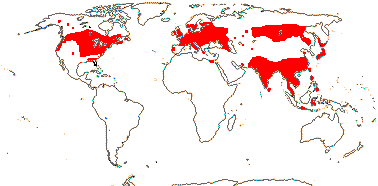
Mycorrhizae 0; vessels 0; cauline endodermis +; branching from the axil of the penultimate foliar leaf outside the inflorescence spathe; leaves two-ranked, ventralized isobifacial [oriented edge on to the stem, bases equitant], intravaginal squamules + [?= colleters]; inflorescence scapose, peduncle with two separate vascular systems; spadix with large associated inflorescence bract [spathe]; flowers dense, sessile, bracts 0, bracteoles 0; floral vasculature forms a basal complex; small [5> mm across], weakly monosymmetric [abaxial member of outer T whorl precocious and larger]; T ± hooded; anthers introrse [?level], thecae confluent apically on dehiscence, endothecial thickenings stellate; tapetal cells (1-)2-4-nucleate; pollen sulcus lacking ectexine, endexine lamellate, tectum continuous; G ascidiate-plicate, syncarpy congenital, dorsal carpellary bundle 0, ovary loculi with secretory trichomes, placentae apical, style short, broadly conical, massive, stylar canals with exudate, stigma ± flat, papillate, papillae extend to placentae; ovules several/carpel, straight, pendulous, outer integument 3-5 cells across, tips of integuments with multiseriate hairs, nucellar cap +, hypostase massive, with central column and radiating basal walls of nucellar cells, postament +; antipodal cells ± persistent, (dividing); fruit a thin-walled berry, P persistent, loculi full of mucilage; seeds few; testa cells thin-walled, aerenchymatous, tegmen bilayered, cells spirally thickened; perisperm +, 1-layered, derived from outer nucellar cells [= nucellar epidermis s. str.], not starchy, endosperm copious, embryo long, suspensor ?uniseriate, cylindrical; plastid accD gene lost; x = 12, n = 9, 11, 12; seedling with collar rhizoids, first leaf terete, unifacial.
1 [list]/2-4. Northern Hemisphere. Map: from Hultén (1962) and Fl. N. Am. vol. 22 (2000), perhaps naturalised in Europe and America (Mayo et al. 1997). [Photo - Habit.]
Age. Crown-group Acorus was dated to 19 ± 5.7 Ma by Merckx et al. (2008a), 52-4 Ma by Mennes et al. (2013, see also 2015) and (50-)30(-15) or (10-)9 Ma by Hertweck et al. (2015).
Evolution: Divergence & Distribution. Stockey (2006) provided an evaluation of fossil remains of Acoraceae.
Diversification rates in this clade are distinctly low (indeed: Hertweck et al. 2015; Tank et al. 2015) as are rates of molecular evolution of the plastome (Barrett et al. 2015b).
Pollination. Brood-site pollination mutualisms have been reported in Acorus, gall midges (in A. gramineus) and kateretids, short-winged flower beetles (in A. calamus), being involved (Funamoto et al. 2020).
Genes & Genomes. T. Shi et al. (2022) discuss the evolution of the genome of Acorus, and suggest that its base chromosome number (following a duplication) is x = 12.
There has been a great increase in the rate of synonymous substitutions in the mitochondrial genome, but not in that of the chloroplast genome (Mower et al. 2007; see also G. Petersen et al. 2006b Zwonitzer et al. 2024, also Characters).
Chemistry, Morphology, etc.. The root stele is pentarch. Does Acorus have vessels? - it seems to depend on one's definition, Carlquist (2012a, see also 2009) calling the plant functionally vesselless, the tracheids being "pre-vessel" in morphology - although derived. The primary root is described as being diarch by Buell (1935). Kaplan (1970a) and Rudall and Buzgo (2002) discuss leaf morphology and development; young leaves are terete, furthermore, the anatomy of the scape and spadix are odd; it is possible that the basal part of what is now called the spathe is adnate to the inflorescence peduncle.
The abaxial tepal is large, bract-like, and encloses the young flower, indeed, it seems to have "merged" with the bract (Buzgo 2001), being depicted as an organ of "hybrid" nature (Bateman et al. 2006b); Ronse de Craene (2010) interprets it as a bract, one tepal being missing (if this is the correct interpretation, some apomorphies above will have to be changed). For possible septal nectaries, see above. The ovules are surrounded by mucilage secreted by the intra-ovarian trichomes.
Several details of embryogeny need confirmation. Buell (1938) suggested that cells of the nucellar epithelium divided periclinally (a nucellar cap), cells of the innermost layer elongating radially. The polar nucleus divided before fertilization, one nucleus moving to the antipodal end of the cell, and a cell wall forming. Early development of the possibly diploid endosperm nucleus produced a file of four large cells. Buell (1935) mentioned that the suspensor was "small"; the structure in Fig. 2A indicated as being the suspensor looks more like a slightly darkened file of cells in the root cap. Rudall and Furness (1997) unfortunately did not follow details of embryo development, but they illustrated the perisperm cells as being radially elongated and covered by a cuticle. The seedling has a single cotyledonary bundle, the root stele is diarch, there is a single stem bundle and three traces to the first leaf (Buell 1935).
Additional information is taken from Grayum (1987), Bogner and Mayo (1998), and Bogner (2011), all general, Carlquist and Schneider (1997) and Keating (2003a), both anatomy, Soukup et al. (2005: root development, intermediate), French and Tomlinson (1981a: stem anatomy, 1981b: branching), Buzgo and Endress (2000: floral morphology), Eyde et al. (1967: floral anatomy), Buell (1938: ovule), Floyd and Friedman (2000b: endosperm with uniseriate cells in micropylar chamber, etc.), and Tillich (1985: seedling). For a checklist and bibliography, see Govaerts and Frodin (2002) and World Checklist of Monocots.
![[Photo - Habit.]](javascript:showImage('http://www.csdl.tamu.edu/FLORA/schoepke/ac_cal_2.jpg',600,500))