 |


QUICK SEARCH
MO PROJECTS:
Africa
Asia/Pacific
Mesoamerica
North America
South America
General Taxonomy
Photo Essays
Training in Latin
America
MO RESEARCH:
Wm. L. Brown Center
Bryology
GIS
Graduate Studies
Research Experiences
for Undergraduates
Imaging Lab
Library
MBG Press
Publications
Climate Change
Catalog Fossil Plants
MO DATABASES:
W³MOST
Image Index
Rare Books
Angiosperm
Phylogeny
Res Botanica
All Databases
INFORMATION:
What's New?
People at MO
Visitor's Guide
Herbarium
Jobs & Fellowships
Symposium
Research Links
Site Map
Search
 | table of contents |
 | |||||||

PROFILE: Marshall Crosby | |||||||
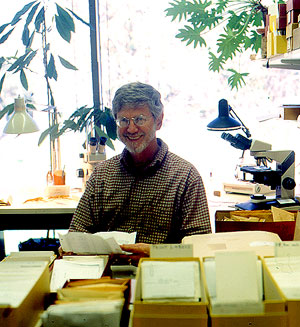 |
Marshall Crosby is Senior Botanist at the Garden and the world's leading authority on moss names. The Crosby Bryophyte Herbarium is named in his honor.
Photo: Trent Foltz |
||||||
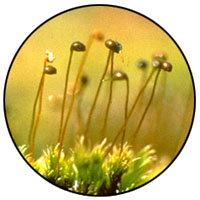
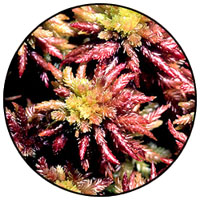
Mysteries of the MossesMosses are second in numbers only to flowering plants. Over the centuries, 50,000 names have been used to describe the 13,000 moss species. In the early 1970's, as the first bryologist on the Garden staff, Crosby took on the challenge of tracking and sorting out these redundancies, and he has become the world's leading authority on moss names. This taxonomy project, like much of Crosby's work, is decidedly un-showy; he describes the mosses he studies as "little green plants in moist, shady places." But while they may lack the showy appeal of roses or orchids, mosses can be both beautiful and scientifically significant. "Often they are the first plants to appear in areas affected by landslides and lava flows," says Crosby. "Understanding mosses is critical in the big scheme of things." Crosby delights in working behind the scenes, compiling bibliographies and classifying and preserving the knowledge essential to an understanding of the botanical world. "The value we create for others is to provide a reservoir of information and a standardized base of reference resources," he says. "This is basic science at its best." | |||||||
| |||||||
Next Section >> | |||||||
| Text and photos from "The Unseen Garden" available from MBG Press. | |||||||
© 1995-2025 Missouri Botanical Garden, All Rights Reserved
4344 Shaw Blvd.
St. Louis, MO 63110
(314) 577-5100
Technical Support