 |


QUICK SEARCH
MO PROJECTS:
Africa
Asia/Pacific
Mesoamerica
North America
South America
General Taxonomy
Photo Essays
Training in Latin
America
MO RESEARCH:
Wm. L. Brown Center
Bryology
GIS
Graduate Studies
Research Experiences
for Undergraduates
Imaging Lab
Library
MBG Press
Publications
Climate Change
Catalog Fossil Plants
MO DATABASES:
W³MOST
Image Index
Rare Books
Angiosperm
Phylogeny
Res Botanica
All Databases
INFORMATION:
What's New?
People at MO
Visitor's Guide
Herbarium
Jobs & Fellowships
Symposium
Research Links
Site Map
Search
 |
Malagasy/Indo-australo-malesian Phytogeographic ConnectionsLong Distance Dispersal | Conclusion | References Alangium and Anacolosa Paleochorological analysis of Alangium (Alangiaceae) and Anacolosa (Olacaceae) (Krutzsch 1989), both originally Laurasian elements that are now restricted to Africa/Madagascar/Asia s.l., supports the stepping-stone hypothesis. Pollen of Anacolosidites (= Anacolosa) and Alangium first appear in India in the upper Eocene, although the former is now absent there. With regard to Anacolosa in Madagascar, the two species differ markedly: A. pervilleana is a deciduous small- leaved, small-fruited species in the dry west, whereas A. casearioides is an evergreen, large-leaved, large-fruited species in humid sublittoral forests along the northeast coast. Insofar as Anacolosidites is known from the Miocene of east Africa, it is possible the two Malagasy species arrived by different routes. 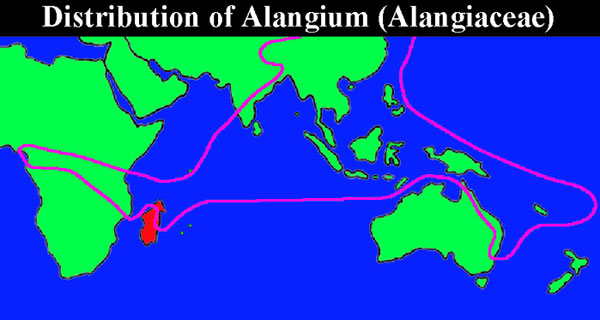 The pollen study of Alangium by Reitsma (1970) suggests a close relationship of dioecious Malagasy A. grisolleoides with A. barbatum in India, and reveals that African A. chinense possesses a distinct and possibly more advanced pollen than the rest of A. chinense, suggesting divergence after an early (Eocene-Oligocene) arrival in Africa. The presence of A. salvifolium in the Comores on Mayotte (3.65 - 5.4 MY) and Moheli (1.5 MY) must be a more recent dispersal. 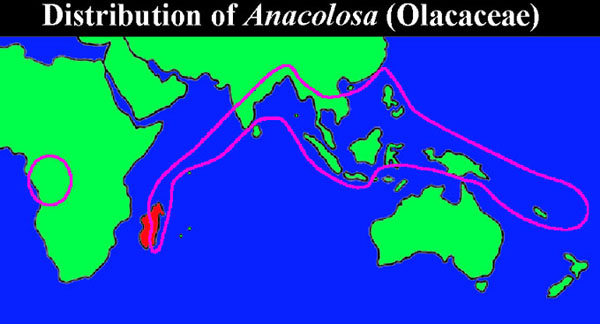
|
© 1995-2025 Missouri Botanical Garden, All Rights Reserved
4344 Shaw Blvd.
St. Louis, MO 63110
(314) 577-5100
Technical Support