EMBRYOPSIDA Pirani & Prado
Gametophyte dominant, independent, multicellular, initially ±globular, not motile, branched; showing gravitropism; glycolate oxidase +, glycolate metabolism in leaf peroxisomes [glyoxysomes], acquisition of phenylalanine lysase* [PAL], flavonoid synthesis*, microbial terpene synthase-like genes +, triterpenoids produced by CYP716 enzymes, CYP73 and phenylpropanoid metabolism [development of phenolic network], xyloglucans in primary cell wall, side chains charged; plant poikilohydrous [protoplasm dessication tolerant], ectohydrous [free water outside plant physiologically important]; thalloid, leafy, with single-celled apical meristem, tissues little differentiated, rhizoids +, unicellular; chloroplasts several per cell, pyrenoids 0; centrioles/centrosomes in vegetative cells 0, microtubules with γ-tubulin along their lengths [?here], interphase microtubules form hoop-like system; metaphase spindle anastral, predictive preprophase band + [with microtubules and F-actin; where new cell wall will form], phragmoplast + [cell wall deposition centrifugal, from around the anaphase spindle], plasmodesmata +; antheridia and archegonia +, jacketed*, surficial; blepharoplast +, centrioles develop de novo, bicentriole pair coaxial, separate at midpoint, centrioles rotate, associated with basal bodies of cilia, multilayered structure + [4 layers: L1, L4, tubules; L2, L3, short vertical lamellae] (0), spline + [tubules from L1 encircling spermatid], basal body 200-250 nm long, associated with amorphous electron-dense material, microtubules in basal end lacking symmetry, stellate array of filaments in transition zone extended, axonemal cap 0 [microtubules disorganized at apex of cilium]; male gametes [spermatozoids] with a left-handed coil, cilia 2, lateral, asymmetrical; oogamy; sporophyte +*, multicellular, growth 3-dimensional*, cuticle +*, plane of first cell division transverse [with respect to long axis of archegonium/embryo sac], sporangium and upper part of seta developing from epibasal cell [towards the archegonial neck, exoscopic], with at least transient apical cell [?level], initially surrounded by and dependent on gametophyte, placental transfer cells +, in both sporophyte and gametophyte, wall ingrowths develop early; suspensor/foot +, cells at foot tip somewhat haustorial; sporangium +, single, terminal, dehiscence longitudinal; meiosis sporic, monoplastidic, MTOC [= MicroTubule Organizing Centre] associated with plastid, sporocytes 4-lobed, cytokinesis simultaneous, preceding nuclear division, quadripolar microtubule system +; wall development both centripetal and centrifugal, 1000 spores/sporangium, sporopollenin in the spore wall* laid down in association with trilamellar layers [white-line centred lamellae; tripartite lamellae]; plastid transmission maternal; nuclear genome [1C] <1.4 pg, main telomere sequence motif TTTAGGG, KNOX1 and KNOX2 [duplication] and LEAFY genes present, ethylene involved in cell elongation; chloroplast genome with close association between trnLUAA and trnFGAA genes [precursors for starch synthesis], tufA, minD, minE genes moved to nucleus; mitochondrial trnS(gcu) and trnN(guu) genes +.
Many of the bolded characters in the characterization above are apomorphies of more or less inclusive clades of streptophytes along the lineage leading to the embryophytes, not apomorphies of crown-group embryophytes per se.
All groups below are crown groups, nearly all are extant. Characters mentioned are those of the immediate common ancestor of the group, [] contains explanatory material, () features common in clade, exact status unclear.
POLYSPORANGIOPHYTA†
Sporophyte well developed, branched, branching dichotomous, potentially indeterminate; hydroids +; stomata on stem; sporangia several, terminal; spore walls not multilamellate [?here].
II. TRACHEOPHYTA / VASCULAR PLANTS
Sporophyte long lived, cells polyplastidic, photosynthetic red light response, stomata open in response to blue light; plant homoiohydrous [water content of protoplasm relatively stable]; control of leaf hydration passive; plant endohydrous [physiologically important free water inside plant]; PIN[auxin efflux facilitators]-mediated polar auxin transport; (condensed or nonhydrolyzable tannins/proanthocyanidins +); borate cross-linked rhamnogalactan II, xyloglucans with side chains uncharged [?level], in secondary walls of vascular and mechanical tissue; lignins +; roots +, often ≤1 mm across, root hairs and root cap +; stem apex multicellular [several apical initials, no tunica], with cytohistochemical zonation, plasmodesmata formation based on cell lineage; vascular development acropetal, tracheids +, in both protoxylem and metaxylem, G- and S-types; sieve cells + [nucleus degenerating]; endodermis +; stomata numerous, involved in gas exchange; leaves +, vascularized, spirally arranged, blades with mean venation density ca 1.8 mm/mm2 [to 5 mm/mm2], all epidermal cells with chloroplasts; sporangia in strobili, sporangia adaxial, columella 0; tapetum glandular; sporophyte-gametophyte junction lacking dead gametophytic cells, mucilage, ?position of transfer cells; MTOCs not associated with plastids, basal body 350-550 nm long, stellate array in transition region initially joining microtubule triplets; archegonia embedded/sunken [only neck protruding]; embryo suspensor +, shoot apex developing away from micropyle/archegonial neck [from hypobasal cell, endoscopic], root lateral with respect to the longitudinal axis of the embryo [plant homorhizic].
[MONILOPHYTA + LIGNOPHYTA]
Sporophyte growth ± monopodial, branching spiral; roots endomycorrhizal [with Glomeromycota], lateral roots +, endogenous; G-type tracheids +, with scalariform-bordered pits; leaves with apical/marginal growth, venation development basipetal, growth determinate; sporangium dehiscence by a single longitudinal slit; cells polyplastidic, MTOCs diffuse, perinuclear, migratory; blepharoplasts +, paired, with electron-dense material, centrioles on periphery, male gametes multiciliate; nuclear genome [1C] 7.6-10 pg [mode]; chloroplast long single copy ca 30kb inversion [from psbM to ycf2]; mitochondrion with loss of 4 genes, absence of numerous group II introns; LITTLE ZIPPER proteins.
LIGNOPHYTA†
Sporophyte woody; stem branching axillary, buds exogenous; lateral root origin from the pericycle; cork cambium + [producing cork abaxially], vascular cambium bifacial [producing phloem abaxially and xylem adaxially].
SEED PLANTS† / SPERMATOPHYTA†
Growth of plant bipolar [plumule/stem and radicle/root independent, roots positively geotropic]; plants heterosporous; megasporangium surrounded by cupule [i.e. = unitegmic ovule, cupule = integument]; pollen lands on ovule; megaspore germination endosporic, female gametophyte initially retained on the plant, free-nuclear/syncytial to start with, walls then coming to surround the individual nuclei, process proceeding centripetally.
EXTANT SEED PLANTS
Plant evergreen; nicotinic acid metabolised to trigonelline, (cyanogenesis via tyrosine pathway); microbial terpene synthase-like genes 0; primary cell walls rich in xyloglucans and/or glucomannans, 25-30% pectin [Type I walls]; lignin chains started by monolignol dimerization [resinols common], particularly with guaiacyl and p-hydroxyphenyl [G + H] units [sinapyl units uncommon, no Maüle reaction]; roots often ≥1 mm across, stele diarch to pentarch, xylem and phloem originating on alternating radii, cork cambium deep seated, gravitropism response fast; stem apical meristem complex [with quiescent centre, etc.], plasmodesma density in SAM 1.6-6.2[mean]/μm2 [interface-specific plasmodesmatal network]; eustele +, protoxylem endarch, endodermis 0; wood homoxylous, tracheids and rays alone, tracheid/tracheid pits circular, bordered; mature sieve tube/cell lacking functioning nucleus, sieve tube plastids with starch grains; phloem fibres +; cork cambium superficial; leaf nodes 1:1, a single trace leaving the vascular sympodium; leaf vascular bundles amphicribral; guard cells the only epidermal cells with chloroplasts, stomatal pore with active opening in response to leaf hydration, control by abscisic acid, metabolic regulation of water use efficiency, etc.; branching by axillary buds, exogenous; prophylls two, lateral; leaves with petiole and lamina, development basipetal, lamina simple; sporangia borne on sporophylls; spores not dormant; microsporophylls aggregated in indeterminate cones/strobili; grains monosulcate, aperture in ana- position [distal], primexine + [involved in exine pattern formation with deposition of sporopollenin from tapetum there], exine and intine homogeneous, exine alveolar/honeycomb; ovules with parietal tissue [= crassinucellate], megaspore tetrad linear, functional megaspore single, chalazal, sporopollenin 0; gametophyte ± wholly dependent on sporophyte, development initially endosporic [apical cell 0, rhizoids 0, etc.]; male gametophyte with tube developing from distal end of grain, male gametes two, developing after pollination, with cell walls; embryo cellular ab initio, suspensor short-minute, embryonic axis straight [shoot and root at opposite ends], primary root/radicle produces taproot [= allorhizic], cotyledons 2; embryo ± dormant; chloroplast ycf2 gene in inverted repeat, trans splicing of five mitochondrial group II introns, rpl6 gene absent; ??whole nuclear genome duplication [ζ/zeta duplication event], 2C genome size (0.71-)1.99(-5.49) pg, two copies of LEAFY gene, PHY gene duplications [three - [BP [A/N + C/O]] - copies], 5.8S and 5S rDNA in separate clusters.
EXTANT GYMNOSPERMS / PINOPHYTA / ACROGYMNOSPERMAE
Biflavonoids +; ferulic acid ester-linked to primary unlignified cell walls, silica usu. low; root apical meristem organization?, protophloem not producing sieve tubes, with secretory cells, sieve area of sieve tube with small pores generally less than 0.8 µm across that have cytoplasm and E.R., joining to form a median cavity in the region of the middle lamella, Strasburger/albuminous cells associated with sieve tubes [the two not derived from the same immediate mother cell], phloem fibres +; sclereids +, ± tracheidal transfusion tissue +, rays uniseriate [?here]; stomatal poles raised above pore, no outer stomatal ledges or vestibule, epidermis lignified; cuticle waxes as tubules, nonacosan-10-ol predominates, n-alkyl lipids scanty; buds perulate/wiith cataphylls; lamina development marginal; plants dioecious; microsporangia abaxial, dehiscing by the action of the epidermis [= exothecium]; pollen tectate, endexine lamellate at maturity and all around grain, esp. intine with callose; ovules aggregated into strobili, erect, pollen chamber formed by breakdown of nucellar cells, nucellus massive; ovules increasing considerably in size between pollination and fertilization, but aborting unless pollination occurs; ovule with pollination droplet; pollen grain germinates on ovule, usu. takes two or more days, tube with wall of pectose + cellulose microfibrils, branched, growing at up to 10(-20) µm/hour, haustorial, breaks down sporophytic cells; male gametophyte of two prothallial cells, a tube cell, and an antheridial cell, the latter producing a sterile cell and 2 gametes; male gametes released by breakdown of pollen grain wall, with >1000 cilia, basal body 800-900 nm long; pollen tube growth rate generally <10 µm h-1, fertilization 7 days to 12 months or more after pollination, to ca 2 mm from receptive surface to egg; seeds "large" [ca 8 mm3], but not much bigger than ovule, with morphological dormancy; testa mainly of coloured sarcoexotesta, scleromesotesta, and ± degenerating endotesta; first zygotic nuclear division with chromosomes of male and female gametes lining up on separate but parallel spindles, embryogenesis initially nuclear, embryo ± chlorophyllous; gametophyte persists in seed; plastid and mitochondrial transmission paternal; genome size [1C] 10< pg [1 pg = 109 base pairs]/(2201-)17947(-35208) Mb; two copies of LEAFY gene [LEAFY, NEEDLY] and three of the PHY gene, [PHYP [PHYN + PHYO]], chloroplast IR expanded, with duplicated ribosomal RNA operons, second intron in the mitochondrial rps3 gene [group II, rps3i2].
[CYCADALES + GINKGOALES]: mucilage +; phloem with scattered fibres; cataphylls +; double leaf trace; leaves petiolate, lamina/leaflet midrib 0; strobili simple; pollen tube branched, growing away from the ovule; spermatogenous cells delimited by circular anticlinal wall, zooidogamy; male gametes released from the swollen proximal part of the tube, ± spherical, with cell wall, cilia >1000, MLS with lamellar strip only along anterior rim, spline 00s of tubules across, plastids numerous, undifferentiated, mitochondria numerous; female gametophyte with chlorophyll, photosynthesising [at least under some conditions]; embryo with >250 nuclei before cellularization; seeds with coloured sarcoexotesta, scleromesotesta, and fleshy, becoming crushed and papyraceous endotesta, endotesta/pachychalazal zone vascularized; plastome with tufA gene; germination hypogeal, cryptocotylar.
GINKGOALES Gorozh. - Main Tree.
Just the one family, 1 genus, 1 species.
Note: In all node characterizations, boldface denotes a possible apomorphy, (....) denotes a feature the exact status of which in the clade is uncertain, [....] includes explanatory material; other text lists features found pretty much throughout the clade. However, the precise node to which many characters, particularly the more cryptic ones, should be assigned is unclear. This is partly because homoplasy is very common, in addition, basic information for all too many characters is very incomplete, frequently coming from taxa well embedded in the clade of interest and so making the position of any putative apomorphy uncertain. Then there are the not-so-trivial issues of how character states are delimited and ancestral states are reconstructed (see above).
seed plants in general.Synonymy: Ginkgoidae Engler - Ginkgoopsida Engler - Ginkgoophytina Reveal - Ginkgoophyta Bessey
GINKGOACEAE Engler - Ginkgo biloba L. - Back to Ginkgoales
Tree, branched, deciduous, with lignotubers; VAM present; biflavones, non-hydrolysable tannins, ability to synthesize S-type lignins; root cortical cell walls with phi [φ] thickenings, ?root hairs; resin canals +; reaction wood on lower side of stem; wood pycnoxylic; vessels 0, tracheid pits with margo [bordered]; phloem with scattered fibres; cork cambium subhypodermal; nodes 1:2; sclereids +; stomata perigenous and mesoperigenous, ± stephanocytic s. str., Florin rings ?0; long and short shoots alternating along the axis, short shoots also axillary, bearing sporophores/strobili, wood manoxylic; all leaves with axillary buds; lamina margin lobed, venation dichotomising, open; plant dioecious; microsporangiophore/filament with terminal microsporangia; microsporangia 2/microsporophyll, pendulous, dehiscing by the action of the hypodermis [= endothecium]; pollen exine thin [2³ µm thick], sexine 0 in sulcus; male gametophyte: pollen shed at 4-nucleate stage, germinates in a week or so, 6-nucleate [2 prothallial cells + tube cell + sterile cell + gametes], generative cell delimited by circular anticlinal wall, nucleus lens-shaped, with two lateral globular osmiophilic bodies, tube develops distally, branched, growth haustorial, intracellular, penetrates nucellus, wall with ß-(1,3)(1,4)-glucan, spermatids discharged from swollen proximal part of tube, with plastids, golgi apparatus, ca 1000 cilia; megasporophyll single; ovules 2(-4) together, terminal, unvascularized, integument 12-24 cells across, basal collar +, pollen chamber +; female gametophyte: chlorophyllous; seeds large, 2∠ cm long, platyspermic, fleshy, endotesta/pachychalazal zone alone vascularized; proembryo with 128/256 nuclei in initial phase of free nuclear divisions, plumular leaves differentiated; n = 12, nuclear genome [1 C] ca 12 pg/10.61 Gb, one duplication in the PHYO clade; germination (cotyledons 3).
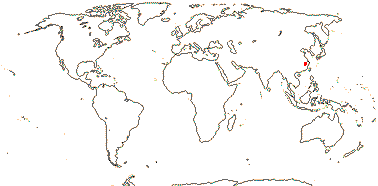
1/1. Eastern China, ?wild. Photo: Microsporangia, Ovules, and Seeds.
Age. Ginkgo is known from the early Jurassic, while G. biloba itself may be over 100 Ma, dating to the early Cretaceous (as G. adiantoides, see Royer et al. 2003). For the early Caenozoic fossil history of Ginkgo, see Manchester et al. (2009). Tank et al. (2015: Table S2) suggested an age of around 265.2 Ma for Ginkgoaceae.
Ginkgoaceae and relatives have a long and rich fossil record dating back to the early Permian, the Cisuralean ca 299-273 Ma (Z.-Y. Zhou 2009; Pott et al. 2016; Herrera et al. 2017a). Ginkgoopsida (see e.g. Meyen 1984 for their circumcription) were almost world-wide in distribution and included several genera in the Mesozoic. They have a possible origin from Palaezoic pteridosperms, perhaps in the Upper Carboniferous (Thomas & Spicer 1987; Zhou 1997). Shi et al. (2016) suggest a connection with the corystosperms, including Unkomasiales, which persisted up to the early Cretaceous and whose ovules/seeds were enclosed in a lobed cupule. The early Cretaceous (125-100 Ma) Ulmaltolepis mongoliensis (see also Vladimaria) had such seeds, and was associated with the very Ginkgo-like foliage of Pseudotorellia, e.g. P. resinosa, with short shoots, leaves with two veins entering at the base of the lamina, dichotomising and alternating with resin canals, and stomata with four accessory cells and a C-shaped flange bordering the guard cells (Herrera et al. 2017a). Platyspermales may also be part of this complex. The morphology of some of these early Ginkgo-like plants is uncertain, and the ovules may have been more numerous, very differently arranged and some at least were inverted (and/or platyspermic). Ginkgo-like leaves are known from the Permian onwards, but Unkomasiales and Peltaspermales may also have compound leaves (see Zhou & Zhang 2003).
Phylogeny. For discussion on the relationships of Ginkgoaceae, see Cycadales. For further information on the major seed plant groups, see angiosperms, Cupressales, Cycadales, Gnetales and Pinales, and for discussion as to their relationships, see also Angiosperm History I, conifers in general, and the relatives of extant seed plants.
Evolution: Divergence & Distribution. For the phylogeography of Ginkgo biloba, see Gong et al. (2008). Ecological evidence suggested to C. Q. Tang et al. (2012) that wild populations still persist, while Y.-P. Zhao et al. (2019) thought that there were three main populations in China that had separated within the last half million years or so.
Ecology & Physiology. In the Late Cretaceous-Miocene Ginkgo was a common plant of disturbed streamside habitats, growing along relief/abandoned water channels and unstable crevasse splays, but not in backswamps; frequent associates included Platanus, Metasequoia and Cercidiphyllum (Royer et al. 2003). With its long generation time, great longevity and large seeds it hardly fits current ideas of plants that flourish in such habitats, but conditions in the early Cretaceous may have been quite different from those of today (Royer et al. 2003).
L. Wang et al. (2020) note how the stem vascular cambium maintains its activity over time, overall wood production remaining constant, the genes involved in flavonoid synthesis remaining active (flavonoids are involved in protection against both biotic and abiotic stresses), etc., overall, the plant showed no signs of senescence even when 600 years old - c.f. Populus, perhaps, although clones there live for far longer (see also age and plants elsewhere).
Pollination Biology & Seed Dispersal. Thrip pollination of Ginkgoaceae is reported from the Albian ca 105 Ma (Peris et al. 2017). Indeed, although extant Ginkgo biloba is wind pollinated, looking at its stigmatic exudate, the high sugar/lower amino acid concentrations suggest ambophilous pollination in the past (Nepi et al. 2017).
Ginkgo and relatives may have been eaten by sauropod dinosaurs (Hummel et al. 2008).
Genes & Genomes. For nuclear genome size, see Zonnefeld (2012); over 3/4 of the nuclear genome consists of repetitive sequences (Guan et al. 2016). Considerable intraspecific variation in ploidy level is reported Smarda et al. 2018).
There may have been a genome duplication here 147-74 Ma as well as a very much older duplication ca 735-515 Ma (Guan et al. 2016). However, Roodt et al. (2017) question the existence of the former duplication and place the latter somewhere between just before the divergence of Cycadales and Ginkgoales to as far back as basal to seed plants as a whole, but they provide no independent age estimate (see also Zwaenepoel & Van de Peer 2019).
Dioecy may be associated with chromosomal differentiation (female xx, male xy), but c.f. Hizume (1997).
The chloroplast genome has a somewhat contracted inverted repeat (Lin et al. 2012), and substitution rates of protein-coding genes are low, on a par with those in Cycadales (C.-S. Wu & Chaw 2015).
Chemistry, Morphology, etc.. Sinapyl lignin and S[yringyl]-lignin is synthesized in suspension cell cultures in Ginkgo biloba, but not in woody cell walls, hence perhaps supporting the idea that the ability to produce this lignin unit evolved very low down on the phylogenetic tree (it is also found in Selaginella), but then has subsequently been lost several times - or it has evolved independently here and elsewhere (e.g. Vanholme et al. 2010; Espiñeira et al. 2011). Interestingly, S-lignin is not found in Ginkgo wood (Novo-Uzal et al. 2014 and references).
For stem growth and anatomy, see Little et al. (2013 and references). The leaf is innervated by two leaf traces that originate from independent cauline vascular sympodia; there are a very few anastomoses between the veins in the blade. Rudall et al. (2012) discussed stomatal development; some authors have suggested that the cells surrounding the stomata have small papillae ± overarching the guard cells.
The integument is initiated in two places, but the two parts soon become confluent. Zumajo-Cardona et al. (2021a; see also D'Apice et al. 2022) looked at the expression patterns of a number of genes involved in ovule development in Arabidopsis and also in Ginkgo, and they found substantial differences, including expression in microsporangia, etc.; interestingly, a couple of genes were expressed in the abscission zone of the ovule/seed. For the expression of most of these genes in Gnetum gnemon, rather different again, see Zumajo-Cardona & Ambrose (2021), and for ovule evolution, see elsewhere. The chalazal cell of the linear tetrad develops to form the female gametophyte (Friedman & Gifford 1997). The nuclei of the female gametophyte, haploid, have the same DNA content as diploid cells. An AGAMOUS gene is involved in the development of the fleshy part of the seed (Lovisetto et al. 2011, 2015), and the embryo develops after the seeds have fallen (c.f. Gnetum).
For additional information, see Crane (2013), the papers in Hori et al. (1997) and the Gymnosperm Database, all general, Dute (1994: torus:margo pits), Bonacorsi and Seago (2014: root anatomy), Khan et al. (2019: epidermis), Dörken (2013a: vegetative anatomy and morphology), Friedman (1987: male gametophyte development), Carothers (1907) and Soma (1997) female gametophyte and embryogeny, Mundry and Stützel (2004b: stamen and leaf development), Douglas et al. (2007: ovule), Norstog et al. (2004: spermatids), Y. Li et al. (1989: flagellar ultrastructure), Hori and Miyamura (1997: fertilization), Takaso (1981), Dogra (1992) and L. Wang et al. (2011), all embryology, Friedman and Goliber (1986: photosynthesis in the female gametophyte - see also Cycadales), seed anatomy and development (Zumajo-Cardona et al. 2021b) and reproduction in general, Favre-Duchartre (1956).
)
)
)