 |


QUICK SEARCH
MO PROJECTS:
Africa
Asia/Pacific
Mesoamerica
North America
South America
General Taxonomy
Photo Essays
Training in Latin
America
MO RESEARCH:
Wm. L. Brown Center
Bryology
GIS
Graduate Studies
Research Experiences
for Undergraduates
Imaging Lab
Library
MBG Press
Publications
Climate Change
Catalog Fossil Plants
MO DATABASES:
W³MOST
Image Index
Rare Books
Angiosperm
Phylogeny
Res Botanica
All Databases
INFORMATION:
What's New?
People at MO
Visitor's Guide
Herbarium
Jobs & Fellowships
Symposium
Research Links
Site Map
Search
 |
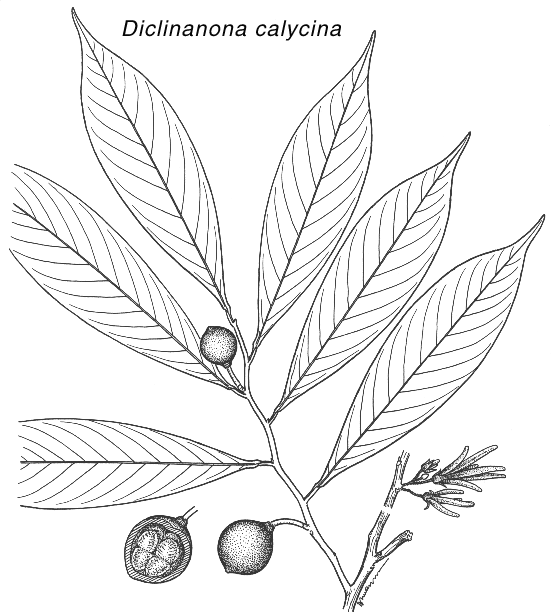
Flora of the Venezuelan GuayanaANNONACEAE 5. DICLINANONA Diels, Notizbl. Bot. Gart. Berlin-Dahlem 10: 174. 1927. by Julian A. Steyermark Small to medium-sized trees, young stems covered with simple hairs. Inflorescence axillary, several-flowered; peduncles articulate above a bract. Flowers bisexual or unisexual (plants polygamous or dioecious), medium-sized, remaining almost closed at anthesis; pedicels short. Sepals 3, free, valvate; petals 6, free, erect, biseriately valvate, oblong-linear, ascending, longer than the sepals, somewhat fleshy, concave within at base, biglandular on the margins. Stamens numerous in the staminate flowers, fewer in the bisexual flowers; connective dilated and disk-shaped above the anther locules; anthers not locellate. Carpels few, pilose; ovules 6--9. Monocarps free, sessile, thick-walled. Seeds 3--8 per monocarp. Amazonian Venezuela, Brazil, and Peru; 3 species, 1 in Venezuela. Diclinanona calycina (Diels) R.E. Fr., Acta Horti Berg. 12: 4. 1934. ---Xylopia calycina Diels, Notizbl. Bot. Gart. Berlin-Dahlem 10: 175. 1927. Diclinanona calycina var. macrophylla R.E. Fr., Kongl. Svenska Vetenskapsakad. Handl. ser. 3, 24(10): 13. 1948. Tree 6--25 m; leaves abruptly long-caudate; flowers with erect, rufous-gray or golden-yellow, sericeous petals; monocarps 2--2.5 cm long, seeds to 2 cm long. Evergreen lowland forests, ca. 100 m; Amazonas (Caño Caname, near San Carlos de Río Negro). Peru, Brazil. Fig. 359. Paul Berry (peberry@facstaff.wisc.edu) or Kay Yatskievych (kay.yatskievych@mobot.org). |
© 1995-2025 Missouri Botanical Garden, All Rights Reserved
4344 Shaw Blvd.
St. Louis, MO 63110
(314) 577-5100
Technical Support