EMBRYOPSIDA Pirani & Prado
Gametophyte dominant, independent, multicellular, initially ±globular, not motile, branched; showing gravitropism; glycolate oxidase +, glycolate metabolism in leaf peroxisomes [glyoxysomes], acquisition of phenylalanine lysase* [PAL], flavonoid synthesis*, microbial terpene synthase-like genes +, triterpenoids produced by CYP716 enzymes, CYP73 and phenylpropanoid metabolism [development of phenolic network], xyloglucans in primary cell wall, side chains charged; plant poikilohydrous [protoplasm dessication tolerant], ectohydrous [free water outside plant physiologically important]; thalloid, leafy, with single-celled apical meristem, tissues little differentiated, rhizoids +, unicellular; chloroplasts several per cell, pyrenoids 0; centrioles/centrosomes in vegetative cells 0, microtubules with γ-tubulin along their lengths [?here], interphase microtubules form hoop-like system; metaphase spindle anastral, predictive preprophase band + [with microtubules and F-actin; where new cell wall will form], phragmoplast + [cell wall deposition centrifugal, from around the anaphase spindle], plasmodesmata +; antheridia and archegonia +, jacketed*, surficial; blepharoplast +, centrioles develop de novo, bicentriole pair coaxial, separate at midpoint, centrioles rotate, associated with basal bodies of cilia, multilayered structure + [4 layers: L1, L4, tubules; L2, L3, short vertical lamellae] (0), spline + [tubules from L1 encircling spermatid], basal body 200-250 nm long, associated with amorphous electron-dense material, microtubules in basal end lacking symmetry, stellate array of filaments in transition zone extended, axonemal cap 0 [microtubules disorganized at apex of cilium]; male gametes [spermatozoids] with a left-handed coil, cilia 2, lateral, asymmetrical; oogamy; sporophyte +*, multicellular, growth 3-dimensional*, cuticle +*, plane of first cell division transverse [with respect to long axis of archegonium/embryo sac], sporangium and upper part of seta developing from epibasal cell [towards the archegonial neck, exoscopic], with at least transient apical cell [?level], initially surrounded by and dependent on gametophyte, placental transfer cells +, in both sporophyte and gametophyte, wall ingrowths develop early; suspensor/foot +, cells at foot tip somewhat haustorial; sporangium +, single, terminal, dehiscence longitudinal; meiosis sporic, monoplastidic, MTOC [= MicroTubule Organizing Centre] associated with plastid, sporocytes 4-lobed, cytokinesis simultaneous, preceding nuclear division, quadripolar microtubule system +; wall development both centripetal and centrifugal, 1000 spores/sporangium, sporopollenin in the spore wall* laid down in association with trilamellar layers [white-line centred lamellae; tripartite lamellae]; plastid transmission maternal; nuclear genome [1C] <1.4 pg, main telomere sequence motif TTTAGGG, KNOX1 and KNOX2 [duplication] and LEAFY genes present, ethylene involved in cell elongation; chloroplast genome with close association between trnLUAA and trnFGAA genes [precursors for starch synthesis], tufA, minD, minE genes moved to nucleus; mitochondrial trnS(gcu) and trnN(guu) genes +.
Many of the bolded characters in the characterization above are apomorphies of more or less inclusive clades of streptophytes along the lineage leading to the embryophytes, not apomorphies of crown-group embryophytes per se.
All groups below are crown groups, nearly all are extant. Characters mentioned are those of the immediate common ancestor of the group, [] contains explanatory material, () features common in clade, exact status unclear.
POLYSPORANGIOPHYTA†
Sporophyte well developed, branched, branching dichotomous, potentially indeterminate; hydroids +; stomata on stem; sporangia several, terminal; spore walls not multilamellate [?here].
II. TRACHEOPHYTA / VASCULAR PLANTS
Sporophyte long lived, cells polyplastidic, photosynthetic red light response, stomata open in response to blue light; plant homoiohydrous [water content of protoplasm relatively stable]; control of leaf hydration passive; plant endohydrous [physiologically important free water inside plant]; PIN[auxin efflux facilitators]-mediated polar auxin transport; (condensed or nonhydrolyzable tannins/proanthocyanidins +); borate cross-linked rhamnogalactan II, xyloglucans with side chains uncharged [?level], in secondary walls of vascular and mechanical tissue; lignins +; roots +, often ≤1 mm across, root hairs and root cap +; stem apex multicellular [several apical initials, no tunica], with cytohistochemical zonation, plasmodesmata formation based on cell lineage; vascular development acropetal, tracheids +, in both protoxylem and metaxylem, G- and S-types; sieve cells + [nucleus degenerating]; endodermis +; stomata numerous, involved in gas exchange; leaves +, vascularized, spirally arranged, blades with mean venation density ca 1.8 mm/mm2 [to 5 mm/mm2], all epidermal cells with chloroplasts; sporangia in strobili, sporangia adaxial, columella 0; tapetum glandular; sporophyte-gametophyte junction lacking dead gametophytic cells, mucilage, ?position of transfer cells; MTOCs not associated with plastids, basal body 350-550 nm long, stellate array in transition region initially joining microtubule triplets; archegonia embedded/sunken [only neck protruding]; embryo suspensor +, shoot apex developing away from micropyle/archegonial neck [from hypobasal cell, endoscopic], root lateral with respect to the longitudinal axis of the embryo [plant homorhizic].
[MONILOPHYTA + LIGNOPHYTA]Sporophyte growth ± monopodial, branching spiral; roots endomycorrhizal [with Glomeromycota], lateral roots +, endogenous; G-type tracheids +, with scalariform-bordered pits; leaves with apical/marginal growth, venation development basipetal, growth determinate; sporangium dehiscence by a single longitudinal slit; cells polyplastidic, MTOCs diffuse, perinuclear, migratory; blepharoplasts +, paired, with electron-dense material, centrioles on periphery, male gametes multiciliate; nuclear genome [1C] 7.6-10 pg [mode]; chloroplast long single copy ca 30kb inversion [from psbM to ycf2]; mitochondrion with loss of 4 genes, absence of numerous group II introns; LITTLE ZIPPER proteins.
LIGNOPHYTA†
Sporophyte woody; stem branching axillary, buds exogenous; lateral root origin from the pericycle; cork cambium + [producing cork abaxially], vascular cambium bifacial [producing phloem abaxially and xylem adaxially].
SEED PLANTS† / SPERMATOPHYTA†
Growth of plant bipolar [plumule/stem and radicle/root independent, roots positively geotropic]; plants heterosporous; megasporangium surrounded by cupule [i.e. = unitegmic ovule, cupule = integument]; pollen lands on ovule; megaspore germination endosporic, female gametophyte initially retained on the plant, free-nuclear/syncytial to start with, walls then coming to surround the individual nuclei, process proceeding centripetally.
EXTANT SEED PLANTS
Plant evergreen; nicotinic acid metabolised to trigonelline, (cyanogenesis via tyrosine pathway); microbial terpene synthase-like genes 0; primary cell walls rich in xyloglucans and/or glucomannans, 25-30% pectin [Type I walls]; lignin chains started by monolignol dimerization [resinols common], particularly with guaiacyl and p-hydroxyphenyl [G + H] units [sinapyl units uncommon, no Maüle reaction]; roots often ≥1 mm across, stele diarch to pentarch, xylem and phloem originating on alternating radii, cork cambium deep seated, gravitropism response fast; stem apical meristem complex [with quiescent centre, etc.], plasmodesma density in SAM 1.6-6.2[mean]/μm2 [interface-specific plasmodesmatal network]; eustele +, protoxylem endarch, endodermis 0; wood homoxylous, tracheids and rays alone, tracheid/tracheid pits circular, bordered; mature sieve tube/cell lacking functioning nucleus, sieve tube plastids with starch grains; phloem fibres +; cork cambium superficial; leaf nodes 1:1, a single trace leaving the vascular sympodium; leaf vascular bundles amphicribral; guard cells the only epidermal cells with chloroplasts, stomatal pore with active opening in response to leaf hydration, control by abscisic acid, metabolic regulation of water use efficiency, etc.; branching by axillary buds, exogenous; prophylls two, lateral; leaves with petiole and lamina, development basipetal, lamina simple; sporangia borne on sporophylls; spores not dormant; microsporophylls aggregated in indeterminate cones/strobili; grains monosulcate, aperture in ana- position [distal], primexine + [involved in exine pattern formation with deposition of sporopollenin from tapetum there], exine and intine homogeneous, exine alveolar/honeycomb; ovules with parietal tissue [= crassinucellate], megaspore tetrad linear, functional megaspore single, chalazal, sporopollenin 0; gametophyte ± wholly dependent on sporophyte, development initially endosporic [apical cell 0, rhizoids 0, etc.]; male gametophyte with tube developing from distal end of grain, male gametes two, developing after pollination, with cell walls; embryo cellular ab initio, suspensor short-minute, embryonic axis straight [shoot and root at opposite ends], primary root/radicle produces taproot [= allorhizic], cotyledons 2; embryo ± dormant; chloroplast ycf2 gene in inverted repeat, trans splicing of five mitochondrial group II introns, rpl6 gene absent; ??whole nuclear genome duplication [ζ/zeta duplication event], 2C genome size (0.71-)1.99(-5.49) pg, two copies of LEAFY gene, PHY gene duplications [three - [BP [A/N + C/O]] - copies], 5.8S and 5S rDNA in separate clusters.
IID. ANGIOSPERMAE / MAGNOLIOPHYTA
Lignans, O-methyl flavonols, dihydroflavonols, triterpenoid oleanane, apigenin and/or luteolin scattered, [cyanogenesis in ANA grade?], lignin also with syringyl units common [G + S lignin, positive Maüle reaction - syringyl:guaiacyl ratio more than 2-2.5:1], hemicelluloses as xyloglucans; root cap meristem closed (open); pith relatively inconspicuous, lateral roots initiated immediately to the side of [when diarch] or opposite xylem poles; epidermis probably originating from inner layer of root cap, trichoblasts [differentiated root hair-forming cells] 0, hypodermis suberised and with Casparian strip [= exodermis]; shoot apex with tunica-corpus construction, tunica 2-layered; starch grains simple; primary cell wall mostly with pectic polysaccharides, poor in mannans; tracheid:tracheid [end wall] plates with scalariform pitting, multiseriate rays +, wood parenchyma +; sieve tubes enucleate, sieve plates with pores (0.1-)0.5-10< µm across, cytoplasm with P-proteins, not occluding pores of plate, companion cell and sieve tube from same mother cell; ?phloem loading/sugar transport; nodes 1:?; dark reversal Pfr → Pr; protoplasm dessication tolerant [plant poikilohydric]; stomata randomly oriented, brachyparacytic [ends of subsidiary cells ± level with ends of guard cells], outer stomatal ledges producing vestibule, reduction in stomatal conductance with increasing CO2 concentration; lamina formed from the primordial leaf apex, margins toothed, development of venation acropetal, overall growth ± diffuse, secondary veins pinnate, fine venation hierarchical-reticulate, (1.7-)4.1(-5.7) mm/mm2, vein endings free; flowers perfect, pedicellate, ± haplomorphic, protogynous; parts free, numbers variable, development centripetal; P = T, petal-like, each with a single trace, outer members not sharply differentiated from the others, not enclosing the floral bud; A many, filament not sharply distinguished from anther, stout, broad, with a single trace, anther introrse, tetrasporangiate, sporangia in two groups of two [dithecal], each theca dehiscing longitudinally by a common slit, ± embedded in the filament, walls with at least outer secondary parietal cells dividing, endothecium +, cells elongated at right angles to long axis of anther; tapetal cells binucleate; microspore mother cells in a block, microsporogenesis successive, walls developing by centripetal furrowing; pollen subspherical, tectum continuous or microperforate, ektexine columellate, endexine restricted to the apertural regions, thin, compact, intine in apertural areas thick, orbicules +, pollenkitt +; nectary 0; carpels present, superior, free, several, spiral, ascidiate [postgenital occlusion by secretion], stylulus at most short [shorter than ovary], hollow, cavity not lined by distinct epidermal layer, stigma ± decurrent, carinal, dry; suprastylar extragynoecial compitum +; ovules few [?1]/carpel, marginal, anatropous, bitegmic, micropyle endostomal, outer integument 2-3 cells across, often largely subdermal in origin, inner integument 2-3 cells across, often dermal in origin, parietal tissue 1-3 cells across, nucellar cap?; megasporocyte single, hypodermal, functional megaspore lacking cuticle; female gametophyte lacking chlorophyll, four-celled [one module, egg and polar nuclei sisters]; ovule not increasing in size between pollination and fertilization; pollen grains bicellular at dispersal, germinating in less than 3 hours, siphonogamy, pollen tube unbranched, growing towards the ovule, between cells, growth rate (ca 10-)80-20,000 µm h-1, tube apex of pectins, wall with callose, lumen with callose plugs, penetration of ovules via micropyle [porogamous], whole process takes ca 18 hours, distance to first ovule 1.1-2.1 mm; male gametophytes tricellular, gametes 2, lacking cell walls, ciliae 0, double fertilization +, ovules aborting unless fertilized; fruit indehiscent, P deciduous; mature seed much larger than fertilized ovule, small [<5 mm long], dry [no sarcotesta], exotestal; endosperm +, ?diploid [one polar nucleus + male gamete], cellular, development heteropolar [first division oblique, micropylar end initially with a single large cell, divisions uniseriate, chalazal cell smaller, divisions in several planes], copious, oily and/or proteinaceous, embryo short [<¼ length of seed]; plastid and mitochondrial transmission maternal; Arabidopsis-type telomeres [(TTTAGGG)n]; nuclear genome [2C] (0.57-)1.45(-3.71) [1 pg = 109 base pairs], ??whole nuclear genome duplication [ε/epsilon event]; ndhB gene 21 codons enlarged at the 5' end, single copy of LEAFY and RPB2 gene, knox genes extensively duplicated [A1-A4], AP1/FUL gene, palaeo AP3 and PI genes [paralogous B-class genes] +, with "DEAER" motif, SEP3/LOFSEP and three copies of the PHY gene, [PHYB [PHYA + PHYC]]; chloroplast IR expansions, chlB, -L, -N, trnP-GGG genes 0.
[NYMPHAEALES [AUSTROBAILEYALES [MONOCOTS [[CHLORANTHALES + MAGNOLIIDS] [CERATOPHYLLALES + EUDICOTS]]]]]: wood fibres +; axial parenchyma diffuse or diffuse-in-aggregates; pollen monosulcate [anasulcate], tectum reticulate-perforate [here?]; ?genome duplication; "DEAER" motif in AP3 and PI genes lost, gaps in these genes.
[AUSTROBAILEYALES [MONOCOTS [[CHLORANTHALES + MAGNOLIIDS] [CERATOPHYLLALES + EUDICOTS]]]]: phloem loading passive, via symplast, plasmodesmata numerous; vessel elements with scalariform perforation plates in primary xylem; essential oils in specialized cells [lamina and P ± pellucid-punctate]; tension wood + [reaction wood: with gelatinous fibres, G-fibres, on adaxial side of branch/stem junction]; anther wall with outer secondary parietal cell layer dividing; tectum reticulate; nucellar cap + [character lost where in eudicots?]; 12BP [4 amino acids] deletion in P1 gene.
[MONOCOTS [[CHLORANTHALES + MAGNOLIIDS] [CERATOPHYLLALES + EUDICOTS]]] / MESANGIOSPERMAE: benzylisoquinoline alkaloids +; sesquiterpene synthase subfamily a [TPS-a] [?level], polyacetate derived anthraquinones + [?level]; outer epidermal walls of root elongation zone with cellulose fibrils oriented transverse to root axis; P more or less whorled, 3-merous [?here]; pollen tube growth intra-gynoecial; extragynoecial compitum 0; carpels plicate [?here]; embryo sac monosporic [spore chalazal], 8-celled, bipolar [Polygonum type], antipodal cells persisting; endosperm triploid.
[CERATOPHYLLALES + EUDICOTS]: ethereal oils 0 [or next node up]; fruit dry [very labile].
EUDICOTS: (Myricetin +), asarone 0 [unknown in some groups, + in some asterids]; root epidermis derived from root cap [?Buxaceae, etc.]; (vessel elements with simple perforation plates in primary xylem); nodes 3:3; stomata anomocytic; flowers (dimerous), cyclic; protandry common; K/outer P members with three traces, ("C" +, with a single trace); A ?, filaments fairly slender, anthers basifixed; microsporogenesis simultaneous, pollen tricolpate, apertures in pairs at six points of the young tetrad [Fischer's rule], cleavage centripetal, wall with endexine; G with complete postgenital fusion, stylulus/style solid [?here], short [<2 x length of ovary]; seed coat?; palaeotetraploidy event.
[PROTEALES [TROCHODENDRALES [BUXALES + CORE EUDICOTS]]]: (axial/receptacular nectary +).
[TROCHODENDRALES [BUXALES + CORE EUDICOTS]]: benzylisoquinoline alkaloids 0; euAP3 + TM6 genes [duplication of paleoAP3 gene: B class], mitochondrial rps2 gene lost.
[BUXALES + CORE EUDICOTS]: mitochondrial rps11 gene lost.
CORE EUDICOTS / GUNNERIDAE: (ellagic and gallic acids +); leaf margins serrate; compitum + [one position]; micropyle?; γ genome duplication [allopolyploidy, 4x x 2x], x = 3 x 7 = 21, 2C genome size (0.79-)1.05(-1.41) pg, PI-dB motif +; small deletion in the 18S ribosomal DNA common.
[ROSIDS ET AL. + ASTERIDS ET AL.] / PENTAPETALAE / [SANTALALES, CARYOPHYLLALES, SAXIFRAGALES, DILLENIALES, VITALES, ROSIDAE, [BERBERIDOPSIDALES + ASTERIDAE]: root apical meristem closed; (cyanogenesis also via [iso]leucine, valine and phenylalanine pathways); flowers rather stereotyped: 5-merous, parts whorled; P = K + C, K enclosing the flower in bud, with three or more traces, odd K adaxial, C with single trace; A = 2x K/C, in two whorls, alternating, (many, but then usually fasciculate and/or centrifugal); pollen tricolporate; G [(3, 4) 5], when 5 opposite K, whorled, placentation axile, style +, stigma not decurrent, compitum + [one position]; endosperm nuclear/coenocytic; fruit dry, dehiscent, loculicidal [when a capsule]; floral nectaries with CRABSCLAW expression, RNase-based gametophytic incompatibility system present.
Phylogeny. Prior to the seventh version of this site asterids were part of a major polytomy that included rosids, Berberidopsidales, Santalales, and Caryophyllales, but then the order of branching below the asterids seemed to be stabilizing, perhaps with a clade [Berberidopsidales [Santalales [Caryophyllales + Asterids]]] while rosid relationships seemed to be [Saxifragales [Vitales + Rosids]]]. However, recent work suggests a polytomy is indeed probably the best way to visualize relationships around here at present. So for further discussion of relationships at the base of asterids and rosids, see the Pentapetalae
[SAXIFRAGALES + ROSIDS] / ROSANAE Takhtajan / SUPERROSIDAE: ??
ROSIDS / ROSIDAE: anthers ± dorsifixed, transition to filament narrow, connective thin.
[ROSID I + ROSID II]: (mucilage cells with thickened inner periclinal walls and distinct cytoplasm); if nectary +, usu. receptacular; embryo long; chloroplast infA gene defunct, mitochondrial coxII.i3 intron 0.
ROSID I / FABIDAE / [ZYGOPHYLLALES [the COM clade + the N-fixing clade]]: endosperm scanty.
[the COM clade + the N-fixing clade]: ?
[OXALIDALES [CELASTRALES + MALPIGHIALES]] / the COM clade: seed exotegmic, cells fibrous.
[CELASTRALES [APODANTHALES [HUALES + MALPIGHIALES]]]: ?
Some evidence suggests that Huaceae/Huales, ex Oxalidales, should be sister to this clade (W. J. Baker et al. 2021: see Seed Plant Tree), or sister to Malpighiales alone, (although with a pp = 0 as of vii.2023...). The holoparasitic Apodanthaceae/Apodanthales (ex Cucurbitales) may be sister to Huales + Malpighiales], but with stronger support.
Indeed, Apodanthaceae, like other holoparasitic angiosperms, were often previously included in Rafflesiaceae s.l.; Rafflesiaceae s.s. is included in Malpighiales above but is not close to Apodanthaceae. The relationships of Apodanthaceae have for some time been unclear, e.g. they are unplaced in A.P.G. 2009. Nickrent et al. (2004) suggested a place either within Malvales (especially the three-gene analyses and that of nuclear SSU rDNA), or in or near Cucurbitales (analysis of matR), but they inclined to the former position. Barkman et al. (2007: support weak, but rather comprehensive analysis) suggested the latter position; the mitochondral genes cox1 and matR showed massive divergence, but not the atp1 gene (Barkman et al. 2007). (Relationships of Apodanthaceae with Malvales have indeed seemed possible, some Malvaceae in particular lacking normal anther thecal structure (like Apodanthaceae), the androecium may be fused, etc. - e.g. Blarer et al. 2004; Endress & Matthews 2006a; Schönenberger & von Balthazar 2006.) Additional molecular analyses (D. Nickrent, pers. comm.; esp. Filipowicz & Renner 2010) supported a position of Apodanthaceae in Cucurbitales. This is consistent with their dioecy, extrose anthers, inferior ovary and parietal placentation, all features common in Cucurbitales (see also Filipowicz & Renner 2010), but these features are quite common in other parasitic plants (Renner & Ricklefs 1995). There are also a number of codon subsitutions in common between Apodanthaceae and Cucurbitales (Barkman et al. 2007; Filipowicz & Renner 2010). The exact position of the family in Cucurbitales was not certain, the relationships suggested with the morphologically rather different (but apomorphically so) Corynocarpaceae and Coriariaceae being only weakly supported, and Apodanthaceae are on a very long branch (Filipowicz & Renner 2010; see also M. Sun et al. 2016). The situation remained the same in Bellot and Renner (2014b), and in trees used when estimating substitution rates Apodanthaceae linked either with a clade [Anisophylleaceae + Corynocarpaceae] or a clade including the whole of the rest of the family, but with a rather different topology to that used here; other topologies were also obtained, although none with strong support. González and Pabón-Mora (2017b: see Table 2) compared Apodanthaceae with other Cucurbitales noting characters like parietal placentation, inferior ovary and numerous ovules that they have in common with some of the rest of the order (but see above - the parasitism syndrome). Molecular data did suggest a position in Cucurbitales of the N-fixing clade, although exactly where to place them was unclear.
CELASTRALES Link - Back to Main Tree.
Vessel elements with simple perforation plates; tension wood ?; mucilage cells; stomata ?; lamina teeth?, stipules +; inflorescence cymose; flowers small; K quincuncial; micropyle bistomal; chloroplast infA gene present. - 2 families, 94 genera, 1355 species.
Includes Celastraceae, Lepidobotryaceae.
Note: In all node characterizations, boldface denotes a possible apomorphy, (....) denotes a feature the exact status of which in the clade is uncertain, [....] includes explanatory material; other text lists features found pretty much throughout the clade. However, the precise node to which many characters, particularly the more cryptic ones, should be assigned is unclear. This is partly because homoplasy is very common, in addition, basic information for all too many characters is very incomplete, frequently coming from taxa well embedded in the clade of interest and so making the position of any putative apomorphy uncertain. Then there are the not-so-trivial issues of how character states are delimited and ancestral states are reconstructed (see above).
Age. The age of crown-group Celastrales was estimated as (87-)81(-75) or (62-)56(-50) Ma (two penalized likelihood dates) or ca 88.1 Ma (Tank et al. 2015: Table S1, S2); Bayesian relaxed clock estimates were up to 100 Ma (H. Wang et al. 2009) [Check].
Evolution: Divergence & Distribution. Matthews and Endress (2005b, 2006) discuss possible additional synapomorphies of this clade. For instance, there is distinctive postgenital carpel closure by conspicuously elongated cells, and functionally imperfect flowers are common. All Celastrales are basically synascidiate. Tao et al. (2018) discuss pollen evolution in the order.
Phylogeny. Huaceae were placed in this area by Nandi et al. (1998), and as sister to rest of Celastrales (inc. Lepidobotryaceae, when in the analysis), but with only moderate support, by Savolainen et al. (2000a, b); they were, however, not obviously close at all in Simmons et al. (2001 - Lepidobotryaceae not included) and were placed sister to Oxalidales with moderate support in Zhang and Simmons (2006; see also Soltis et al. 2011, etc.).
Previous Relationships. Celastrales were a wildly heterogenous group in the past (see e.g. Lobreau 1965; Cronquist 1981), and any discussion of their limits or relationships involved families scattered throughout Pentapetalae.
Synonymy: Brexiales Lindley, Hippocrateales Berchtold & J. Presl, Parnassiales J. Presl, Stackhousiales Martius - Celastranae Takhtajan - Celastropsida Brongniart
LEPIDOBOTRYACEAE J. Léonard, nom. cons. - Back to Celastrales
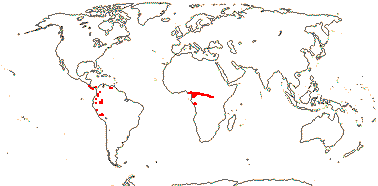
Tree; cork?; woodm fluoresces; nodes also 2:2 [Lepidobotrys]; cristarque cells in bundle sheath; stomata paracytic; leaves two-ranked, lamina articulated with petiole, margins entire, stipel +, single, long, (stipules adnate to petiole); plant dioecious; inflorescences terminal, congested; K and C similar in size; A 10, of two lengths, ± connate basally, anthers basifixed; nectary on inside of staminal tube; G [2-3], styles ± separate, stigmas capitate ormstyle short, stigma lobed; ovules 2/carpel, collateral, apical, pachychalazal, epitropous, outer integument 7-10 cells across, inner integument ca 4 cells across [Ruptiliocarpon], parietal tissue ca 10 cells across, funicular obturator +; fruit a septicidal capsule, endocarp distinct, columella persisting; seed large, arillate; integuments multiplicative, (exotegmen not fibrous - Lepidobotrys); endosperm 0; n = x = ?
2 [list]/2-3. West Africa (Lepidobotrys staudtii), Central and South America, scattered, to Peru, inc. W. Amazon (Brasil: Acre) (Ruptiliocarpon caracolito). Map: from Hammel and Zamora (1993), Trop. Afr. Fl. Pl. Ecol. Distr. vol. 1 (2003), Heywood (2007) and Tropicos (consulted iii.2014). [Photo - Fruit]
Evolution: Plant-Bacterial/Fungal Associations. Bechem et al. (2014) recorded Lepidobotrys staudtii as being an arbuscular mycorrhizal plant.
Chemistry, Morphology, etc.. Ruptiliocarpon, at least, has distinctive spirotriterpenoids unique to flowering plants (Asim et al. 2010). Dahlgren (1988) suggested that the vessel elements have scalariform perforation plates, but they are simple; scalariform pitting is found between vessels and rays. The pits of Ruptiliocarpon are vestured (Mennega 1993). There is no evidence other than morphology (articulation, stipels) that the apparently simple leaves are really unifolioliate, and are derived from compound leaves.
For information, see Hammel and Zamora (1993) and Kubitzki (2004b), also Matthews and Endress (2005b: floral morphology), Link (1991a: nectaries of Lepidobotrys), Tobe and Hammel (1993: flower and fruit of Ruptiliocarpon), and for the nodal anatomy of Lepidobotrys, pers. comm. R. A. Howard.
Previous Relationships. Hutchinson (1973) also included Sarcotheca and Dapania (here in Oxalidaceae) with Lepidobotrys, and the leaves of Lepidobotrys are indeed superficially like those of Oxalidaceae, although differing in the stipel and paired stipules. However, the funicular obturator, septicidal capsule, etc., separates Lepidobotrys from Oxalidaceae; furthermore, the sieve tube plastids of Lepidobotrys are the common starch type. Cronquist (1981) included Lepidobotrys in Oxalidaceae, and Takhtajan (1997) placed Leipodoboryaceae and Oxalidaceae alone in his Oxalidales, while suggesting that Ruptiliocarpon - then quite recently described - was rather different, and might even be meliaceous.
CELASTRACEAE R. Brown, nom. cons. - Back to Celastrales
Shrubs and trees to lianes (herbs); hexitol dulcitol, flavonols +, ellagic acid 0; tension wood 0 [2 genera]; nodes 1:1; K with a single trace, in bud small, C enveloping flower bud; A = and opposite K; pollen grains often tricellular; G opposite C, stigma commissural; ovules with parietal tissue 0-1 cell across, laterally thin; exotegmen?; x = 7 (?9, ?10), nuclear genome [1 C] (0.012-)0.712(-42.169) pg.
94[list]/1,410. World-wide.
Age. The age of crown-group Celastraceae in Magallón and Castillo (2009) was ca 71.6 Ma, while Wikström et al. (2001) suggested an age of (88-)85(-82) My; there are similar ages of (89-)76, 71(-60) Ma in Bell et al. (2010); (128.4-)113.7(-97.4) Ma is a substantially older set of ages suggested by Xia et al. 2022).
Wood attributed to Celastraceae has been found in end-Cretaceous deposits ca 68 Ma in New Mexico (Estrada-Ruiz et al. 2012).
Parnassioideae Arnott / Parnassieae Dumortier —— Synonymy: Parnassiaceae Martynov, nom. cons., Lepuropetalaceae Nakai
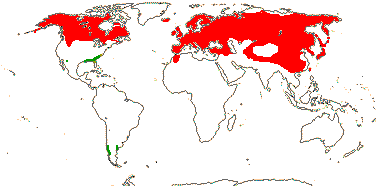
Herbs, perennial, (minute, ephemeral); cork?; young stem with separate bundles; basal leaves sessile, petiole adnate to stem; petiole bundle arcuate to ± circular; epidermis with tanniniferous cells; leaves spiral, lamina with secondary veins (sub)palmate, margins entire, stipules 0 (basal appendages +); inflorescence monochasial/flowers single; K basally connate, quincuncial, 1-trace dividing into 3, C (0), (margins ± fimbriate); filament bundle mesarch, staminodes +, opposite C, complex and fringed/digitate, or small, spathulate; nectary at or towards base of staminodes, with gland-tipped projections; G [3-4(-5)], to ± inferior, odd member abaxial, placentation parietal, stigmas commissural (down side of G), dry; ovules many/carpel, uni- or bitegmic, (micropyle zig-zag), outer integument 2-3 cells across, inner integument 2-4 cells across, nucellar cap 0?, (endothelium +); (antipodal cells persist); fruit a loculicidal capsule; seeds small, exotesta with thickened anticlinal walls, exotegmic cells with ± U-shaped thickening [Parnassia], raphe 0, or endotestal cell walls much thickened, anticlinal walls sinuous [Lepuropetalon], tegmen multiplicative, structure?; endosperm ± 0; n = 9, 16, (23 - Lepuropetalon).
2/61: Parnassia (60). N. temperate to Arctic, esp. China, Lepuropetalon spathulatum S.E. U.S.A, Mexico, southern South America. Map: from Hultén (1971), Fl. China vol. 8 (2001) and Alvarez et al. (2013): Parnassia red, Lepuropetalon green). [Photo - Parnassia Flower © H. Wilson.]
Age. The crown-group age of this clade has been estimated at (29-)26, 19(-16) Ma (Wikström et al. 2001), (48-)34, 28(-17) Ma (Bell et al. 2010) and (52.9-)40.0(-28.1) Ma (Xia et al. 2022: only P.).
In Parnassia, for example, the anthers abscise as the stamens recurve, so releasing their pollen (Ren & Bu 2014). Seeds of Parnassia are notably small when compared with those of their immediate relatives, and this is possibly associated with the adoption of the herbaceous habit by the genus (Moles et al. 2005a). Seeds of Lepuropetalon remain exposed surrounded by the large calyx lobes after the capsule opens, and there may be splash-cup dispersal.
Vegetative Anatomy. The rosette leaves of Parnassia appear to be sessile, but in fact the petiole is adnate to the stem, as is clear from the course of the vascular bundles (Cutler & Gregory 1998). Lepuropetalon is about as small as any other flowering plant; ?anatomy.
Chemistry, Morphology, etc.. The single, usually rather large flower of Parnassia is the first flower of a much reduced cyme, and the sessile bract has been interpreted as a petiolate bract the petiole of which is concaulescent with the pedicel (Watari 1939). Staminodes develop later than the stamens, but the androecium is obdiplostemonous. The stamens change their position as they mature, but are initially introrse (Hultgård 1987). There are conflicting reports on testa anatomy. Lepuropetalon is a very small - and poorly known - plant that may lack a corolla and has simple staminodes, the ovary is more or less inferior and the ovules are unitegmic.
There is other information in Bohm et al. (1986) and Y.-L. Hu et al. (2013), both chemistry, Pace (1912) and Saxena (1976) for embryology, also Murbeck (1918) and Alvarez et al. (2013 and references), both Lepuropetalon, Spongberg (1972: general), Leins (2000: floral morphology of Parnassia), Simmons (2004), and Takahashi and Sohma (1981) and Wu et al. (2005: pollen).
Previous Relationships. The floral anatomy of Parnassia differs from that of Saxifragaceae (Bensel & Palser 1975a, d), where the genus has often been placed.
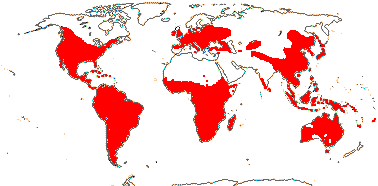
Shrubs and trees to lianes (herbs); gutta, cardenolide pyrrolizidine and sesquiterpene alkaloids, distinctive triterpenoids [pristimerin = monomethylcelastrol, ß-agarofurans, quinone methides], (maytansinoids - synthesised by associated microorganisms), myricetin +; phloem loading via intermediary cells [specialized companion cells with numerous plasmodesmata, raffinose etc. involved]; (cork cortical); true tracheids +; young stem with vascular cylinder; (pericyclic fibres 0); (nodes 3:3 - Brexia; 1:5-7 - Lophopetalum); latex sacs or laticifers +; petiole anatomy often complex; hairs (stellate), cuticle waxes 0 (platelets); stomata laterocytic (paracytic, etc.), epidermal cork-warts [some Celastroideae]; branching from previous innovation; leaves spiral, opposite, or two-ranked, lamina vernation involute (flat-conduplicate), margins serrate, with veins running to congested deciduous tooth, (entire/spiny), colleters +, stipules often small (fringed [inc. Brexia]/0); flowers (2-)4-5-merous; K free or ± connate; A (2-)3-5(-many - Plagiopteron), extrorse, introrse or transverse, (anther slits confluent), (staminodes +, fringed, e.g. Brexia), tapetal cells multinucleate (binucleate - Stackhousia, Empleuridium); nectary disciform, massive, inside or outside A (0); pollen with endexinal fold in aperture (0); G [2-5(-several)], ± immersed in nectary (inferior - A alone on top), when 3 odd member adaxial, (ovary 1-locular), style hollow, (long), stigma not or little expanded; ovules (1-)2-many/carpel, pleurotropous or apotropous (epitropous), apical to basal, (micropyle endostomal), outer integument 3-8 cells across, inner integument 2-5 cells across, parietal tissue (0-2-4 cells across, endothelium +/0, postament +; antipodal cells usu. ephemeral; fruit a (septicidal) capsule, drupe, berry, schizocarp, or with longitudinal wings (Tripterygium 1-seed); seeds medium to large, winged, or aril +, exostomal; testa multiplicative, to 16 layers thick, (vascularized), exotesta with thick cuticle (tanniniferous), mesotesta with sclerotic cells (0), (exotegmen of laterally compressed fibres), endotegmen (persistent, tanniniferous), (tegmen multiplicative - Gymnosporia); endosperm copious to 0, embryo chlorophyllous, cotyledons (very) large, (connate); n = 8-10, 12, 14-16, 20, etc..
92/1,350: Euonymus (150, inc. Glyptopetalum), Salacia (150), Monteverdia (125), Hippocratea (120, inc. Loeseneriella). Largely tropical, but also temperate (map: from Heywood 1978; modified by Hultén & Fries 1986; Trop. Afr. Fl. Pl. Ecol. Distr. 5. 2010). [Photo - Fruit, Fruit, Collection.]
Pottingerioideae (Engler) Airy Shaw
Fruit a nut or capsule; seeds 1, many.
2/6: Mortonia 5. S.W. U. S. A. and adjacent Mexico, Assam, Myanmar, Thailand.
Microtropoideae (C. Y. Chang & T. C. Kao) Simmons
3/94: Microtropis (66). S.E. Asia to Macronesia, Mexico to N. South America.
Monimopetaloideae Simmons - Monimopetalum chinense Rehder
A sessile on disc; fruit a capsule, C persistent, wing-like; aril small; n = 10.
1/1. E. China (Anhui, Hubei, Jiangxi).
Siphonodontoideae Croizat
4/11: Siphonodon (7). Tropics, scattered.
Crossopetaloideae Simmons
Fruit a drupe.
2/36: Crossopetalum (26). Tropical America, the Caribbean, Africa and Madagascar. ??
Celastroideae Burnett ——
Synonymy: Canotiaceae Airy Shaw,
Maytenoideae Biral & Lombardi
Salaciopsioideae Simmons - Salaciopsis Baker f.
1/6. New Caledonia.
[Stackhousioideae [Cassinoideae [Elaeodendroideae [Hippocrateoideae + Salacioideae]]]]: ?
Stackhousioideae Burnett —— Stackhousiaceae R. Brown, nom. cons.
[Cassinoideae [Elaeodendroideae [Hippocrateoideae + Salacioideae]]]: ?
Cassinoideae Loesener
Cassine (60)
[Elaeodendroideae [Hippocrateoideae + Salacioideae]]: ?
Elaeodendroideae Lindley ——
Synonymy: Brexiaceae Loudon
[Hippocrateoideae + Salacioideae]: ?
Hippocrateoideae (Jussieu) Lindley —— Hippocrateaceae Jussieu, nom. cons.
Salacioideae Thorne & Reveal —— Salaciaceae Rafinesque
Synonymy: Chingithamnaceae Handel-Mazzetti, Euonymaceae Berchtold & J. Presl, , Plagiopteraceae Airy Shaw, Pottingeriaceae Takhtajan, , Siphonodontaceae Gagnepain & Tardieu-Blot, nom. cons.
Evolution: Divergence & Distribution. For an evaluation of leaf fossils of Celastraceae by the intuitive method, i.e., not using synapomorphies, see Bacon et al. (2015: p. 369); the oldest fossils accepted, of Euonymus, were dated to 59-54 Ma. Tylerianthus crossmanensis, in Late Cretaceous deposits from eastern North America of ca 90 Ma, has been compared to Saxifragaceae s. str. (well, sort of, also including Parnassiaceae, Gandolfo et al. 1998b; Friis et al. 2014); see Hydrangeaceae.
Both Salacioideae and Hippocrateoideae may be Old World in origin (Simmons et al. 2009a, b). There are eight separate clades of Celastraceae on Madagascar, the oldest (and largest) being (69.6-)61.7(-53.8) Ma, the youngest only around 4.1 Ma, indeed, Madagascar may be important in the biogeography of the family, with dispersals from the island occurring in genera like Elaeodendron and Pleurostylia (Bacon et al. 2015). For biogeographical relationships within Celastrus, perhaps of tropical Asian origin and with seeds dispersed by birds, sometimes over long distances, see Y.-X. Zhu et al. (2020)
Diversification rates may have increased at a node in Celastraceae that excludes Parnassia and dated to (68.4-)51.1(-42.8) My (Magallón et al. 2018).
Potential floral synapomorphies for Celastraceae as presently circumscribed are calcium oxalate druses in floral tissues and ovary characters (Matthews & Endress 2005b; Zhang & Simmons 2006); for morphology in general, see Simmons and Hedin (1999).
Ecology & Physiology. Celastraceae are ecologically one of the more important groups of lianes in the New World (Gentry 1991, as Hippocrateaceae, this old family was made up largely of lianes), with perhaps 360 species involved (Angyalossy et al. 2015; Schnitzer et al. 2015 for additional information).
Pollination Biology. Stamens in a number of Celastraceae move sequentially during the course of anthesis. Fungus gnats are pollinators of some species of Euonymus in Japan, but a variety of other insects pollinate species in that genus (Mochizuki & Kawakita 2017; Mochizuki et al. 2023).
Plant-Animal Interactions. Caterpillars of species of Yponomeutoidea-Yponomeutini moths are common on Celastraceae (Sohn et al. 2013).
Plant-Bacterial/Fungal Associations. Some South African Celastraceae have distinctive maytansinoids, ansamycin antibiotics, with a nineteen-member ring (18 C, 1 N), that are likely to be synthesized by the rhizosphere/endophyte actinomycete Actinosynnema pretiosum rather than the plant itself (Pullen et al. 2003; Cassady et al. 2004; Wink 2008: Wings et al. 2013).
Genes & Genomes. There is a genome duplication, the STSPα event of ca 67.7 Ma, that appears to involve the whole family (Landis et al. 2018).
Chemistry, Morphology, etc.. The chemistry of the group would repay further study (see Brüning & Wagner 1978 for a summary). Celastraceae commonly have yellow triterpene derivatives in their bark, and distinctive triterpenoid quinone methides are quite common, although they have not yet been reported from Parnassioideae or from ex-Stackhousiaceae (Gunatilaka 1996; see also Deepa & Narmatha Bai 2010). Monoamine alkaloids such as cathinone and cathine are potentially quite widely distributed in Celastreae (Simmons et al. 2008) and are the active principal in khat, an infusion made from the leaves of Catha edulis. For the identity and biological activity of secondary metabolites of Celastrus, see Su et al. (2009).
The roots of Empleuridium are described as having a superficial cork cambium (Goldblatt et al. 1985). Both Brexia and Parnassia have leaf traces departing from the center of the stem well below the leaf they innervate (Cutler & Gregory 1998).
Polycardia has epiphyllous inflorescences. Savinov (2008) drew the flowers of Stackhousia and Parnassia with the median sepal abaxial. Ex Stackhousiaceae appear to have polysymmetric flowers, but because two stamens are shorter than the others, there is a measure of monosymmetry, too, although I suspect that this is immaterial to the pollinators. A number of taxa have anthers that fall off soon after pollen is dispersed. The filaments are often massive and quite short, and may not be articulated with the anther. Nectary morphology and position - inside or outside of the androecium, vascularized or not, adnate to the gynoecium or not - is notably variable (e.g. Gomes & Lombardi 2013; Yao et al. 2018). The flower of Empleuridium has an ovary immersed in the disc and that has been described as being inferior, although it is clearly superior in fruit; its ovule also has an endostomal micropyle (Goldblatt et al. 1985). The inner integument may be thicker than the outer. Variation in fruit and aril is extensive (Simmons et al. 2001), indeed, Zhang et al. (2012, 2014) suggest that a distinctive feature of arils in Celastraceae is that they develop from the exostome - and so might properly be called caruncles (but see also Pfeiffer 1891; Kapil et al. 1980), while Yao et al. (2018) note that the protrusions on the fruits of Euonymus sect. Echinococcus develop from protrusions of the nectary - note that they occur all over the fruit... Salacia has porate pollen; Tripterygium has epitropous ovules. Polyembryony is common in Celastraceae, the embryos developing from the inner integument.
Matthews and Endress (2005b) provide a great deal of information, especially about floral morphology, see also Pierre (1894), Airy Shaw et al. (1973: Pottingeria), Simmons (2004), Savinov (2004), Leins and Erbar (2010), abd Barker (2012: Stackhousioideae), all general, esp. flowers and fruits. For further anatomical details, see Stant (1952: Stackhousia), Y.-L. Li and Zhang (1990), den Hartog and Baas (1978: stomata), Gornall et al. (1998: as Escalloniaceae), Gregory (1998: as Hydrangeaceae), Gornall and Al-Shammary (1998: Parnassia) and Joffily et al. (2010: epidermal cork-warts); see also J.-Y. Li et al. (2014: inflorescence), Klopfer (1973: some floral morphology), Johnston (1975: Canotia), Lobreau (1969) and Lobreau-Callen (1977: pollen), Berkeley (1953), gynoecium, Pace (1912), Andersson (1931), Mauritzon (1933, 1936c, 1939a), Adatia and Gavde (1962), Copeland (1967), Sharma (1968b) and Tobe and Raven (1993), all embryology, and Takhtajan (2000: seed, testa anatomy).
Phylogeny. Celastraceae have turned out to be a somewhat problematic group, and relationships within the family have remained unclear for some time. Some of the initial difficulties encountered in elucidating the phylogeny of the family were because it was polyphyletic. Thus Bhesa was distinctive in early morphological analyses (Simmons & Hedin 1999), and is now placed in Malpighiales-Centroplacaceae (Zhang & Simmons 2006) and Goupia in Malpighiales-Goupiaceae, near Violaceae. Matthews and Endress (2005b) found that Perrottetia was rather unlike other members of the family in characters of floral anatomy, however, that genus has found a firm home in Huerteales near Tapiscia (e.g. M. Simmons in Matthews & Endress 2005b; Worberg et al. 2009). Indeed, the inclusion of these three genera (and also Siphonodon) in Celastraceae had previously been considered rather uncertain (Metcalfe & Chalk 1950; Ding Hou 1962; den Hartog & Baas 1978; Matthews & Endress 2005b); Siphonodon, however, is not about to move. Forsellesia has also moved, in this case to Crossosomataceae (Thorne and Scogin (1978). With the removal of these genera, vessels in Celastraceae are predominantly simple, nodal anatomy unilacunar, stipules are minute, indeed, the family became notably less variable morphologically (Zhang & Simmons 2006).
At the same time Celastraceae have accumulated taxa, that is, some associated families are turning out to be firmly embedded in Celastraceae, and some of the more distinctive groups in Celastraceae as it is currently delimited are briefly characterized at the end of this section. For studies suggesting a broad circumscription of Celastraceae, see also Soltis and Soltis (1997), Savolainen et al. (1997), Zhang & Simmons 2006; etc. More particularly, Stackhousiaceae were included as a separate family in Celastrales by Takhtajan (1997), but they have been found to be consistently embedded in Celastraceae in Savolainen et al. (2000a), Simmons et al. (2000, 2001a, b), Soltis et al. (2007a, but sampling), etc.. Ex-Stackhousiaceae may be sister to a poorly-supported clade including Maytenus (Coughenour et al. 2010, but c.f. M. Sun et al. 2016: in different major clades).
Simmons et al. (2000) found Parnassia to group with Celastraceae such as Perrottetia (sic!), although with only moderate support. In Simmons et al. (2001a) [Quetzalia + Zinowiewia] were sister to other Celastraceae s.l. (strong support), then [Perrottetia + Mortonia] were in turn sister to rest of the family (poor support) using PHYB alone; adding morpholology reversed the position of the two basal clades. Zhang and Simmons (2006) could not resolve the relationships between Celastraceae and Parnassiaceae, the latter group being sister to Mortonia and Pottingeria, with parietal placentation, which formed a poorly supported clade very weakly associated with other Celastraceae; Parnassia was monophyletic (100%) and sister to Lepuropetalum (see also Wikström et al. 2001; Soltis et al. 2007a, 2011; etc.). Simmons et al. (2012a), in a study focussing on Euonymeae, found that [Parnassia + Lepuropetalum], [Mortonia + Pottingeria] and [Quetzalia + Microtropis] were successively sister to the rest, but support for these positions was not strong, while in Simmons et al. (2012b) the last two clades reversed their positions; where Pottingeria should go is unclear. Parnassia is sometimes recovered as sister to the rest of the family (Bacon et al. 2015; H.-T. Li et al. 2019), in the latter followed by Microtropis, then Stackhousia + the rest. However, M. Sun et al. (2016) found Mortonia to be sister to the rest of the family, with [Parnassia + Lepuropetalum] and [Zinowiewia [Quetzalia + Microtropis]] together forming a clade (see also Z.-D. Chen et al. 2016: only Chinese genera). Xia et al. (2022: focus on Chinese Parnassia) found that relationships in the family were [Parnassia [Microtropis + Celastroideae]] in nuclear ITS analyses, while Microtropis was sister to a clade that included Parnassia plus some Celastroideae in chloroplast analyses. Although Xia et al. (2022) consistently recovered a monophyletic Parnassia, the topology within the genus differed substantially depending on whether the analyses were based on nuclear ITS or chloroplast genes; in the former there were three clades, and in clade I, sister to a paraphyletic clade II plus clade III, P. lutea was sister to the rest of that clade, while in the latter analyses clades I and II were scrambled, P. lutea had a rather different position, and so on.
Brexia, another genus that has been segregated as a family, appears to be sister to Empleuridium (Zhang & Simmmons 2006). Plagiopteron belongs here; see also Soltis et al. (2007a) who found it was embedded in the family, although sampling was poor. Simmons et al. (2009a) placed it in Hippocrateoideae, while Coughenour et al. (2010) found that it was sister to a clade including ex Salacioideae and Sarawakodendron. Pottingeria, of the monogeneric Pottingeriaceae, is probably also to be included; it is weakly supported as sister to Mortonia (Zhang & Simmons 2006). The xeromorphic Canotia, sometimes segregated in its own family, is close to Euonymus (Coughenour et al. 2010).
Within the old Celastraceae, classical subfamilial limits have not held up at all well. Simmons et al. (2009a) and Coughenour et al. (2010) found that the arillate, capsular Sarawakodendron was sister to Salacioideae, the copious mucilaginous pulp of the berry of that group possibly also being arillate in nature. Sister to this combined group is Hippocrateoideae, with the arillate Helictonema being sister to other taxa (Simmons et al. 2009b; Coughenour et al. 2011). Many Hippocrateoideae have fruits that are deeply trilobed, the lobes being strongly dorsi-ventrally flattened, the seed wings are basal - although some taxa have a corky testa and the wing is vestigial, and the pollen apertures have an annulus (Coughenour et al. 2010, 2011). Sister to the clade made up of all taxa just mentioned is a largely Old-World clade that includes Lophopetaleae. Seed wings in Lophopetaleae vary in their position relative to the body of the seed. For relationships around Maytenus and Gymnosporia, see McKenna et al. (2011) and Biral et al. (2017). Cassinoideae and Tripterygioideae have turned out to be very polyphyletic (Simmons et al. 2012b). For a phylogeny of Celastrus, see Mu et al. (2012) and Y.-X. Zhu et al. (2020: Tripterygium to be included?). For an extensive analysis of relationships in Euonymus, very diverse in S.W. China and within which the more tropical Glyptopetalum is embedded, see Y.-N. Li et al. (2014); sections including taxa with spiny and winged capsules respectively are monophyletic, and for a general study of the family, see Sun et al. (2016). Recently Simmons et al. (2022) carried out an Angiosperms353 probe set analysis on 151 taxa of the family (all genera included) and recovered the basal relationships [[Parnassia + Lepuropetalon] [[Mortonia + Pottingeria] [[Zinowiewia [Quetzalia + Microtropis]] [Monimiopetalum [[[Goniodiscus + Wilczekra] [Siphonodon + Peripterygia]] [[Crossopetalum + Xenodrys] [perhaps 7 more clades]]]]]]], so Microtropis is quite basal, although the focus of that work was on various quality control measures that focused on alignments. These relationships are also apparent
Classification. For a reworking of the classification of Celastraceae, we await the conclusion of Mark Simmons's march through the family. If [Parnassia + Lepuropetalum] do turn out to be sister to all other Celastraceae, it would be best to recognise two families, and although Zhang and Simmons (2006) could not resolve the relationships between Celastraceae and Parnassiaceae, they elected to keep the two families separate provisionally.
For generic limits, see Islam et al. (2006), Simmons et al. (2008), McKenna et al. (2011: the Maytenus and Gymnosporia areas), and Biral et al. (2017: more on Maytenus); there are generic problems in Hippocrateoideae (Simmons et al. 2009b) and Salacioideae (Coughenour et al. 2010).
Previous Relationships. Plagiopteron was included in Flacourtiaceae by Sleumer (1961) and placed in Malvales by Takhtajan (1997). Brexia was included in Hydrangeaceae by Cronquist (1981), but was placed near Celastraceae by Takhtajan (1997). Stackhousiaceae were placed in in Celastrales by both Cronquist (1981) and Takhtajan (1997). Pottingeriaceae were included in Hydrangeales by Takhtajan (1997), who described the stamens as being adnate to the extrastaminal disc, but there is no evidence for such a position. Hippocrateaceae, with A often fewer than C, borne inside/on top of the disc, anthers usu. transversely dehiscent, aril 0, endosperm 0, have often been separated from Celastraceae, but are clearly embedded within them (see above).
![[Photo - Fruit]](javascript:showImage('http://mobot.mobot.org/cgi-bin/search_vast?w3till=MOA-03546_001.jpg',600,500))
![[Photo - Parnassia Flower © H. Wilson.]](javascript:showImage('http://www.csdl.tamu.edu/FLORA/dcs420/b/hdw12089919b.jpg',600,500))
)
)