 |


QUICK SEARCH
MO PROJECTS:
Africa
Asia/Pacific
Mesoamerica
North America
South America
General Taxonomy
Photo Essays
Training in Latin
America
MO RESEARCH:
Wm. L. Brown Center
Bryology
GIS
Graduate Studies
Research Experiences
for Undergraduates
Imaging Lab
Library
MBG Press
Publications
Climate Change
Catalog Fossil Plants
MO DATABASES:
W³MOST
Image Index
Rare Books
Angiosperm
Phylogeny
Res Botanica
All Databases
INFORMATION:
What's New?
People at MO
Visitor's Guide
Herbarium
Jobs & Fellowships
Symposium
Research Links
Site Map
Search
 |
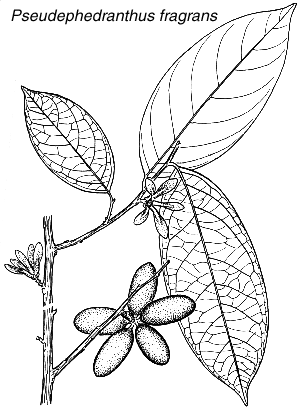
Flora of the Venezuelan GuayanaANNONACEAE 12. PSEUDEPHEDRANTHUS Aristeg., Mem. New York Bot. Gard. 18(2): 43, fig. 10. 1969. by Julian A. Steyermark Trees with glabrous stems and leaves. Leaves shiny and midvein raised on upper surface, secondary veins widely spaced and 5--9 on either side of the midvein. Inflorescence axillary, sessile. Pedicels articulate above the basal bract, furnished with a few (ca. 3) bracts below the middle and above the articulation. Flowers bisexual or staminate (plants androdioecious), staminate flowers with a conical, acute receptacle. Sepals 3, valvate; petals 6, subequal, free, imbricately biseriate, sericeous. Stamens numerous (few in bisexual flowers), the anther locules linear, not locellate; outer and middle stamens with the connective ligulate at apex; interior stamens with connective truncate-dilated at apex. Bisexual flowers with numerous carpels; ovule solitary, basal, erect. Monocarps short-stipitate, 1-seeded. Endemic to the Guayana Shield in southwestern Venezuela and adjacent Brazil; 1 species. Pseudephedranthus fragrans (R.E. Fr.) Aristeg., Mem. New York Bot. Gard. 18: 43, fig. 10A--P. 1969. ---Ephedranthus fragrans R.E. Fr., Mem. New York Bot. Gard. 9: 327. 1957. Tree 15 m; leaves elliptic, membranous-chartaceous; flowers white, fragrant; fruit oblong, orange. Evergreen lowland forests, ca. 100--200 m; Amazonas (Piedra Nunca north of Piedra Cocuy). Brazil (Amazonas: base of Serra da Neblina). Fig. 383. Paul Berry (peberry@facstaff.wisc.edu) or Kay Yatskievych (kay.yatskievych@mobot.org). |
© 1995-2025 Missouri Botanical Garden, All Rights Reserved
4344 Shaw Blvd.
St. Louis, MO 63110
(314) 577-5100
Technical Support