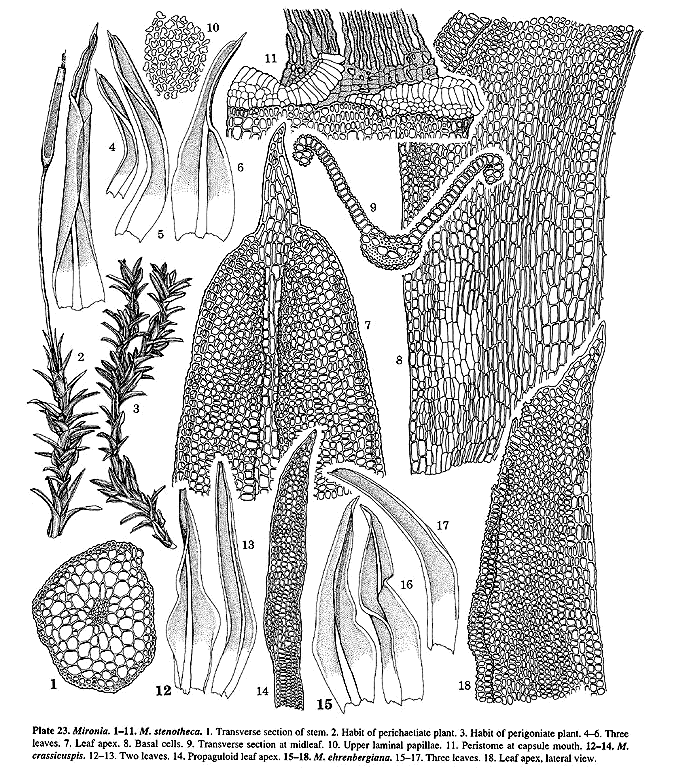
19. MIRONIA Plate
23.
Mironia Zander, nom. nov.
Morinia Card., Rev. Bryol. 37: 124, 1910. Type: Morinia trichostomoides
(Besch.) Card., Mexico, D.F., Desierta Vieja, Bourgeau 1335, holotype, PC;
isotype, NY. (Non Morinia Berlese & Bresadola 1889 nec Rinomia Nieuwl., nec
Morinia Linn. 1753.)
Plants in cushions, yellowish or reddish green above, reddish
brown below. Stems occasionally branching, to 4.0 cm in length,
rounded-pentagonal in transverse section, central strand strong, sclerodermis
present, hyalodermis absent; axillary hairs of ca. 6–10 cells, the basal 1–2
yellowish or brownish. Leaves twisted, appressed to erect when dry, erect-spreading
to squarrose from top of sheathing base when wet, ovate- to
oblong-lanceolate, 1.5–3.5 mm in length; margins narrowly recurved
in lower 3/4, entire or dentate, narrowly bistratose in upper 1/3; apex
broadly to narrowly acute, occasionally thickened as a fragile or deciduous
multistratose propagulum; base oblong and sheathing; costa
percurrent or excurrent as a short, sharp mucro, superficial cells ventrally
quadrate or elongate, dorsally elongate, ca. 4–6 cells across ventral surface
of costa, costal transverse section reniform, with two stereid bands
(the ventral often weak), epidermis present on both sides (dorsally weak),
guide cells 2–5 in 1 layer, hydroid strand present; upper laminal cells
subquadrate, occasionally short-rectangular, ca. 10 µm in width, 1(–2):1, walls
thin to evenly thickened, superficially flat; papillae solid, low,
flattened, granular to multifid, 2–6 per lumen; basal cells
differentiated across leaf, filling the sheathing leaf base and
reaching somewhat higher medially, rectangular, ca. 10 µm in width, 3–5:1,
walls moderately thickened to porose. Dioicous. Perichaetia terminal, inner
leaves oblong-lanceolate to long-oval, sheathing, often to 6 mm in
length, basal cells long rhomboidal in lower half to most of leaf. Perigonia
terminal, gemmate, inner leaves ovate-triangular. Seta ca. 1–2 cm in length,
yellow- to red-brown, twisted counterclockwise above, clockwise below; theca
(1–)3–6 mm in length, red-brown, long-cylindrical; exothecial cells
rectangular, walls thin; stomates present at base of theca, phaneropore;
annulus of 1–3 rows of strongly vesiculose cells, deciduous in strips; peristome
of 32 filamentous, red, densely spiculose teeth, up to 1.2 mm
in length, of many articulations, twisted counterclockwise about 2.5 times,
basal membrane low but distinct, spiculose. Operculum long-conic, ca. 1.3 mm in
length, cells in counterclockwise twisted rows. Calyptra cucullate, smooth, ca.
4 mm in length. Spores ca. 8–11 µm in diameter, light brown to yellowish,
weakly papillose. Laminal KOH color reaction red, seldom olive or
yellow.
The
genus is restricted to Mexico, Central America and the northern Andes
(Venezuela, Ecuador, Colombia), generally found at high elevations on a variety
of substrates, including soil, rock and bark.
Mironia is similar to Bryoerythrophyllum in the
red coloration of the plants (especially in reaction to KOH), the well
differentiated leaf base; the upper leaf cells with characteristically thin to
evenly but rather weakly thickened walls, these often somewhat sinuose; the
low, generally solid (in mature leaves) and bifid laminal papillae, 4–6
scattered over each lumen (Pl. 23, f. 10); and the often reniform costal
transverse section generally with one or more hydroid strands (Pl. 23, f. 9).
It differs in the leaves commonly keeled, with narrowly bistratose margins, and
leaf apices sometimes thickened, fragile or deciduous (Pl. 23, f. 14). The
peristome is very long and twisted; likewise, some species recently transferred
to Bryoerythrophyllum from Barbula have well-developed peristomes
(Zander 1980a).
The
comparatively large, lanceolate, occasionally dentate, keeled, often squarrose
leaves with highly differentiated leaf bases and the much modified perichaetial
leaves are also characters of Leptodontium, but Mironia differs
in the presence of an epidermis and hydroid strand(s) in the costa and of a
central strand in the stem (Pl. 23, f. 1). The general leaf shape is similar to
that of Barbula, but this last genus has unistratose leaf margins and,
like Leptodontium, a yellow response to KOH solution.
Additional
literature: Hilpert (1933), Zander (1978g, 1983d), Zander et al. (1980).
Number
of accepted species: 3.
Species
examined: M. crassicuspis (BUF, FH, MICH, TENN), M. ehrenbergiana
(BM, BUF, DUKE, FH, NY, PC, TENN, US), M. stenotheca (BUF, MEXU,
TENN).
New
heterotypic synonymy: Didymodon killipii Williams = Mironia
ehrenbergiana (C. Müll.) Zand.
New
combinations: Mironia crassicuspis (Robins.) Zand., comb. nov. (Barbula
crassicuspis Robins., Bryologist 67: 446, 1964; Morinia crassicuspis
(Robins.) Zand.). Mironia ehrenbergiana (C. Müll.) Zand., comb. nov.
(Barbula ehrenbergiana C. Müll., Synop. Musc. 1: 636, 1849; Morinia
ehrenbergiana (C. Müll.) Thér.). Mironia ehrenbergiana var. elongata
(Wils. in Mitt.) Zand., comb. nov. (Barbula elongata Wils. in
Mitt., Kew J. Bot. 3: 51, 1851; Morinia ehrenbergiana var. elongata
(Wils. in Mitt.) Zand.). Mironia stenotheca (Thér.) Zand., comb. nov.
(Barbula stenotheca Thér., Smiths. Misc. Coll. 85(4): 21, 1931; Morinia
stenotheca (Thér.) Zand.).