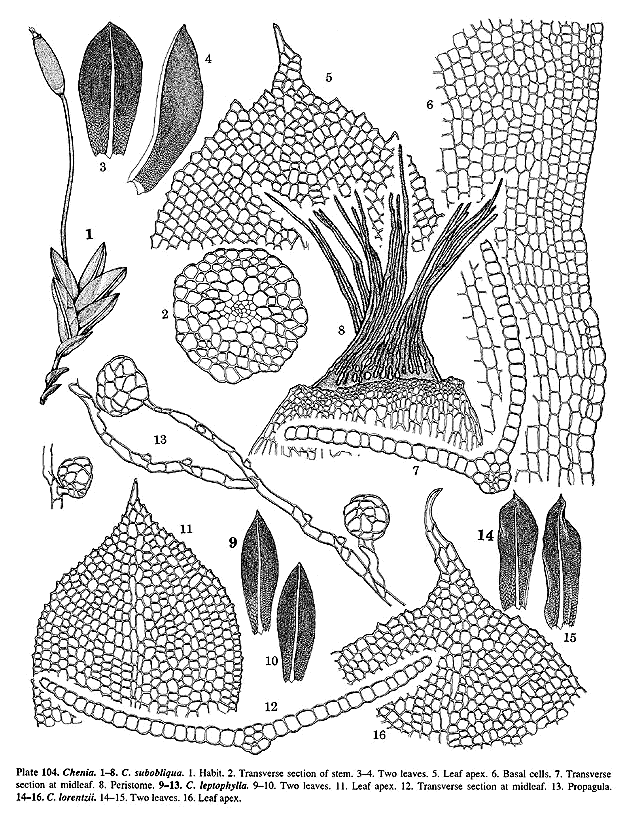
73. CHENIA Plate
104.
Chenia Zand., Phytologia 65: 424, 1989. Type: Chenia subobliqua
(Williams) Zand.
Phascum sect. Leptophascum C. Müll., Flora 71: 7, 1888. Type: Phascum
leptophyllum C. Müll.
Phascum
subg. Leptophascum (C. Müll.) Roth, Aussereur. Laubm. 2: 214, 1911.
Plants
forming turfs, occasionally rosulate, green above, brownish below. Stems seldom
branching, 0.3–1.0 cm in length, transverse section rounded, central strand
weak to strong, sclerodermis present, hyalodermis absent; axillary hairs small,
of 3–4 cells, basal cell firm-walled; rhizoids usually few. Leaves
appressed and somewhat contorted when dry, spreading when moist, ligulate to
spathulate, 1.5–2.5 µm in length, upper lamina occasionally
grooved along costa, plane or broadly channeled across leaf, margins plane
above, weakly recurved below, sharply crenulate to irregularly dentate above
with sharp mid-marginal wall projections usually ending in a weak simple
papilla, marginal cells often smaller than the medial; apex rounded
to broadly acute, often sharply apiculate by a distinctive thick-walled cell
or cells; base rectangular or not differentiated in shape; costa weak,
ending several (6–9) cells before the apex or percurrent, costa with lamina
inserted ventrally to laterally, ventral and dorsal superficial cells
short-rectangular, narrower than laminal cells, 2 rows of cells across costa
ventrally at midleaf, costal transverse section rounded to elliptical, stereid
band very weak or occasionally absent, rounded in shape, ventral and dorsal
epidermis present, guide cells 2 in 1 layer, hydroid strand present, small to
large; upper laminal cells large, bulging-hexagonal, 15–18 µm in width,
1:1, walls thin, weakly trigonous, superficially convex on both sides; papillae
absent (upper marginal teeth may be interpreted as ending in sharp, simple
papillae); basal cells differentiated across the leaf base (except for one row
of marginal cells similar to the upper cells), rectangular, ca. 20–25 µm in
width, 2–4:1, walls thin, weakly trigonous. Propagula when present borne on
rhizoids in soil, irregularly rounded to clavate, ca. 100–130 µm in longest
dimension. Dioicous. Perichaetia terminal,
inner leaves little different from the cauline, slightlylarger.Seta ca.
0.1–1.2 cm in length, 1 per perichaetium, reddish brown, twisted clockwise;
when present theca 0.7–2.0 µm in length, brown, nearly spherical (then with a
narrow beak to 0.25 µm in length) or short-ovate or cylindrical, exothecial
cells rectangular, 20–45 µm in width, 1–4:1, thin-walled, stomates at base of
theca, phaneropore, cleistocarpous or stegocarpous, annulus when present of 2–3
layers of strongly vesiculose cells, persistent; when present peristome teeth
32, filamentous, somewhat anastomosing, densely branching-spiculose, ca. 400 µm
in length, with ca. 5 articulations, nearly straight or weakly twisted
counterclockwise, basal membrane 25–35 µm in height, low spiculose. Operculum when
differentiated short- to long-conic, 500–650 µm in length, cells twisted weakly
counterclockwise. Calyptra cucullate or mitriform and then three-lobed, smooth,
1.5–2.0 µm in length. Spores 10–20 µm in diameter, light brown, nearly smooth
to finely papillose. Laminal KOH color reaction red. [Information on the
cleistocarpous sporophyte of C. leptophylla from Arts and Sollman 1991]
Found
on soil from sea level to nearly 3000 meters elevation; North and South
America, Europe, eastern Asia and Australia.
Corley
et al. (1981) suggested that Chenia leptophylla (as Tortula
rhizophylla) “is completely anomalous in Tortula.” The Andean C.
obliqua (Pl. 104, f. 1–8) is closely related and differs from C.
rhizophylla in the peristomate sporophyte, broad leaf apex, margins
strongly dentate in the upper 1/3 of the leaf and lacking a leaf apiculus of
thick-walled cells. Although these two species are rather different, a third
species, C. lorentzii (Pl. 104, f. 14–18), is sterile but otherwise
intermediate in character, with narrower leaves, not or moderately dentate, and
the apiculus is occasionally differentiated and thick-walled. Small, sterile
plants mixed in with the type of C. lorentzii are quite like C.
leptophylla. The autoicous condition ascribed to C. lorentzii in the
original description cannot be confirmed as no antheridia were found in the NY
isotype.
Like
Stegonia, Chenia is a small genus that includes both peristomate
and cleistocarpous species. Chenia is easily distinguished from other Tortula-like
species by the combination of the dentate upper leaf margins, large, epapillose
upper laminal cells, a thin costa (Pl. 104, f. 12), and red coloration in KOH.
The last may have to be determined by examination of the upper laminal cell
walls under high magnification because the dense yellow-green of the
chlorophyll overwhelms the color of the very thin cell walls. The leaf teeth
are each usually tipped with a single, simple papilla. Phascum leptophyllum
of central and southern Africa, an earlier name than Physcomitrium
rhizophyllum Sak., was reported by Arts and Sollman (1991) to be the same
as C. rhizophylla, along with Pottia denticulata Dix. & Varde
of India and P. splachnobryoides C. Müll. of Asia; they describe
and illustrate the sporophyte with its cleistocarpous capsule, and review the
literature on this widely distributed species. Chenia leptophylla is, as
is the case with Didymodon australasiae var. umbrosus (cf.
Crundwell & Whitehouse 1978, Eckel 1986a, Preston & Whitehouse 1985,
Synnott & Robinson 1990, and others), apparently spread by human agency
through rhizoid-borne propagula (Pl. 104, f. 13) in the soil. Chenia is
similar to Hennediella, especially H. serrulata (which has a
quite similar gametophytic appearance); also, Tortula paulsenii has
somewhat similar morphology. Phylogenetic analysis indicates a close
relationship, however, to Syntrichia (see Cladograms 13 and 14).
Additional
literature: Cortini and Aleffi (1989), Iwatsuki and Saito (1972), Martinez et
al. (1989), Neumann (1972), Pedrotti and Aleffi (1989), Reese (1967, 1968),
Smith and Whitehouse (1974), Sollman (1979), Stone (1980a).
Number
of accepted species: 3.
Species
examined: C. lorentzii (NY), C. leptophylla (BUF, PAC), C.
subobliqua (NY).
New
combinations: Chenia leptophylla (C. Müll.) Zand., comb. nov. (Phascum
leptophyllum C. Müll., Flora 71: 6, 1888). Chenia lorentzii (C.
Müll.) Zand., comb. nov. (Barbula lorentzii C. Müll., Linnaea 42:
346, 1879 [“-i”]; Tortula lorentzii (C. Müll.) Broth.