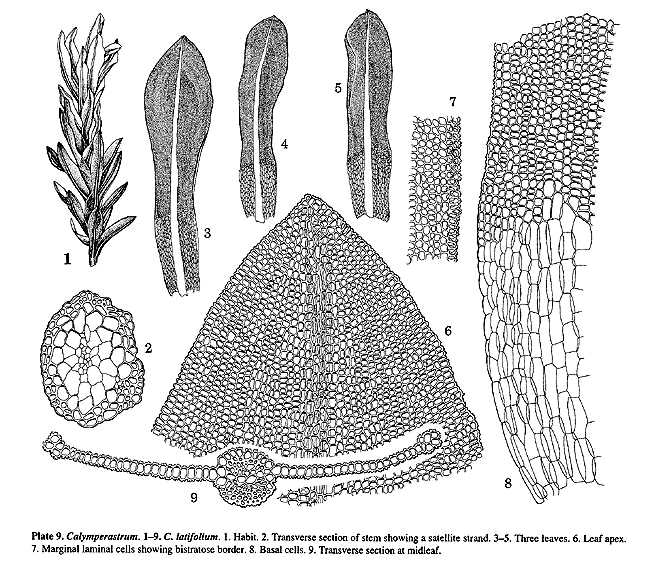
8. CALYMPERASTRUM
Plate
9.
Calymperastrum Stone, J. Bryol. 14: 315–318, 1986. Type: Calymperastrum latifolium
(Hampe) Stone.
Plants
in a low turf, yellowish green above, yellowish brown below.
Stems not branching, ca. 6 mm in length, transverse section rounded-pentagonal
to triangular, central strand distinct, generally with an satellite strand
just below the sclerodermis, sclerodermis of 1–2 layers of thick-walled
cells, hyalodermis weakly developed in patches; axillary hairs ca. 6 cells in
length, all hyaline; papillose, reddish brown tomentum on lower part of stem.
Leaves spreading-incurved and conduplicate from an appressed base when
dry, spreading when moist, long-spathulate, 2.0–3.1 mm in length, upper
lamina broadly concave, margins plane to weakly incurved above, entire,
bistratose in 1(–3) rows from shoulder to 3/4 length of leaf, cell walls
of border slightly thickened; apex rounded-acute and bluntly apiculate; base
strongly differentiated in shape in lower 1/3 of leaf, cuneate, with
distinct shoulders, basal cells narrower along margins; costa strong
and tapering above, percurrent, superficial cells quadrate to
short-rectangular and papillose ventrally, elongate and weakly papillose
dorsally, 4–6 rows of cells across costa ventrally at midleaf, costal
transverse section nearly round, stereid bands two, usually strong
ventrally (the cell walls often thicker than those of dorsal band, especially
in sections made through leaf base) and generally larger than the dorsal,
distinct to nearly absent dorsally, epidermis well differentiated ventrally but
absent dorsally, guide cells small and 4 in 1 layer, hydroid strand strong,
in a central position just dorsal to the guide cells and often also ventrally; upper
laminal cells subquadrate to 5– or 6–sided, often slightly longer than
wide, 9–13 µm in width, 1(–2):1, walls thin to weakly evenly thickened, superficially
strongly bulging ventrally, less strongly bulging dorsally; papillae
small, crowded, bifid, solid, ca. 8 per
lumen; basal cells strongly differentiated from upper cells, rising higher
and larger medially, weakly inflated, rectangular, ca. 20 µm in width, 2–4:1,
walls thin, hyaline, lacking internal or superficial pores. Sexual structures
and sporophyte unknown. Laminal KOH color reaction yellow.
A
monotypic genus endemic to western Australia, growing on cycads.
This
genus can be excluded from the Calymperaceae mainly by the hydroid strand (Pl.
9, f. 9) in the leaf. It appears to have many of the characteristics of Bryoerythrophyllum
and Mironia (especially those of the areolation), but it differs
markedly in being yellow in KOH. From Dialytrichia, which also has a
bistratose leaf margin (Pl. 9, f. 7), it differs in its broadly concave ventral
laminal surface (not deeply grooved along the costa), its plane leaf margins
(not recurved below midleaf), its round (not semicircular) costal section and
semicircular (not crescent-shaped) section of dorsal stereid band. Calymperastrum
is also somewhat like Trichostomum especially in the plane to incurved
margins but a hydroid strand is rare in that genus, and the only Trichostomum
species seen with a bistratose leaf margin, T. marginatum, only
doubtfully belongs to Trichostomum.
Calymperastrum is also like certain species of Leptodontium
(e.g. L. stoloniferum) in the leaf shape and strongly
differentiated basal cells, but the presence of a central strand, a hydroid
strand and a differentiated costal epidermis are not characters of Leptodontium.
Transverse sections of the stem show satellite strands just interior to the
sclerodermis, usually one per section and correlated with a broad stem ridge
decurrent from each costa. The satellite strand appears to be a leaf hydroid
strand (these being unusually strong in Calymperastrum) extending into
the central cortex but not reaching the stem central strand (Pl. 9, f. 2). Aloinella,
an unrelated taxon, has a similar stem morphology. A more thorough description
of the genus is given by Stone (1986), who saw additional material.
This
monotypic genus appears to be, like Hypodontium, transitional in
morphology between the Pottiaceae and the Calymperaceae, approaching the latter
through the following combination of characters: arboreal habitat, leaves with
rounded apices and plane, thickened margins, costa percurrent, ending in an
apiculus, the ventral stereid band of cells with walls more strongly thickened
that those of the dorsal (cf. Syrrhopodon richardsii Dix.), upper
laminal cells more strongly bulging ventrally than dorsally, basal cells
strongly differentiated from the upper cells (but not as sharply demarcated as
is usual in Calymperes and Syrrhopodon), and laminal KOH reaction
yellow. The ventral stereid cells being more strongly thickened than those of
the dorsal band is a character not found elsewhere in the Pottiaceae, but is
apparently occasional in the Calymperaceae. The only unique character to my
knowledge distinguishing Calymperastrum from genera of the Calymperaceae
is the presence of a leaf hydroid strand. Other characters cited in the
original description (Stone 1986) as indicative of Pottiaceae are also found in
various genera of both the Calymperaceae and the Pottiaceae, including the stem
central strand, papillae on the upper cells of the sheathing leaf base, bifid
papillae on both surfaces of laminal cells, and absence of foliar gemmae. The
significance of the presence of seriate papillae on the dorsal costal surface
cannot be evaluated here, and information on the sporophyte is lacking.
Number
of accepted species: 1.
Species
examined: C. latifolium (MELU).