22. TRIQUETRELLA Plates
28–
29.
Triquetrella C. Müll., Öst. Bot. Zeit. 47: 421, 1897. Lectotype: Triquetrella
tristicha (C. Müll.) C. Müll. fide Grout, Moss Fl. N. Amer. 1: 170,
1938.
Plants
growing in mats, yellowish or blackish green above, brown or blackish brown
below. Stems branching occasionally, to 7 cm in length, transverse
section rounded-triangular, central strand absent or present and small,
sclerodermis present, of 1–3 layers of stereid cells, hyalodermis absent;
axillary hairs to 9 cells in length with cells weakly bulging, basal 1–2 cells
thick-walled; weakly radiculose below. Leaves in 3 distinct rows, the
rows straight or weakly spiralling in either direction, appressed- to
spreading-incurved when dry, widely spreading to squarrose and strongly
reflexed when moist, triangular to ovate-triangular, ca. 2 mm in
length, upper lamina keeled, narrowly channeled along costa, margins recurved
in middle 3/4–4/5 of leaf, entire to weakly serrulate near apex; apex
narrowly acute to short-acuminate; base ovate, basal leaf margins broadly
long-decurrent; costa percurrent, superficial cells elongate and
weakly papillose ventrally, rhombic-quadrate near apex and papillose
dorsally, 2(–4) rows of cells across costa ventrally at midleaf, costal
transverse section ovate to semicircular, 2 stereid bands present, ventral
epidermis absent, the dorsal weakly differentiated, guide cells 2–4 in 1 layer,
hydroid strand absent; upper laminal cells rounded rhombic to
quadrate, ca. 9–11 µm in width, 1:1, occasionally elongate transversely, walls
thickened, weakly trigonous, superficially weakly convex to
distinctly bulging on both sides; papillae spiculose, mostly simple
to bifid, 1 per lumen; basal cells differentiated weakly in a
very small group medially, occasionally across insertion, rectangular,
little wider than upper cells, 2–4:1, walls thick-walled, somewhat porose.
Dioicous. Perichaetia both terminal and lateral in the same species and
occasionally on the same plant (acrocarpous and pleurocarpous), often in
clusters, inner leaves ovate, rounded or short-acuminate to apiculate,
to 2.5 mm in length, strongly sheathing seta, lower cells rhombic,
thick-walled throughout. Perigonia terminal and lateral in clusters. Seta ca.
1.5–2.3 cm in length, 1 per perichaetium, yellow, twisted clockwise; theca
1.6–2.1 mm in length, yellowish brown, elliptical, exothecial cells
short-rectangular, 20–25 µm in width, thin-walled, stomates phaneropore, at
base of theca, annulus of ca. 3 rows of smaller, vesiculose cells; peristome
teeth 16, variously cleft (usually to base) or occasionally
perforate, subulate, transparent, smooth or very weakly spirally
striate, 110–180 µm in length, with ca. 6 articulations, straight, basal
membrane absent. Operculum conic, ca. 0.7–0.8 mm in length, cells straight.
Calyptra cucullate, smooth, ca. 2.6–2.8 mm in length. Spores ca. 10–13 µm in
diameter, light brown, papillose. Laminal KOH color reaction orange to
yellowish orange.
A small
genus found on soil or rock generally in or near dry, Mediterranean climates;
Europe (Spain), South Africa, western North America (California), southern
South America, Australia, Tasmania and New Zealand.
Triquetrella
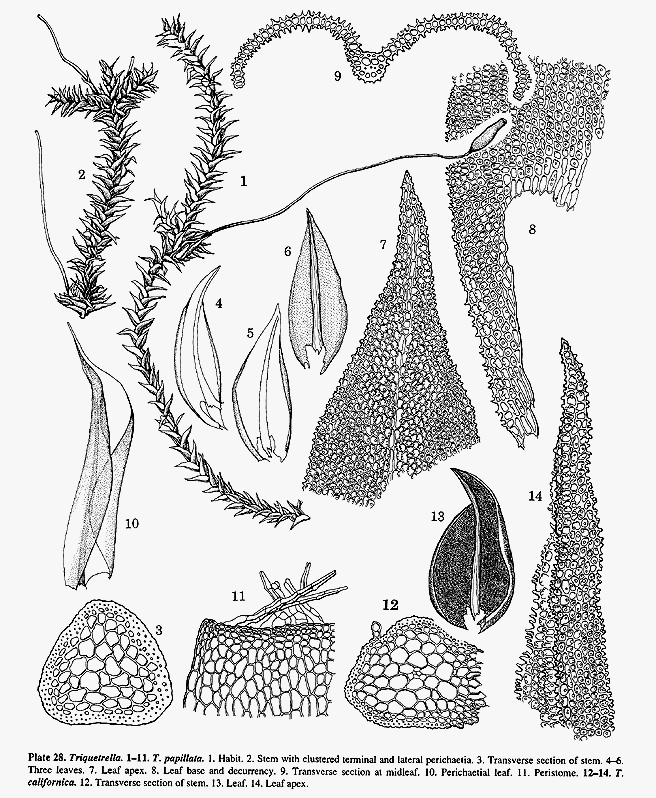
papillata (Pl. 28, f. 1–11, NY!)
has perichaetia that in some plants are terminal and in others are distinctly
lateral on the stem, often clustered below a terminal perichaetium (cf. Ganguleea).
Perigonia, too, are clustered both terminally and laterally near the stem apex
on separate, entirely perigoniate plants. The “acropleurocarpous” condition may
be an anomaly, but whether this also occurs elsewhere in the genus cannot be
immediately determined since perichaetia-bearing herbarium specimens are
uncommon. Catcheside (1980) indicated that sporophytes are rare in South
Australia, and Brotherus (1924–25) found the genus mostly sterile.
Triquetrella is similar to Leptodontium in the 16
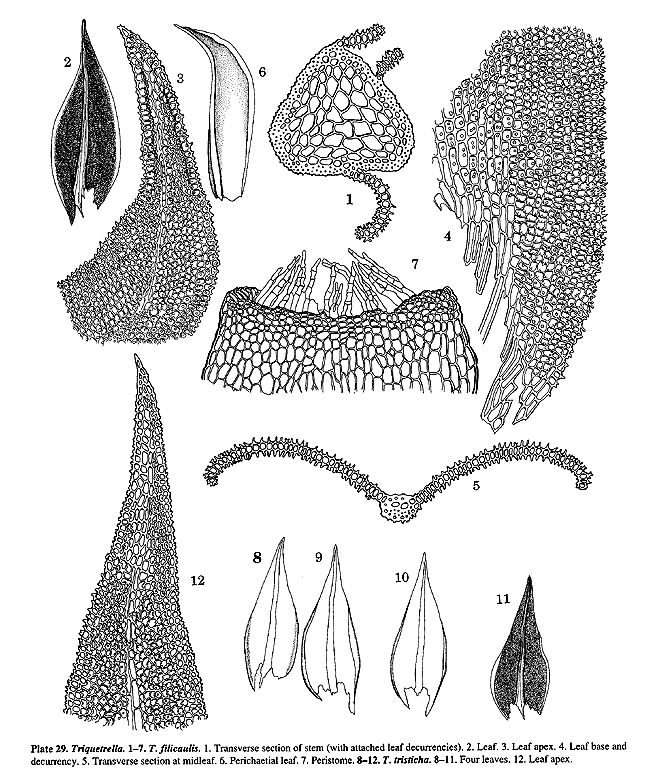
smooth or nearly smooth peristome teeth, mostly cleft to the base (Pl. 28, f.
11; 29, f. 7); strongly differentiated perichaetial leaves (Pl. 28, f. 10);
stem usually without a central strand (Pl. 28, f. 3); squarrose, strongly
reflexed cauline leaves; and absence of a differentiated epidermal layer on the
ventral surface of the costa (Pl. 28, f. 9). Triquetrella differs from Leptodontium
by the occasional presence of a stem central strand (in T. californica,
Pl. 28, f. 12–14, which also lacks the otherwise characteristic triangular
section of the stem); the short, triangular cauline leaves forming three
distinct rows (Pl. 28, f. 1–2); and sharp, spiculose upper laminal papillae
(blunt and columnar in sect. Leptodontium). An intermediate taxon is Leptodontium
paradoxicum, which shares with Triquetrella two characters rare in Leptodontium:
entire leaves and dorsal costal epidermis differentiated. On the other hand,
Eddy (1990) said about Triquetrella that “the sum of its gametophytic
and sporophytic characters strongly suggests that the genus is misplaced in the
Pottiaceae,” without further explanation.
There
are differences between the species of Triquetrella in length of the
theca, leaf shape, acumination of the leaf apex, length of the decurrencies,
and in presence or absence of the stem central strand, that might be used to
distinguish taxa, but, in general, the species are much alike. Casas et al.
(1993) summarized the differences between most of the species in their study of
T. arapilensis. Triquetrella preissiana of Australia has been
synonymized with T. papillata by Watts and Whitelegge (1902) according
to Stone and Scott (1976); the type of the former name (BM!) is indeed
taxonomically T. papillata.
Additional
literature: Cour (1955), Moore et al. (1982), Müller (1897b), Stark (1980),
Zander (1980a).
Number
of accepted species: 9.
Species
examined: T. arapilensis (FH), T. californica (FH, NY), T.
filicaulis (NY), T. papillata (BM, DUKE, FH, NY), T. patagonica
(FH), T. tristicha (NY).