10. TRICHOSTOMUM Plates
11,
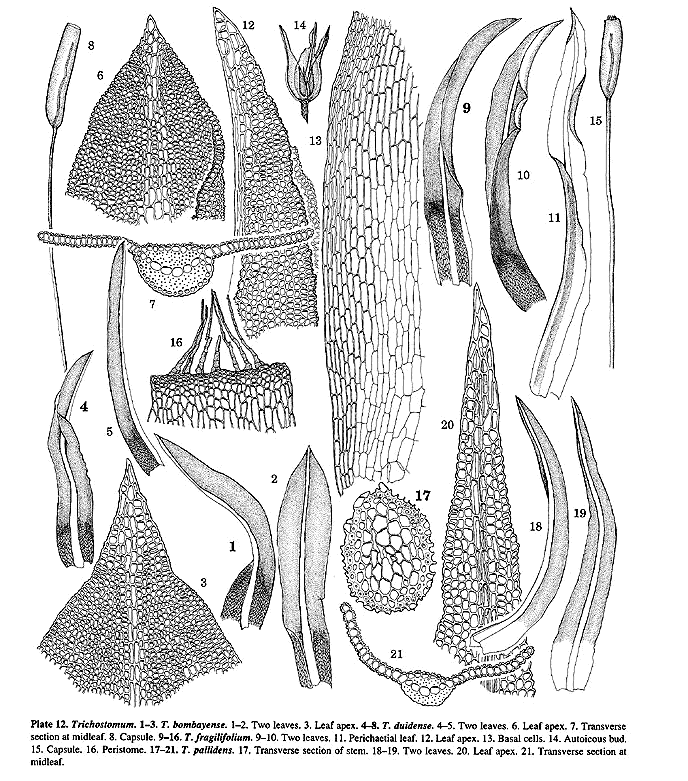
12–
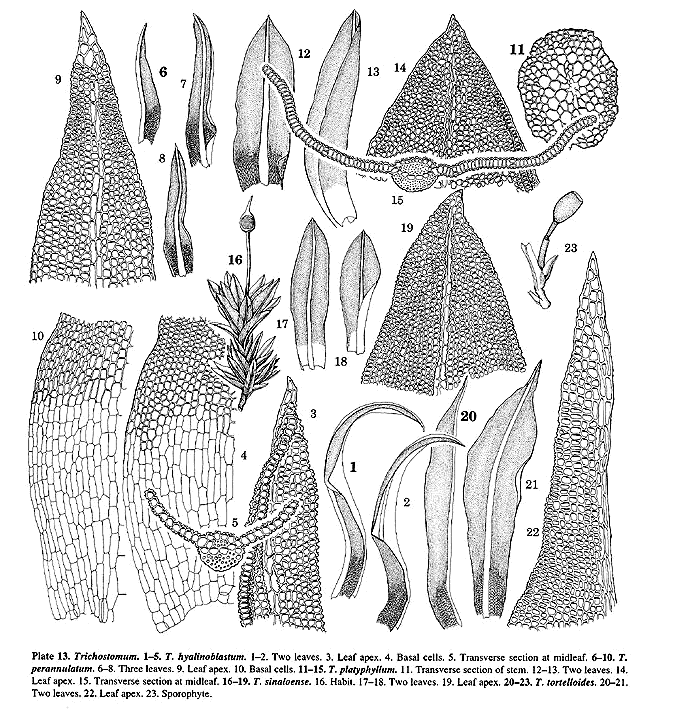
13.
Trichostomum Bruch, Flora 12: 396, 1829, nom. cons. non Hedw., 1801.
Lectotype: Trichostomum brachydontium Bruch.
Subg. Trichostomum (Hedw.) Turn., Musc.
Hib. Spic. 35, 1804 (as autonym).
Trichostomum subg. Trichostomum Lor., Bryol. Notizb. 20: 1865, nom.
illeg.
Didymodon subg. Trichostomum Kindb., Eur. N. Amer. Bryin. 2: 272, 1897.
Type: Trichostomum Hedw., nom. rej., p.p.
Bryum
sect. Trichostomum (Hedw.) Relh., Fl. Cantabr. ed 2: 422, 1802, nom.
illeg.
Trichostomum sect. Lancifolia B.&S. in BSG, Bryol. Eur. 2: 119 [fasc.
18–20 (Trichost.): 5], 1843.
Trichostomum sect. Pycnophyllum C. Müll., Syn. 1: 567, 1849.
Tortula sect. Trichostomum Mitt., J. Linn. Soc. Bot. 12: 142, 146,
1869, nom. illeg.
Subg. Crispuliformes (Kindb.) Zander, comb.
et stat. nov. see below.
Didymodon sect. Crispuliformes Kindb., Eur. N. Amer. Bryin. 2: 272, 1897.
Type: Didymodon crispulus (Bruch) Wils.
Subg. Laminanchium Zander, subg. nov.
see below. Type: Trichostomum tortelloides (Broth. & Dix.) Zand.
Subg. Oxystegus Limpr., Laubm. Deutschl.
1: 569, 1888. Type: Trichostomum cylindricum (Bruch ex Brid.) C. Müll. fide
Saito, J. Hattori Bot. Lab. 39: 436, 1975, hom. illeg.
Oxystegus (Limpr.) Hilp., Beih. Bot. Centralbl. 50: 666, 1933.
Stephanodictyon Dix., J. Linn. Soc. Bot. 50: 86, 1935. Type: Stephanodictyon
borneense Dix.
Paraleptodontium Long, J. Bryol. 12: 181, 1982. Type: Paraleptodontium
recurvifolium (Tayl.) Long.
Didymodon subg. Oxystegus (Limpr.) Roth, Eur. Laubm. 1: 304, 1904.
Sect. Campylopus Arnott, Mém. Soc. Linn.
Paris 5: 244, 1827.
Sect. Leptomitrium Wallr., Fl. Crypt.
Germ. 1: 170, 1831.
Plants
turf-forming, yellowish green above, medium brown to light brown below. Stems
branching irregularly, to ca. 3 cm in length, transverse section
rounded-pentagonal, occasionally rounded-triangular, central strand present or
absent, cells of central cylinder thin- or thick-walled, sclerodermis
variously developed but often weak, of substereid cells or of one or two
layers of stereid cells, hyalodermis present or seldom absent; axillary
hairs ca. 10 cells in length, basal 1–3 cells thicker walled or all hyaline;
sparsely radiculose, or occasionally with a thin red tomentum. Leaves
incurved, occasionally tubulose and often catenulate or reflexed at top of
appressed base when dry, spreading to squarrose when moist, oblong, elliptical
or ligulate to long-lanceolate, 1.5–2.5(–5.0) mm in length, upper lamina
flat or broadly channeled, leaves seldom keeled, occasionally grooved along
costa, margins usually plane, seldom broadly incurved to tubulose, entire
to crenulose-notched or occasionally dentate in the upper 1/2–3/4,
occasionally with a narrow, less papillose border above or throughout, rarely
2–3 rows of marginal cells bistratose; apex narrowly to broadly acute or
rounded, occasionally fragile and broken, occasionally sharply reflexed or
constricted, seldom cucullate; base elliptical to rectangular, occasionally
sheathing or not differentiated in shape; costa usually excurrent as a
smooth, sharp mucro, occasionally ending 2–3 cells below apex,
seldom short-awned, superficial cells quadrate or occasionally elongate
(especially near apex) ventrally, elongate or seldom short-rectangular
dorsally, 2–6(–8) rows of cells across costa ventrally at midleaf, costal
transverse section semicircular, reniform or ovate, two stereid bands present,
occasionally very weak ventrally, ventral stereid band smaller or about same
size as dorsal stereid band, epidermis present ventrally, weak or absent
dorsally, guide cells 2–4(–6) in 1 layer or seldom 1–3 scattered bistratose
pairs, hydroid strand absent or very seldom present; upper laminal cells
rounded-quadrate, occasionally rectangular or hexagonal, seldom transversely
elliptical along margin, 6–12(–18) µm in width, 1(–2):1, seldom bistratose
along margins or in small medial patches, walls usually evenly thickened,
superficially usually strongly convex on both sides or seldom somewhat
more bulging ventrally than dorsally; papillae usually bifid, crowded,
2–6 per lumen, occasionally single, multiplex and completely
covering lumen; basal cells differentiated across leaf or occasionally
only medially or rising weakly along margins, rectangular, seldom
bulging superficially, 7–15 µm in width, 3–5:1, walls thin to somewhat
thickened, occasionally porose. Propagula rare, on rhizoids or ventral
surface of costa, of several cells, vermiform to irregular in shape,
occasionally branching. Dioicous or occasionally autoicous. Perichaetia
terminal, inner leaves usually little different from cauline leaves,
rarely oblong-sheathing and constricted at the apex, lower basal cells inflated
rectangular to rhomboid, hyaline. Perigonia terminal, outer leaves often
similar to the cauline, inner leaves elongate-triangular, or occasionally
present in leaf axils of archegoniate plants as flattened buds. Seta 0.4–1.5 cm
in length, 1 or seldom 2–3 per perichaetium, yellowish brown, occasionally
reddish, twisted clockwise, in cleistocarpous species with an abscission layer
just below capsule; theca ca. 1–3 mm in length, yellowish brown, occasionally
orange, cylindrical or elliptical, occasionally slightly curved, exothecial
cells thin-walled, rectangular, stomates phaneropore at base of theca, stegocarpous
or seldom cleistocarpous, annulus of 1–4 rows of vesiculose cells, persistent
or seldom revoluble; peristome teeth 16, usually rather short,
occasionally rudimentary or absent, ligulate to filamentous, entire
or occasionally irregularly cleft 2–3–fid or perforate, papillose, striate
or spiculose, occasionally smooth, occasionally rather distant, to
400 µm, with several articulations, straight or seldom weakly twisted
counterclockwise, basal membrane absent or low but distinct, papillose to
spiculose, mouth of capsule occasionally closed by a hymenium. Operculum
long-conic to rostrate, ca. 0.4–0.7 mm in length, cells straight, seldom weakly
twisted counterclockwise or not differentiated. Calyptra cucullate, smooth, ca.
2.0–2.5 mm in length. Spores 8–20 µm in diameter, yellow to brown, essentially
smooth to strongly papillose. Laminal KOH color reaction medium orange to
yellowish orange, occasionally yellow. Reported chromosome number n = 12, 13,
13+m.
A
large genus found on soil, rock (often calcareous) or organic material on all
continents except Antarctica.
Trichostomum has been a large, “wastebasket” genus of species
that cannot be easily assigned to other genera. It differs from similar Barbula
(Merceyoideae) species with plane or erect upper leaf margins (B. sect. Convolutae)
by the cells of the outer layer of the stem usually with large lumens (Pl. 11,
f. 14; 13, f. 11), lower leaf margins plane, upper leaf margins seldom dentate
(but commonly minutely serrulate by projecting cell walls), costal hydroid
strand seldom present (Pl. 11, f. 12), dorsal costal epidermal cells sometimes
not differentiated (Pl. 12, f. 21), ventral stereid band generally large,
almost or about the thickness of the dorsal band, perichaetial leaves generally
not differentiated from the cauline, and propagula (Pl. 11, f. 5) very rarely
present. The genus differs from Hyophila by the mostly narrower leaves
that are broadest at the base, laminal cells usually somewhat bulging on both
exposed surfaces (rather than just one surface though this is variable in Hyophila),
propagula usually lacking, and peristome usually present (among other
characters, see Hyophila); however, the thick-walled exothecial cells of
Hyophila (forming a series of concatenated semicircles as seen in
transverse section of the theca) are matched in some eperistomate species of Trichostomum.
I have
found no good distinctions between Trichostomum and Oxystegus at
the generic level. There are no characters of the sporophyte that acceptably
distinguish the two; for instance, Trichostomum (subg. Trichostomum)
brachydontium may have the spiral peristome tooth ornamentation typical
of T. (subg. Oxystegus) tenuirostre). Gametophytically,
subg. Oxystegus differs only weakly from subg. Trichostomum in
(1) generally plane (occasionally tubulose when dry) upper leaf laminae, (2) a
tendency toward broadly sheathing leaf bases with the differentiated marginal
cells somewhat running up the margins as in Tortella, (3) medial upper
basal cells thick-walled and rectangular (forming a group sensibly different
from the upper cells and lower basal cells), and (4) the upper laminal cells
often distinctly enlarged and rounded rectangular, 1–2:1. The first two of
these characters are, however, also present to some degree in Trichostomum
sect. Trichostomum, and the last is neither constant nor easily gauged.
Crum and Anderson (1981) likewise proposed that Trichostomum include Oxystegus.
Saito (1975a) recognized Oxystegus but did not discuss it as a genus.
His key to genera of the Trichostomoideae separated Oxystegus and Pseudosymblepharis
from Trichostomum by the presence of a central strand in the last; Eddy
(1990) used the same character to separate the two. This distinction does not,
however, hold outside of Japan or, apparently, Malesia. Stoneburner (1985)
expressed the opinion that differences between Trichostomum and Oxystegus
were probably artificial. Norris and Koponen (1989) distinguished between Oxystegus
and Trichostomum by “a suite of differing, although somewhat overlapping
characters”: Trichostomum having leaves with lengths less than 6:1,
blunt papillae grouped over the lumens, and laminal marginal cells thick-walled
near the shoulders; Oxystegus having leaves longer than 6:1, sharp
papillae grouped around the lumens, and cells of the shoulders thin-walled.
These differences are recognized here at the subgeneric level. They also
indicated that although Oxystegus and Pseudosymblepharis are
morphologically close gametophytically, the red peristome of the former
contrasts with the whitish peristome of the latter.
There
are trends in subg. Oxystegus towards three morphotypes of robust
stature: a lingulate leaf as in Trichostomum recurvifolium (= Paraleptodontium
Long 1982b, a synonym), a lanceolate leaf (e.g. Trichostomum hibernicum),
and a linear leaf (e.g. Trichostomum borneense, originally published as
the type of Stephanodictyon). Such tendencies are duplicated in
infraspecific variation in the central species of the Oxystegus complex—T.
tenuirostre. Eddy (1990) made Stephanodictyon a synonym of Pseudosymblepharis
(along with Chionoloma, here recognized as a good genus).
Of
species common in North Temperate Zone climates, Trichostomum (subg.
Oxystegus) tenuirostre is rather different from T. crispulum
and T. brachydontium (both of subg. Trichostomum) in its plane
margins, vaguely vee-shaped area of differentiated basal cells, and less
well-developed peristome; as a genus, however, Oxystegus cannot be
maintained at the world level because of considerable variation in expression
and combination of characters among the species. For instance, the difference
between the peristomes of T. crispulum (often 32 filamentous rami like
of those of Tortella, but sometimes reduced) and T. brachydontium
(16 variously cleft or perforated lanceolate teeth) is greater than that
between the peristomes of T. brachydontium (generitype of Trichostomum)
and T. (subg. Oxystegus) tenuirostre.
Tortella can be separated from Trichostomum on the
basis of a single relatively constant character, the vee-shaped basal cell
region, with the usually long and twisted peristome and generally larger upper
laminal cells being associated trends; see Cladogram 15 for analysis of
phylogenetically important character state changes. Species of Trichostomum
may also have basal cells differentiated in a (less distinctive) vee-shape, and
those with flattened autoicous buds (e.g. Trichostomum fragilifolium,
Pl. 12, f. 14) differ gametophytically from certain Tortella species
(like Tortella humilis) with similar buds only in the basal cells being
differentiated evenly across the leaf rather than running higher up the
margins. Quite probably, Trichostomum, Pseudosymblepharis and
possibly also Tortella represent a complex of several transformation
series. This needs to be studied. Future revision of the Trichostomum
complex may turn up a satisfactory generic classification recognizing several
separate phyletic series, with perhaps Trichostomum brachydontium, T.
crispulum, Weissia jamaicensis or even species of Tortella
variously at the unreduced end of each.
Species
of Weissia (and of Tetrapterum) with clearly plane or
erect-incurved upper laminal margins (including subg. Hymenostomum and
subg. Astomum) examined during this study are here transferred to Trichostomum
s. lat. Groups of Trichostomum species very similar to each other
in areolation and certain other gametophytic characters may be construed (until
analysis demonstrates otherwise) as separate reduction series toward smaller
stature of gametophyte, shorter seta or capsule (the latter occasionally almost
spherical), short or absent peristome, and monoicy, and are recognized below as
subgenera.
Trichostomum subg. Trichostomum
Leaves ovate to long-lanceolate, apex usually
rounded, plane; upper margins plane; costa thick and excurrent in a stout,
sharp mucro; basal cells moderately differentiated across leaf base.
Occasionally
the upper margins in some leaves are rather narrowly incurved, like Weissia
species. A reduction series (large to small stature with concomitant reduction
of morphological details) might include: Trichostomum brachydontium, T.
planifolium, T. urceolare, T. sinaloense (Pl. 13, f. 16–19), T.
termitarum, T. williamsii, T. unguiculatum and T.
austrocrispum. Also belonging here is T. incertum. Trichostomum
subg. Crispuliformes (Kindb.) Zander, comb. and stat. nov.
Basionym: Didymodon sect. Crispuliformes
Kindb., Eur. N. Amer. Bryin. 2: 272, 1897. Type: Trichostomum crispulum
Bruch ex F. A. Müller.
Leaves elliptical to long-lanceolate; apex
rounded-acute, often somewhat cucullate; upper margins broadly incurved; costa
evenly tapering and generally ending before the apex or percurrent; basal cells
moderately differentiated across leaf base.
This
taxon includes the series: Tortella inflexa, Trichostomum crispulum
(Pl. 11, f. 18–21), T. castaneum, T. caespitosum, T.
brittonianum, T. subangustifolium, T. atrocaule, T.
perligulatum, and possibly Weissia crispa. Also belonging here are T.
connivens and T. pulicare.
Trichostomum subg. Laminanchium Zander, subg. nov. Type: Trichostomum
tortelloides (Broth. & Dix.) Zand.
Folia longiligulata, et plerumque in regione
supra basem subvaginantem angustata et regione sub apice, apice acuto, plano,
marginibus supernis et interdum infernis planis, costa decrescenti
excurrentique, mucronem formanti, cellulis basalibus valde in regione mediana
distinctis et in marginali cellulissubangustatis praedita.
Leaves
long-ligulate, often pinched just above the somewhat sheathing base and also
just below the apex; apex acute, plane; upper margins and sometimes the lower
margins plane; costa tapering and excurrent as a mucro; basal cells strongly
differentiated medially with narrower cells marginally.
The
upper medial superficial cell walls of most species of this subgenus are
ventrally bulging and dorsally nearly flat, and are also commonly papillose.
Few sporophytes have been seen, but these appear to uniformly lack peristomes
and sometimes have rather short setae. Species included here are similar to Barbula
sect. Convolutae by the mainly medially differentiated basal cells, but
the basal cells of species of sect. Convolutae are rather thick-walled
and not strongly differentiated. Species of subg. Laminachium are: Trichostomum
bombayense (Pl. 12, f. 1–3, and see discussion of Townsend 1983), T.
contractum (Pl. 11, f. 13–16), T. criotum (autoicous, with flattened
axillary perigonia), and T. tortelloides (Pl. 13, f. 20–23). See also
discussion of Calymperastrum.
Trichostomum subg. Oxystegus Limpr. Type: Trichostomum tenuirostre
(Hook. & Tayl.) Lindb.
Leaves lanceolate to linear-lanceolate,
occasionally with a sharply dilated base; apex rounded to narrowly acute,
plane; upper margins plane; costa tapering and excurrent as a short mucro;
basal cells moderately differentiated, often running up the margins somewhat as
in Tortella, and bordered distally by a region of thick-walled
rectangular cells.
Species
of this subgenus could include the following series: Trichostomum tenuirostre
(Pl. 11, f. 1–6), T. duidense (Pl. 12, f. 4–8), T. melanostomum, T.
spirale and T. abyssinicum. There are certainly many other names
that might go here.
Trichostomum caespitosum, having leaves with small upper laminal cells
and broadly incurved margins, and being autoicous, was recognized in Pottia
recently by both Smith (1978) and Corley et al. (1981), but clearly fits in a
reduction series involving T. crispulum. Its distinctly differentiated
perichaetial leaves are, however, unusual in the genus.
The
idea that Trichostomum might include taxa with much reduced or absent
peristomes has been entertained recently by several bryologists (pers. comm.)
with interest in the group. Magill (1981) pointed out that Trichostomum
brachydontium has rudimentary peristomes or gymnostomous capsules both in
South Africa and South America. He also noted that the gametophyte of the
gymnostomous and rhexolytically operculate species Phasconica tisserantii
(= T. unguiculatum cf. Crundwell & Nyholm 1974) resembles that of T.
brachydontium. Brotherus (1924–25) avoided the problem of the relationship
of species with Trichostomum-like gametophytes and cleistocarpous
capsules by referring all these to Tetrapterum.
Tuerckheimia is quite like Trichostomum in general
appearance but the leaf bases of the former genus are not differentiated in
shape, the basal cells are merely short-rectangular in a small area near the
insertion, the upper laminal cells have a massive, multiplex papilla over the
center of each lumen (but not covering the lumen as in Oxystegus), and
the leaves (often widest near the middle) are pale yellow in KOH solution.
Non-type
specimens from India collected by Ramskuhl (BM) and identified as Desmatodon
longirostris (Griff.) Mitt. (= Merceyopsis longirostris (Griff.)
Broth. & Dix.) proved to be the superficially similar Scopelophila
cataractae; the correct name for D. longirostris is now Trichostomum
contractum, nom. nov. (see below).
Additional
literature: Bartram (1924c), Blumrich (1916), Brown (1897), Crum and Anderson
(1958a), Dixon (1911b), Frisvoll (1978), Hammerschmid (1915), Herzog (1907),
Lett (1901), Redfearn (1976), Zander (1978d,h, 1982a,c,i, 1985a).
Number
of accepted species: 130, plus 2 combinations remaining in Oxystegus.
Species
examined: T. abyssinicum (PC), T. acutiusculum (H), T.
aequitoriale (BM), T. arcticum (BUF, C, CANM, NY), T. atrocaule
(TNS), T. austrocrispum (NY), T. bombayense (NY—typified by
Townsend 1983), T. borneense (BM), T. brittonianum (NY), T.
castaneum (NY), , T. connivens (NY), T. criotum (BUF), T.
cylindrotheca (NY), T. distans (NY), T. duidense (BUF, NY), T. eckelianum (NY), T. exulatum
(NY), T. fallax (L), T. fragilifolium (NY), T. hyalinoblastum
(NY), T. imshaugii (NY), T. incertum (NY), T. laticostatum
(PC), T. lindigii (NY), T. melanostomum (NY), T. mitteneanum
(NY), T. orthodontum (NY), T. ovatifolium (H), T. pallidens
(BM), T. perannulatum (BM), T. perligulatum (COLO), T.
planifolium (MICH, NY), T. platyphyllum (NY), T. portoricense
(BUF, NY), T. pulicare (PC), T. recurvifolium (BUF), T.
sinaloense (FH, MICH, NY, TENN), T. spirale (BUF, PC), T.
subangustifolium (PC), T. subintegrum (H), T. tenuirostre, T.
termitarum (NY), T. tortelloides (FH), T. unguiculatum (PRE),
T. urceolare (BM), T. wagneri (H), T. williamsii (NY).
New
heterotypic synonymy: Barbula wollei Aust. (Didymodon wollei
(Aust.) Aust.) = Trichostomum tenuirostre var. holtii (Braithw.)
Dix. Hyophila usambarica Broth. = Trichostomum brachydontium
Bruch. Phasconica tisserantii P. de la Varde = Trichostomum
unguiculatum (Mitt.) Zand. Stephanodictyon obscurirete Dix. =
Trichostomum brachydontium Bruch. Trichostomum molariforme Zand. = Trichostomum
portoricense Crum & Steere. Trichostomum schlimii C. Müll. = Trichostomum
tenuirostre (Hook. & Tayl.) Lindb. Weissia tortivelata Williams
= Trichostomum tenuirostre var. gemmiparum (Schimp.) Zand.
New
names, combinations and statuses (see also discussion section above):
Trichostomum abyssinicum (Thér.) Zand., comb. nov. (Weissia
abyssinica Thér., Bull. Mus. Hist. Nat. Paris 34: 116, 1928).
Trichostomum acutiusculum (Broth.) Zand., comb. nov. (Hyophila
acutiuscula Broth., Bot. Jahrb. 20: 183, 1894).
Trichostomum arboreum (Mitt.) Zand., comb. nov. (Weissia arborea
Mitt., J. Linn. Soc. Bot. 12: 138, 1869; Hyophila arborea (Mitt.)
Jaeg.).
Trichostomum atrocaule (Saito) Zand., comb. nov. (Weissia
atrocaulis Saito, J. Hattori Bot. Lab. 39: 425, 1975).
Trichostomum austrocrispum (Beck.) Zand., comb. nov. (Phascum
austrocrispum Beck., Trans. New Zealand Inst. 26: 274, 1894; Astomum
austrocrispum (Beck.) Broth.).
Trichostomum austrocrispum var. longifolium (R. Br. ter) Zand., comb.
et stat. nov. (Phascum longifolium R. Br. ter, Trans. New Zealand
Inst. 26: 308, 1894).
Trichostomum borneense (Dix.) Zand., comb. nov. (Stephanodictyon
borneense Dix., J. Linn. Soc. Bot. 50: 86, 1935).
Trichostomum brittonianum Zand., nom. nov. (Hymenostomum
flavescens E. Britt. in N. Britt. & Millsp., Bahama Fl. 485, 1920; Weissia
flavescens (Britt. in N. Britt. & Millsp.) Reese, Bryologist 94: 54,
1991; non Trichostomum flavescens Dix.).
Trichostomum castaneum (Crum & Steere) Zand., comb. nov. (Hymenostomum
castaneum Crum & Steere, Amer. Midland Nat. 60: 12, 1959).
Trichostomum criotum Zand., nom. nov. (Hyophila perannulata
Ren. & Card., Bull. Soc. R. Bot. Belg. 34(2): 60, 1896; non Trichostomum
perannulatum Dix. et P. Vard.).
Trichostomum contractum Zand., nom. nov. (Gymnostomum
longirostre Griff., Calcutta J. Nat. Hist. 2: 480, 1842; Merceyopsis
longirostris (Griff.) Broth. & Dix.; Merceya longirostris
(Griff.) Wijk & Marg. Type: India, Khasia Hills, “123–a 1,” lectotype, BM;
non Trichostomum longirostre (Web. & Mohr) Hartm.).
Trichostomum deciduaefolium (Saito) Zand., comb. nov. (Weissia
deciduaefolia Saito, J. Hattori Bot. Lab. 39: 429, 1975).
Trichostomum eckelianum Zand., nom. nov. (Trichostomum
cirrhatum Hampe, Icon. Musc. 28, 1844, hom. illeg.; Tortella
cirrhata Broth., Nat. Pfl. 1(3): 397, 1902).
Trichostomum exulatum Zand., nom. nov. (Phascum vernicosum
C. Müll. ex Roth, Aussereur. Laubm. 212, 1911; Tetrapterum vernicosum
(Roth) Broth. Type: Brazil, Santa Catharina, Ule 8, isotype, NY; non
Trichostomum vernicosum Ren. & Card.).
Trichostomum finukamactum Zand., nom. nov. (Stephanodictyon
angustinerve Fröhl., Rev. Bryol. Lich. 31: 92, 1962; non Trichostomum
angustinerve Card.), not seen.
Trichostomum imshaugii (Vitt) Zand., comb. nov. (Barbula
imshaugii Vitt, Bryologist 74: 464, 1971 [1972]); the leaf shape, the
variably but often strongly excurrent costa, and a red KOH reaction make this
species curiously reminiscent of the genus Willia, but it is placed here
by the plane leaf margins and the two stereid bands in some leaves.
Trichostomum incertum (Mitt.) Zand., comb. nov. (Weissia
incerta Mitt., Phil. Trans. Roy. Soc. London 168: 389, 1879; Tortula
incerta (Mitt.) Broth.).
Trichostomum (subg. Oxystegus) ligulaefolium (Broth. & Par.)
Zand., comb. nov. (Hyophila ligulaefolia Broth. & Par., Rev.
Bryol. 31: 44, 1904).
Trichostomum lindigii (Hampe) Zand., comb. nov. (Systegium
lindigii Hampe, Ann. Sc. Nat. Bot. ser. 5, 3: 337, 1865; Astomum
lindigii (Hampe) Jaeg.).
Trichostomum melanostomum (Mitt.) Zand., comb. nov. (Weissia
melanostoma Mitt., J. Linn. Soc. Bot. 12: 138, 1869; Hyophila
melanostoma (Mitt.) Jaeg.).
Trichostomum mitteneanum Zand., nom. nov. (Weissia umbrosa
Mitt., J. Linn. Soc. Bot. 12: 133, 1869; Hymenostomum umbrosum (Mitt.)
Kindb.; non Trichostomum umbrosum C. Müll.).
Trichostomum ovatifolium Zand., nom. nov. (Hymenostomum
anomalum Broth. in Herz., Biblioth. Bot. 87: 29, 1916; non Trichostomum
anomalum (BSG) Schimp.).
Trichostomum pallidens (Dix.) Zand., comb. nov. (Pseudosymblepharis
pallidens Dix., J. Bombay Nat. Hist. Soc. 39: 776, 1937).
Trichostomum perligulatum (Flow. ex Crum) Zand., comb. nov. (Weissia
perligulata Flow. ex Crum, Bryologist 76: 291, 1973); this species is
monoicous, and is not a synonym of T. crispulum as per Stoneburner and
Wyatt (1985).
Trichostomum planifolium (Dix.) Zand., comb. nov. (Weissia
planifolia Dix., Rev. Bryol. Lichénol. 1: 179, 1928).
Trichostomum pulicare (Besch.) Zand., comb. nov. (Hymenostomum
pulicare Besch., Ann. Sc. Nat. Bot. ser. 6, 9: 299, 1880).
Trichostomum recurvifolium (Tayl.) Zand., comb. nov. (Bryum
recurvifolium Tayl., Ann. Mag. Nat. Hist. 11: 208, 1843; Oxystegus recurvifolius
(Tayl.) Zand., comb. nov.; Paraleptodontium recurvifolium (Tayl.)
Long).
Trichostomum sinaloense (Bartr.) Zand., comb. nov. (Weissia
sinaloensis Bartr., Bryologist 28: 64, 1925; Hyophila sinaloensis
(Bartr.) Bartr.).
Trichostomum soulae (C. Müll. in Ren. & Card.) Zand., comb.
nov. (Ptychomitrium soulae C. Müll. in Ren. & Card., Bull. Soc.
R. Bot. Belg. 33(2): 118, 1895; Oxystegus soulae (C. Müll. in Ren. &
Card.) Wijk & Marg.).
Trichostomum soulae var. corticicola (Ren. & Card.)
Zand., comb. et stat. nov. (Barbula corticicola Ren. & Card.,
Bull. Soc. R. Bot. Belg. 35(1): 309, 1897; Oxystegus soulae var. corticicola
(Ren. & Card.) Wijk & Marg.).
Trichostomum subangustifolium (Thér.) Zand., comb. nov. (Hyophila
subangustifolia Thér., Smiths. Misc. Coll. 85(4): 14, 1931; Weissia
subangustifolia (Thér.) Zand.).
Trichostomum tenuirostre var. gemmiparum (Schimp.) Zand., comb.
nov. (Didymodon cylindricus var. gemmiparus Schimp., Syn.
Musc. ed. 2 165, 1876; Oxystegus tenuirostris var. gemmiparus
(Schimp.) Zand.).
Trichostomum termitarum (C. Müll.) Zand., comb. nov. (Weissia
termitarum C. Müll., Hedwigia 39: 267, 1900).
Trichostomum tisserantii (P. de la Varde) Zand., comb. nov. (Phasconica
tisserantii P. de la Varde, Rev. Bryol. Lichénol. 7: 231, 1934).
Trichostomum tortelloides (Broth. & Dix.) Zand., comb. nov. (Calymperes
tortelloides Broth. & Dix., J. Bot. 48: 306, 1910; suggested as being
Pottiaceae by Reese, Bryologist 88: 106, 1985)
Trichostomum unguiculatum (Mitt.) Zand., comb. nov. (Systegium
unguiculatum Mitt., J. Linn. Soc. Bot. 22: 304, 1886; Astomum
unguiculatum (Mitt.) Broth.; Weissia unguiculata (Mitt.) Crundw.
& Nyh.).
Trichostomum urceolare (Hampe) Zand., comb. nov. (Hyophila
urceolaris Hampe, Vid. Medd. Naturh. For. Kjoebenh. ser. 3,2: 269, 1870; Hymenostomum
urceolare (Hampe) Hampe).
Trichostomum williamsii Zand., nom. nov. (Astomum chilense
Williams, Bull. Torrey Bot. Club 42: 393, 1915; non Trichostomum chilense
Mont.).