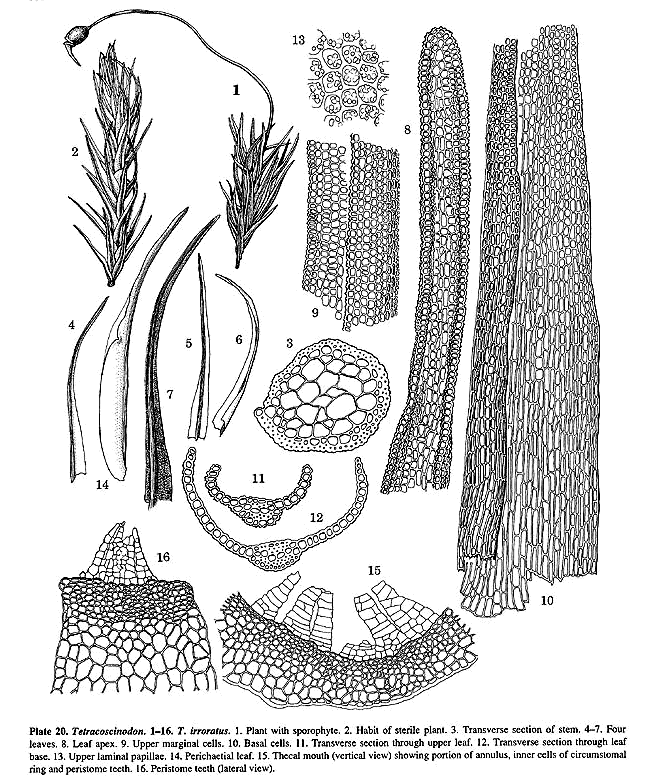
16. TETRACOSCINODON
Plate
20.
Tetracoscinodon R. Br. ter, Trans. & Proc. New Zealand Inst. 29: 532, 1897. Type: Tetracoscinodon
hectorii R. Br. ter.
Plants
growing in clumps or turf, green above, tan below. Stems blackish brown,
branching occasionally, 1–3 cm in length, transverse section
rounded-pentagonal, central strand absent, cells of the central
cylinder large, 30–45 µm in diam., sclerodermis present, of 1–2 layers of
stereids, hyalodermis absent; axillary hairs ca. 10 cells in length, all
hyaline or basal cell thicker walled; rhizoids sparse. Leaves when dry
appressed-incurved, when moist rigid, weakly spreading from the
insertion, long-triangular to linear, 2–3 mm in length, upper
lamina broadly and deeply channeled across leaf, margins plane or seldom
weakly recurved, entire (minutely crenulate by projecting cell walls and
papillae); apex setaceous and very narrowly obtuse; base triangular,
broadest at insertion; costa percurrent, superficial cells on
both sides of costa variously papillose and quadrate or elongate and smooth,
4–6 rows of cells across costa ventrally at midleaf, costal transverse section
semicircular, two stereid bands present, epidermis present on both sides of
costa, guide cells 4–6 in 1 layer, hydroid strand absent; upper laminal
cells quadrate to short-rectangular, 8–12 µm in width, 1–2:1, walls evenly
thickened, superficially bulging on both sides; papillae bifid, crowded,
3–6 per lumen; differentiated basal cells filling the triangular leaf
base, rectangular, little wider than upper cells, 3–5:1, walls evenly
thickened, smooth, bulging more strongly dorsally than ventrally, somewhat
longer on the margins. Dioicous. Perichaetia terminal, inner leaves
lanceolate, little longer than the cauline, convolute-sheathing in lower
half, lower cells long rhomboidal in sheathing portion. Perigonia terminal,
not gemmate, inner leaves sheathing below, paraphyses linear. Seta ca. 1 cm in
length, 1 per perichaetium, brown, twisted clockwise; theca 0.6–1.5 mm
in length, dark brown, short-cylindrical, exothecial cells
rectangular, thin-walled, stomates phaneropore, at base of theca, mouth of
capsule rather thick-walled with a somewhat swollen circumstomal ring
several layers of cells in thickness bearing above it 4–6 rows of dark brown,
vesiculose annular cells; peristome teeth ca. 16, flat, short-triangular,
strongly incurved, much perforated and often cleft into 2–4 rami,
smooth, covered externally by a hyaline membrane, 150–200 µm in length,
with ca. 6–10 articulations, straight, basal membrane absent or present but
low, smooth. Operculum long-conic, usually inclined, 0.5–1.0 mm in length,
cells straight. Calyptra cucullate, smooth, ca. 2 mm in length. Spores large,
25–35 µm in diameter, brown, papillose. Laminal KOH color reaction yellow.
This
is an infrequent taxon restricted to New Zealand where it is found usually
encrusted with limestone deposits on dripping rocks.
Dixon
(1923) was correct in synonymizing Brown's Tetracoscinodon hectorii with
Eucladium irroratum as evidenced by authentic material of both names at
NY, but this species differs widely from Eucladium ((q.v.) in
important features that require recognition of a separate genus. Tetracoscinodon
shares many apparently significant characters with Leptobarbula and Barbula,
such as the stem section showing rather large central cylinder cells and a
strong sclerodermis (Pl. 20, f. 3), a long-triangular leaf shape (Pl. 20, f.
4–7), superficially bulging upper laminal cells with crowded bifid papillae
(Pl. 20, f. 13), and yellow color in KOH. It shares with Tridontium
(Grimmiaceae, Scoulerioideae) and Dialytrichia a hygric habitat and
relatively pachydermous capsule. Like Tridontium (see Excluded Taxa),
the peristome (Pl. 20, f. 15–16) of Tetracoscinodon has an adherent
hyaline membrane, but in the former genus the teeth are closely spiculose. The
peristome o f Tetracoscinodon, in being smooth, extremely thin
periclinally, and in having transverse joints that often do not go all the way
across the tooth but instead angle down to intersect the next upper or lower
joint, has the appearance of derivation from the outer rather then the inner
peristomial layer. This needs further study. The most salient characters of Tetracoscinodon
are its black stems with large cells in the central cylinder and lacking a
central strand; the rigid, long-triangular to linear leaves with narrowly
obtuse apices and papillose, quadrate to short-rectangular superficial cells
dorsally; the rather large and crowded bifid upper laminal papillae; the rather
thick-walled basal cells (Pl. 20, f. 10); the circumstomal ring of the capsule;
and the calcareous incrustation generally found on the lower parts of the
plants.
Additional
literature: Brotherus (1924–25), Sainsbury (1955).
Number
of accepted species: 1.
Species
examined: T. irroratus (NY).
New
combination: Tetracoscinodon irroratus (Mitt. in Hook. f.) Zand., comb.
nov. (Weissia irrorata Mitt. in Hook. f., Handb. New Zealand Fl.
404, 1867).