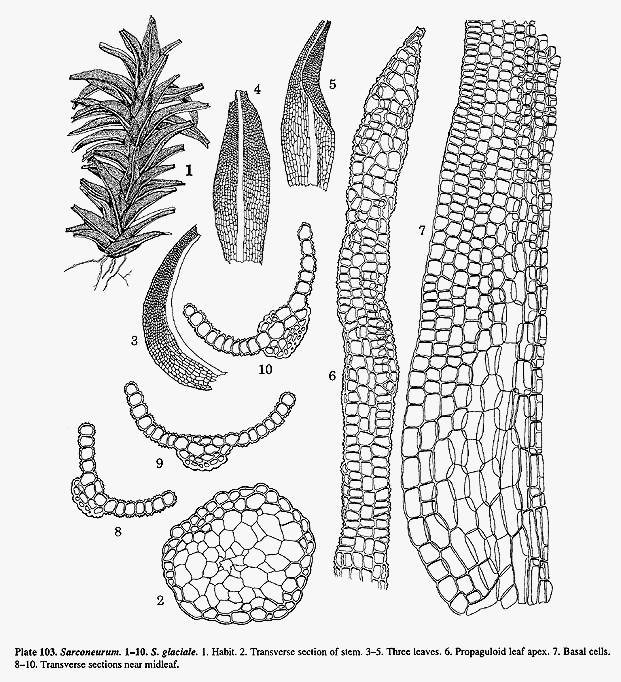
72. SARCONEURUM Plate
103.
Sarconeurum Bryhn, Nyt Mag. Naturvid. 40: 204, 1902. Type: Sarconeurum
antarctium Bryhn.
Plants
forming dense cushions, blackish
green above, reddish brown below. Stems often branching, to 3 cm in
length, rounded-pentagonal in transverse section, central strand absent to
strong, sclerodermis absent, hyalodermis indistinct; axillary hairs of ca. 10
cells, the basal 2–3 firm-walled, yellow. Leaves appressed-incurved when
dry, spreading-recurved when moist, ligulate-lanceolate, to 1.5 µm in
length, broadly channeled across the ventral surface; margins plane, entire; lamina
constricted below apex, which ends in a deciduous, cylindrical,
sharply apiculate propagulum; base scarcely differentiated in shape to
ovate; costa running into the apical propagulum, epidermal cells
quadrate to short-rectangular on both leaf surfaces, ca. 4 rows of cells across
costa ventrally at midleaf, in transverse section with one stereid or
substereid band dorsally (this generally lacking in small leaves), 2–3
guide cells in 1(–2) layers, hydroid strand usually present, a ventral
stereid band occasionally present near the leaf base in large leaves,
epidermis present ventrally, absent dorsally; upper laminal cells quadrate to
rectangular, often transversely elongated, especially along the margins, 15–20
µm wide, 1–2:1, walls evenly thickened or collenchymatous, superficially
flattened, papillae low, small, punctiform or bifid, apparently
solid, several per lumen; basal cells differentiated medially,
thin-walled, bulging-rectangular, to 23 µm in width, 3–5:1.
Sexual organs and sporophyte unknown. Laminal KOH color reaction red.
Found
on sandy and volcanic soil or on lava at low elevations in Antarctica, and,
rarely, southernmost South America.
A
report (Matteri 1982) of sporophytes of Sarconeurum glaciale is based on
specimens (Argentina: trunks of Nothofagus, TBPA B109, TBPA 3486, BA!)
that can be referred to Tortula pygmaea Dix., which is a good species
(BM! and see Lightowlers 1985b) found in southern South America and New
Zealand. Greene (1975) reported Sarconeurum from South America
apparently from specimens of T. pygmaea, a species curiously similar to S.
glaciale in general habit and the constricted leaf apex bearing a
deciduous, sharply apiculate propagulum (Pl. 103, f. 3–6), but differs in the
smaller (ca. 10 µm in width) leaf cells with large, solid bifid papillae and
the deep medial groove along the ventral surface of the costa. On the other
hand, Lightowlers (1985b) demonstrated that the type (“Fuegia septentrionalis”)
of the South American T. lithophila at S is actually S. glaciale.
Sarconeurum
tortelloides has been
transferred to Tortella, leaving Sarconeurum monotypic.
Hilpert
(1933) referred Sarconeurum to the Pottieae near Tortula (without
further discussion) but probably because of the generally single stereid band
in the costa (Pl. 103, f. 8–10) and the large upper laminal cells. There is
considerable similarity to Bryoerythrophyllum, however, in the
essentially oblong-lanceolate leaf shape, the presence of apical laminal
propagulum in the related genus Mironia (but cf. Tortella
tortelloides, which has caducous leaf apices), the bifid papillae, the
occasional second stereid band, the medially differentiated basal cells (Pl.
103, f. 7) and the red color in KOH. The cladistic analysis places Sarconeurum
in the Pottieae (see Cladograms 13 and 14), surprisingly, near Acaulon.
Additional
literature: Greene et al. (1970), Savicz-Ljubitzkaja & Smirnova (1961),
Zander (1978h), Zander & Hoe (1979).
Number
of accepted species: 1.
Species
examined: S. glaciale (BM, NY, US).