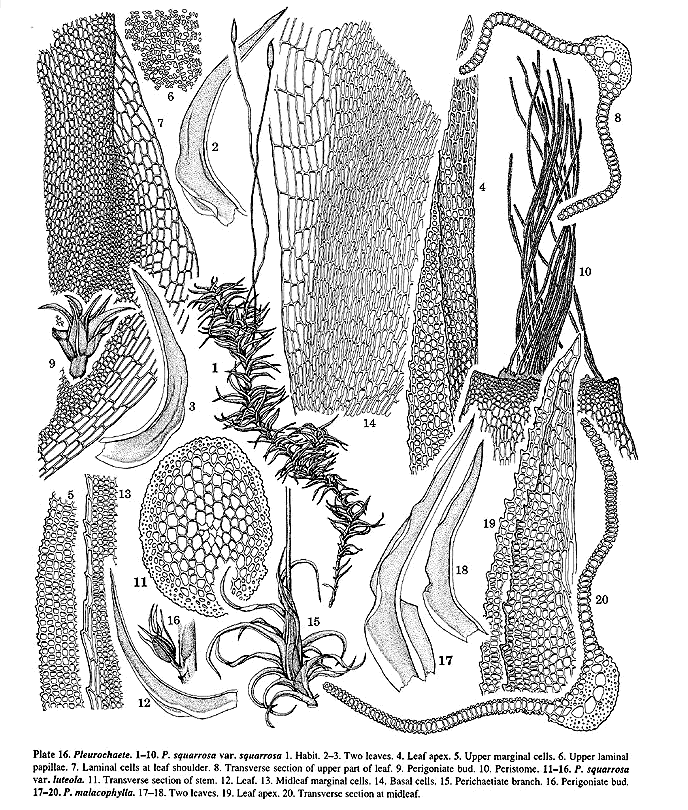
13. PLEUROCHAETE
Plate
16.
Pleurochaete Lindb., Oefv. K. Vet. Ak. Foerh. 21: 253, 1864. Type: Pleurochaete
squarrosa (Brid.) Lindb.
Barbula subg. Pleurochaete (Lindb.) Schimp., Syn. ed. 2: 220, 1876.
Tortella subg. Pleurochaete (Lindb.) Limpr., Laubm. Deutschl. 1: 607,
1890.
Barbula sect. Pleurochaete (Lindb.) C. Müll., Linnaea 39: 400, 1875.
Barbula sect. Squarrosae Lesq. & James, Man. N. Am. Moss. 130,
1884, nom. illeg. incl. sect. prior. Type: Barbula squarrosa
Brid.
Barbula sect. Squarrosa Lzaro é Ibiza, Bot. Descr. Comp. Fl. Esp. 1:
586, 1896, nom. illeg. incl. Barbula sect. Pleurochaete
(Lindb.) C. Müll. Type: Barbula squarrosa Brid.
Barbula subsect. Squarrosae C. Müll., Linnaea 39: 402, 1875.
Plants
forming a deep or sprawling turf,
green above, brown below. Stems branching irregularly, to 4.0 cm in
length, transverse section rounded-pentagonal, central strand small, walls
of central cylinder cells thin to weakly thickened, sclerodermis of 2–4
rows thick-walled cells, hyalodermis present; axillary hairs to 15 cells in
length, cells all hyaline; indumentum weakly radiculose. Leaves
spreading and strongly contorted when dry, squarrose-recurved above a
sheathing base when moist, oblong-lanceolate, 3–5 mm in length,
upper lamina broadly channeled, margins plane but occasionally recurved
to revolute along leaf base, denticulate in upper 1/3 of leaf to throughout,
1–2 marginal rows often weakly papillose distally beyond a border of hyaline,
thin-walled rhomboidal cells not merging below with inner basal cells
but instead extending as a distinct hyaline strip to leaf insertion, 4–7 cells
in width below, narrowing upwards, reaching barely higher than shoulder of leaf
base to 3/4 leaf length; apex usually sharply acute, occasionally broadly
acute; base ovate to rectangular, often broadly sheathing and with distinct
shoulders; costa short-excurrent as a sharp mucro, superficial cells quadrate
to short-rectangular and papillose from top of sheathing leaf base to near apex
ventrally, elongate and smooth dorsally, 6–8 rows of cells across costa
ventrally at midleaf, costal transverse section semicircular or reniform,
stereid bands strong ventrally and dorsally, larger dorsally,
epidermis differentiated in one layer ventrally, present or absent dorsally,
guide cells 4–6 in 1 layer, hydroid strand absent; upper laminal cells
subquadrate, 8–11 µm in width, 1(–2):1, walls thin or evenly weakly thickened,
superficially bulging on both exposed sides or only ventrally and then weakly
convex dorsally; papillae bifid, 1–4 per lumen; basal cells differentiated and
rising higher medially, distinct from the 4–6 rows of border cells, rectangular
to rhomboidal, 10–20 µm in width, 2–5:1, walls thin to evenly thickened or
porose. Dioicous. Perichaetia on very short lateral branches, inner
leaves long-lanceolate, narrower than cauline leaves, to 5 mm in length,
sheathing the seta, lower cells rhomboidal to rectangular and porose, reaching
to 3/4 length of inner leaves. Perigonia lateral on the stem, small. Seta
1.3–1.7 cm in length, 1 per perichaetium, orangish to reddish brown, twisted
clockwise; theca 2.0–2.8 mm in length, light yellowish or reddish brown,
cylindrical, exothecial cells rectangular to rhomboidal, 20–25 µm in width,
3–4:1, walls thin, stomates phaneropore, at base of theca, annulus of 3–5 rows
of vesiculose cells, persistent; peristome teeth 32, filamentous,
branched spiculose, 300–1000 µm in length, often broken, with several
articulations, twisted once counterclockwise, basal membrane apparently
absent or to 35 µm high in height, low-spiculose. Operculum long-conic, 0.9–1.7
mm in length, cells twisted counterclockwise. Calyptra cucullate, smooth, ca. 4
mm in length. Spores 10–13 µm in diameter, yellowish brown, papillose. Laminal
KOH color reaction deep yellow to orange. Reported chromosome number n = 13.
Found
in dry areas on soil and rock (generally calcareous), occasionally on tree
roots; North, Central and South America, Europe, North and Central Africa, the
Middle East and Asia.
Crum
and Anderson (1981) pointed out that Pleurochaete is quite like Tortella
in several respects but differs in that the differentiated thin-walled marginal
cells, which extend up from the insertion often to above midleaf, do not form a
coherent basal vee extending medially to the costa (Pl. 16, f. 7, 14). The
inner basal cells, instead, form a distinct region, much as in the case with
some but not all Pseudosymblepharis species. Pleurochaete is much
like the Asian Chionoloma in leaf shape, marginal strip of elongate
cells (Pl. 16, f. 13), and upper medial cells often bulging much greater
ventrally than dorsally, but the latter has thick-walled border cells and the
upper laminal margins are sharply incurved as in Weissia.
Variation
in the degree of extension of the basal marginal cells up the leaf margins and
in the length of the inner basal cells is not quite continuous, but is
correlated with plant stature. Pleurochaete squarrosa has a largely
Temperate Zone and paleotropical facies (P. squarrosa s. str.,
found in Europe, Ethiopia, the Congo, southern U.S.A., Mexico) and a
neotropical facies (P. luteola, found in southeastern U.S.A., e.g.
Tennessee, Zander 4333, BUF, and Arkansas, Crum & Anderson's exsiccat
Mosses of North America 951 as P. squarrosa; and Latin America). These
morphotypes are distinguishable in most specimens examined. Crum and Anderson
(1981), however, felt that the neotropical variant is only a “robust
expression,” not worthy of a separate name; Crum (1951) indicated that, where
growing sympatrically, these may sometimes be difficult to name as one or the
other. In any case, a varietal name is provided here for workers like myself
who wish to distinguish among the two. The var. luteola (Pl. 16, f.
11–16) differs in being more robust, with a more highly sheathing leaf base,
and the border of thin-walled marginal cells being strongly denticulate and
extending farther up the leaf margins. This parallels the distinction between Molendoa
hornschuchiana and M. sendtneriana, the former differing in stature
(largest in the genus) and denticulate lower leaf margins; however, the larger
species of Molendoa is distributed primarily across the Alps and
Himalayas (one station is in Alaska), while the latter ranges from the Andes
and North American Cordillera across the Arctic and throughout the Eurasian
continent in arctic-montane situations. Thus, if the each of these two genera
developed intraspecifically through reduction, then Pleurochaete
probably originated in Gondwanaland and Molendoa is Laurasian, but vice
versa if large stature and marginal denticulation are elaborations.
African
material identified as Pleurochaete beccarii at BM and NY is P. squarrosa
var. squarrosa; type material of P. beccarii at TR could
not be obtained on loan but is probably also synonymous. Pleurochaete
malacophylla is doubtfully distinct from P. squarrosa var. squarrosa.
Additional
literature: Nebel (1990), Quarterman (1956), Wyatt and Stoneburner (1982).
Number
of accepted species: 4.
Species
examined: P. malacophylla (BM), P. squarrosa.
New
combinations and statuses: Pleurochaete squarrosa (Brid.) Lindb. var. luteola
(Besch.) Zand., comb. et stat. nov. (Trichostomum luteolum
Besch., Mém. Soc. Sc. Nat. Cherbourg 16: 178, 1872; Pleurochaete luteola
(Besch.) Thér.).