38. HYPODONTIUM Plate
51.
Hypodontium C. Müll.,
Hedwigia 38: 96, 1899. Type: Hypodontium dregei (Hornsch.) C. Müll.
(lectotype by Magill 1981).
Plants robust, growing in a dense turf, light or dark green,
often glaucous above, light tan to blackish brown below. Stems branching often,
to 7 cm in length, transverse section rounded-pentagonal, central strand
present, sclerodermis weak, hyalodermis present, often weak; axillary hairs
long and narrow, ca. 5 cells in length, basal 1–2 cells thick-walled;
radiculose or red-tomentose. Leaves tubulose, incurved, often
contorted when dry, widely spreading from a sheathing base when moist, lanceolate,
3.5–6.0 mm in length, upper lamina broadly channeled, margins plane
to broadly incurved or involute, occasionally tubulose near apex, entire
above but sometimes denticulate along basal margins, bordered by 1–5 rows of
narrow, thick-walled cells to midleaf or near apex; apex
rounded-acute, occasionally broadly mucronate; base sheathing in the lower
1/4 of leaf, with distinct shoulders; costa percurrent or ending
in a short, broad mucro, occasionally ventrally strongly bulging,
ventral superficial cells quadrate, dorsally elongate, papillose to spinose,
7–12 rows of cells across costa ventrally at midleaf, costal transverse section
ovate or semicircular, 2 stereid bands present, the ventral occasionally
larger, dorsally lunate, epidermis usually strongly differentiated ventrally,
absent or weakly differentiated dorsally, guide cells 4–6 in 1 layer, hydroid
strand absent; upper laminal cells rounded-quadrate, 8–11 µm in
width, 1:1, walls evenly thickened, superficially ventrally bulging, dorsally
weakly convex; papillae thick, columnar, to 20 µm in height,
one per lumen on each side of the lamina, apex of papilla low-spiculose,
papillae larger medially and ventrally on the leaf; basal cells differentiated
across leaf, rising higher marginally in a vee, rectangular, 15–25 µm in width,
2–4:1, wider medially, walls hyaline, with distinct pores or these grading into
transverse slits. Dioicous. Perichaetia terminal, inner leaves
linear-lanceolate, long-awned, fragile, 6–7 mm in length,
tubulose-sheathing in lower 1/2–2/3, lower cells rectangular and hyaline except
at base of awn. Perigonia consisting of flattened axillary buds in
clusters near apex of perigoniate plants similar in stature to the
perichaetiate. Seta 5–8 mm in length, 1 per perichaetium, yellowish or reddish
brown, twisted counterclockwise; theca fleshy, 1.7–2.0 mm in length,
yellowish or reddish brown, ovate to cylindrical, exothecial cells
short-rectangular, 30–40 µm in width, 1–3:1, very thick-walled,
stomates phaneropore, at base of capsule, annulus weakly differentiated,
of smaller, transversely elongated cells; peristome teeth 16, flat
and long-triangular or broadly lanceolate, smooth, 150–220 µm, with
of 8–10 articulations, straight, strongly incurved, basal membrane
absent or very low, smooth; fragmentary remains of an exostome remaining
attached to the inside of the operculum or as scattered transverse, narrowly
elliptical plates attached externally to the joints of the peristome teeth.
Operculum long-rostrate, ca. 1 mm in length, cells straight. Calyptra
cucullate, rough in upper 1/2 with forward-pointing papillae,
2.7–3.0 mm in length. Spores large, ca. 30–40 µm in diameter, brown,
finely to very coarsely papillose. Laminal KOH color reaction yellow.
The genus is endemic to southern Africa,
where it is found on soil, rock or tree trunks.
Magill's (1981) treatment of the genus is
detailed and up to date. Reese et al. (1986), in an instructive review of the
genera of Calymperaceae, where Hypodontium has heretofore been put,
suggested this genus might be pottiaceous. Edwards (1980a) accepted Hypodontium
as Calymperaceae, and did not discuss it extensively. Edwards (1979, p. 328)
pointed out the fragmentary remains of 32 narrow exostome teeth that remain
attached to the inside of the operculum of Hypodontium and fall with it;
scattered, narrowly elliptical, transversely oriented plates attached to the
external faces of joints of the peristome were seen in this study. An
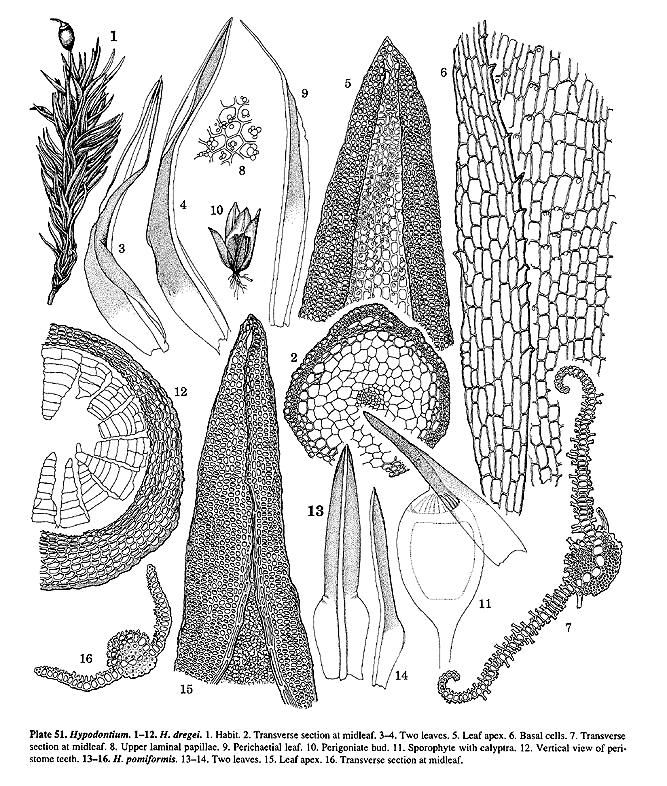
examination of a series of collections of H. dregei (Pl. 51, f. 1–12)
and H. pomiformis (Pl. 51, f. 13–16) from PRE indicates that Hypodontium
lacks many of the central characters of genera of Calymperaceae, e.g. the
campanulate calyptra of Calymperes, a stem central strand, the
intramarginal bands of elongated cells, and the enlarged but short-rectangular
to quadrate basal cells of Calymperes, Mitthyridium and Syrrhopodon.
The elongate, hyaline basal cells of Hypodontium are similar to those of
many of the genera of Pottiaceae. Characters of Hypodontium most
characteristic of the Calymperaceae are the peristome teeth (Pl. 51, f. 12)
being short and incurved, 16, deep orange, triangular, smooth or weakly
verrucose (compare those of Syrrhopodon, or even Octoblepharum cf. Magill
1981); upper basal cells of at least the outer perichaetial leaves sharply
differentiated and inflated-quadrate like the cancellinae of Calymperes;
cauline leaves lanceolate, bordered by much-elongate cells with thick walls,
apex broadly acute to rounded and margins plane to incurved and often spinose,
base with high shoulders; the upper laminal cells usually bulging ventrally and
weakly convex dorsally; and upper laminal and dorsal costal papillae very thick
(Pl. 51, f. 7, 16); none of these characters is, however, unique to the
Calymperaceae. The peristome teeth, in being red, flat and triangular, are
quite like those of Oreoweisia (Dicranaceae), a genus, which, however,
has a rather dissimilar gametophyte morphology.
Unusual in both the
Pottiaceae and Calymperaceae are the inner perichaetial leaves (Pl. 51, f. 9)
sheathing below but narrowly subulate or awned apically (as in Bryobartramia
of the Encalyptaceae, or species of Diphyscium, Diphysciaceae, and
approached in the awned perichaetial leaves of some species of Pseudocrossidium).
Calymperes has a persistent calyptra, opening by slits, which is unique
to Calymperaceae, while the cucullate calyptra of Syrrhopodon often has
a distinct collar on the lower margin that opens late. The calyptra of Hypodontium
(Pl. 51, f. 11) is comparatively small, cucullate, and perched on the rostrum
of the operculum, and is more typical of Pottiaceae, although also found in Mitthyridium,
Calymperaceae (Nowak 1980).
Except for the peristome, Hypodontium
has the same capsule morphology of
fleshy appearance; large, thick-walled exothecial cells; annulus largely
undifferentiated; and spores relatively large, as has Tridontium (here
removed to the Grimmiaceae near Scouleria) and Tetracoscinodon
(Merceyoideae), the last with similarly sheathing, distally narrowly subulate
(but not quite awned) perichaetial leaves. The peristome teeth of these three
genera are also somewhat alike, being broadly triangular-lanceolate, while Hypodontium
and Tetracoscinodon both have smooth teeth, but the gametophytes are
disparate in appearance. If there were some distinctive autapomorphy or
compelling combination of unusual characters, Hypodontium might be
placed in a family of its own.
Number of accepted species: 2.
Species examined: H. dregei
(PRE), H. pomiformis (PRE).