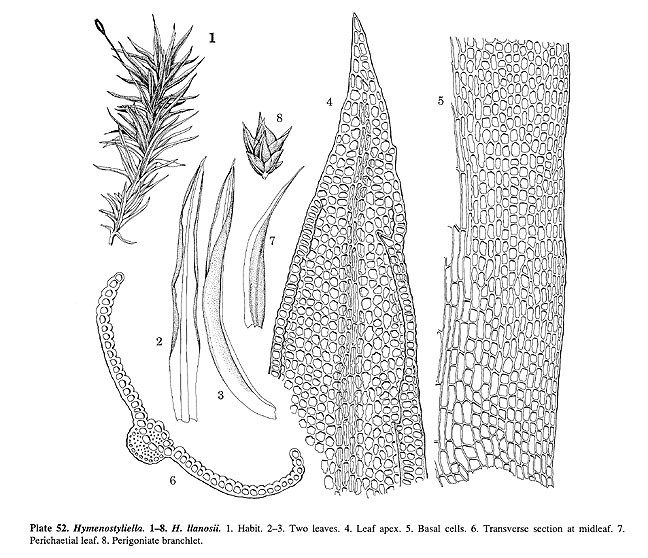
39. HYMENOSTYLIELLA Plate
52.
Hymenostyliella Bartr.,
Philippine J. Sci. 68: 108, 1939. Type: Hymenostyliella involuta (Card.
& Thér.) Bartr.
From
Hymenostylium, a genus + i + ‑ella, diminutive; resembling
the genus Hymenostylium.
Plants in cushions,
yellow-green above, yellow-brown below. Stems branching irregularly, to 3 cm in
length, transverse section rounded-pentagonal, central strand strong,
sclerodermis present, hyalodermis absent; axillary hairs of 7–10 cells, basal
1–2 yellowish brown; red-tomentose. Leaves involute incurved, curled
when dry, spreading-recurved when moist, long-lanceolate, widest
just below midleaf, ca. 4.5 mm in length, upper lamina
broadly channeled across leaf, margins involute in upper 4/5, plane
below, entire or more commonly distantly dentate in upper 1/4; apex
narrowly acute; base not differentiated in shape, somewhat
decurrent; costa short-excurrent as a mucro, occasionally flexuose or
dentate, superficial cells ventrally quadrate to short-rectangular, bulging,
once prorulose at distal ends, dorsally elongate, 4–5 rows of cells
across costa ventrally at midleaf, costal transverse section semicircular, 2
stereid bands present, epidermis present ventrally, weakly developed dorsally,
guide cells 4 in 1 layer, hydroid strand absent; upper laminal cells
rounded-hexagonal or somewhat longitudinally elongate, 10–13 µm in width,
1(–2):1, walls thick, trigonous, superficially strongly
bulging ventrally, flat dorsally; papillae absent; basal
cells weakly differentiated across leaf or somewhat higher along margins,
rectangular, similar to upper cells in width, 2–4:1, walls moderately
thick-walled, somewhat porose. Dioicous. Perichaetia on short lateral
branchlets, inner leaves lanceolate, to 3.0 mm in length, strongly
sheathing in lower half, cells long-rhomboidal in lower 4/5. Perigonia lateral,
small, gemmate, occurring singly or in clusters. Seta ca. 5–6 mm in
length, 1 per perichaetium, reddish brown, twisted clockwise; theca
ca. 1.2–1.5 mm in length, reddish brown, obovoid to elliptical,
exothecial cells rhomboidal, thick-walled, stomates phaneropore, at base of
theca, annulus of 2–3 rows of dark, weakly vesiculose cells; peristome
absent. Operculum long-rostrate, longer than the theca, to 1.5 mm in
length, cells in straight rows. Calyptra cucullate, smooth, ca. 1.7 mm in
length. Spores ca. 10–13 µm in diameter, light brown, essentially smooth.
Laminal KOH color reaction yellow. [This description is based on H. llanosii
collections at PC and US. Robinson (1971a) recently transferred Timmiella
alata Herz. to this genus (without examination of authentic material but
probably correctly), saying this species is closely related but is
distinguished from H. llanosii by a dorsal costal surface winged
with two ridges up to 12 cells in height and a cucullate leaf apex.]
A rare taxon found on
rock in wet areas in the Philippines, India and Brazil.
This genus bears an
immediate resemblance to Timmiella by the elongate, involute leaf and
ventrally bulging-mamillose upper laminal cells (Pl. 52, f. 6), but as Chen
(1941) pointed out, the latter genus has a peristome, as well as a bistratose
upper lamina. Unusual characters in Hymenostyliella are the strongly
involute leaf margins, ventrally bulging-mamillose and trigonous (Pl. 52, f. 4)
upper laminal cells, and sporophytes borne laterally on short branches (Pl. 52,
f. 1). Saito (1975a) noted the monopodial branching of Hymenostyliella
in his discussion of H.japonica (as a synonym of Didymodon japonicus).
The long-lanceolate leaf shape and distant teeth of this genus are reminiscent
of Tuerckheimia, which differs by the distinctive massive laminal
papillae and terminal perichaetium. Robinson (1971a) indicated a similarity to Hyophila
(Cladogram 15 bears out a relationship) through the ventrally bulging-mamillose
upper laminal cells. Hyophila differs, however, in its spathulate leaves,
generally has a hydroid strand, and is acrocarpous; Ganguleea, with
laterally borne sporophytes is seemingly more closely related, but see
Cladogram 15. The characteristic trigonous areolation is found to greater or
lesser degree in genera of other subfamilies, such as Hymenostylium, Leptodontium,
Reimersia, Trichostomum and Tuerckheimia.
Number of accepted
species: 3.
Species examined: H.
llanosii (PC, US).