4. GERTRUDIELLA
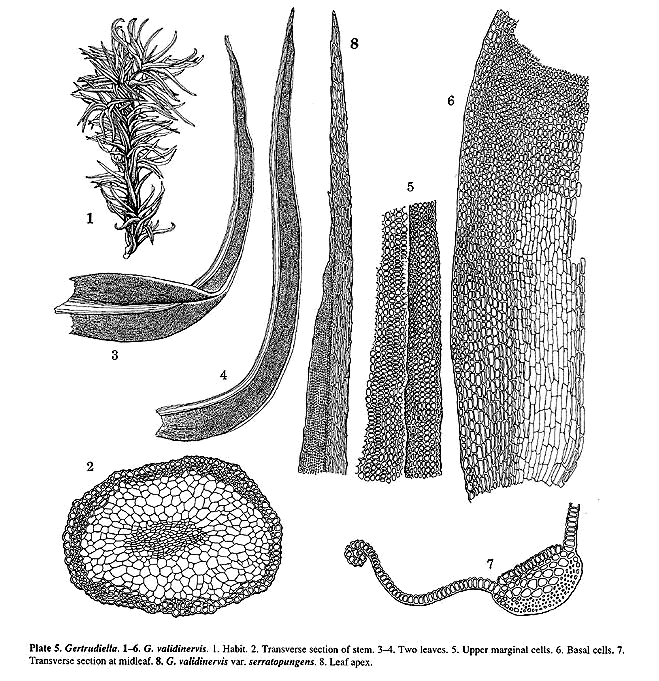
Plate 5.
Gertrudiella Broth., Nat. Pfl. ed. 2, 11: 528, 1925. Type: Gertrudiella
validinervis (Herz.) Broth.
Gertrudia Herz., Biblioth. Bot. 87: 44, 1916, hom.
illeg. non K. Schumann, 1900. Type: Gertrudia validinervis Herz.
Plants
in cushions, green above, brown to red-brown or blackish-brown below. Stems
branching occasionally, to 2.0 cm in length, transverse section
rounded-pentagonal to elliptical, central strand very strong and well
differentiated, sclerodermis present, hyalodermis present but firm-walled;
axillary hairs of 5–7 clear cells. Leaves crowded, weakly spreading,
weakly to strongly contorted or curled when dry, squarrose from a short,
sheathing base when moist, lanceolate, 3.5–4.5 mm in length,
upper lamina broadly channeled across leaf, margins strongly revolute to
near apex, entire or occasionally weakly dentate near apex; apex
narrowly acute, occasionally narrowly obtuse; base long-elliptical; costa
percurrent to excurrent as a short, denticulate awn, superficial
cells quadrate ventrally, elongate dorsally, 10–15 rows of cells across
costa ventrally at midleaf, costal transverse section semicircular, stereid
band single, strong and reniform, epidermis of 1 layer of strongly
hollow-papillose cells ventrally, epidermal cells weakly developed
dorsally, guide cells 15–20 in 3–4 layers, hydroid strand present;
upper laminal cells subquadrate to irregularly hexagonal, small,
8–10 µm in width, 1:1, walls evenly thickened, superficially
bulging-mamillose ventrally, flat dorsally in medial portion of lamina,
bulging on both sides in 10–20 rows marginally; papillae present on
marginal cells, low, simple, hollow; basal cells
differentiated medially, rectangular, little wider than the upper, 3–4:1,
walls thin, occasionally transversely slit across longitudinal walls. Apparently
dioicous. Perichaetia unknown. Perigonia appearing as axillary buds near stem
apex, inner leaves deltoid, outer leaves elongate. Sporophyte unknown. Laminal
KOH color reaction orange.
Rare,
restricted to Bolivia where it has been collected on stone in rather dry areas,
at low to high (300–3200 m) elevations.
This
monotypic genus is well characterized, mainly by the ventrally mamillose medial
cells of the lamina, several rows of marginal cells bulging on both sides and
low-papillose, epidermal cells on the ventral surface of the costa numerous and
strongly hollow-papillose, and guide cells rather thick-walled and forming a
multilayered cylinder (Pl. 5, f. 7). Hilpert (1933) included Trichostomum
ferrugineum Herz. in Gertrudiella on account of the several layers
of guide cells. This species is actually a Didymodon (with much the same
general appearance of D. occidentalis of western North America)
by the orange reaction to KOH, lanceolate leaves deeply and widely channeled
ventrally along the stout costae, and upper laminal margins bistratose, and is
here treated as Didymodon herzogii (nom. nov. in treatment of Didymodon),
differing from related taxa of sect. Vineales by the microstomous,
eperistomate capsule and medial basal cells transversely resorbed across
longitudinal walls to form slits. The last character has also been described
for Kingiobryum Robins. (see Zander & Cleef 1982) of the
Dicranaceae. Although G. validinervis shows some slitting of basal
laminal cells, it and D. herzogii are not closely related. Kingiobryum,
which is eperistomate, may well belong to the Pottiaceae; further study is
needed.
Gertrudiella shares several characters with various species
of Pseudocrossidium, among them revolute margins, differentiation of
medial upper laminal cells (especially P. leucocalyx) and presence of
ventral costal epidermal cells, a single stereid band, guide cells in more than
one layer, and small upper laminal cells. It is, however, apparently not
closely related. Streptocalypta has a similar arrangement of
thick-walled guide cells but has quite different areolation. The guide cell
cylinder of Gertrudiella is probably mainly of structural importance;
sections reveal that there is no direct connection with the equally
well-differentiated stem central strand (Pl. 5, f. 2).
Biblography:
Herzog (1916), Hilpert (1933).
Number
of accepted species: 1.
Taxa
examined: G. validinervis (BUF and isotypes at JE, L, W), G. validinervis
var. serratopungens (JE, L).
New
combination: Gertrudiella validinervis (Herz.) Broth. var. serratopungens
(Herz.) Zand., comb. nov. (Gertrudia validinervis Herz. var. serratopungens
Herz., Biblioth. Bot. 87: 45, 1916).