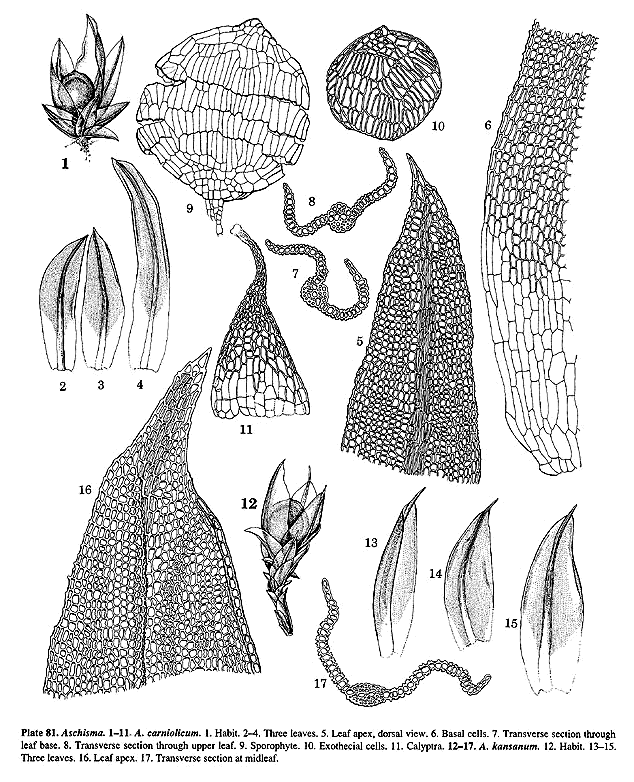
59. ASCHISMA Plate
81.
Aschisma Lindb., Utkast Nat. Grupp. Eur. Bladm. 28, 1878. Type: Aschisma
carniolicum (Web. & Mohr) Lindb.
Phascum
subg. Aschisma (Lindb.) Kindb., Eur. N. Amer. Bryin. 2: 403, 1897.
Plants
very small, gregarious or
forming a thin green turf. Stems seldom branching, ca. 0.2 µm in length,
transverse section rounded-pentagonal, central strand present, weak,
sclerodermis not well differentiated, hyalodermis absent; axillary hairs ca. 3
cells in length, basal cell thicker walled. Leaves incurved and tubulose
when dry, weakly spreading when moist, oblong or triangular to
short-lanceolate, often falcate and plicate on one side, 0.6–1.0 µm
in length, upper lamina broadly channeled, margins plane to occasionally
weakly incurved, entire to sharply serrulate above midleaf, sometimes
bordered above, below or throughout by 1–3 rows of weakly papillose,
elongate cells; apex broadly or rounded-acute; base little
differentiated in shape; costa excurrent as a sharp mucro, this
occasionally rough or denticulate, superficial cells elongate both
ventrally and dorsally, 2–4 rows of cellsacross costa ventrally at midleaf,
costal transverse section circular to elliptical, two stereid bands present,
mostly substereid ventrally, often also substereid dorsally, epidermis not
differentiated, guide cells 2–4 in 1 layer, hydroid strand apparently
absent or occasionally present; upper laminal cells quadrate to occasionally
short-rectangular, 9–12 µm in width, 1:1(–2), walls evenly thickened,
superficially flat or bulging only ventrally or on both exposed surfaces; papillae
stout, bifid, crowded, scattered or centered over lumens, ca. 4 per
lumen; basal cells strongly differentiated, rising higher along
margins in a weak vee, rectangular, little wider than upper cells, 3–5:1,
walls very thin to evenly thickened. Monoicous. Perichaetia terminal, inner
leaves long-elliptical, to 1.5 µm in length, concave or not sheathing, lower
cells oblong. Antheridia paroicous in axils of bracts or in stalked autoicous
buds at base of the perichaetiate plant. Seta very short, ca. 50 µm in
length, 1 per perichaetium, hyaline, straight; capsule cleistocarpous,
0.3 µm in diameter, yellowish brown, spherical, with a small
blunt apiculus (ca. 30 µm in length), exothecial cells rectangular, mostly
ca. 13–18 µm in width, 4–5:1, circling capsule longitudinally in
several even bands with the appearance of a palisade, stomates absent,
annulus absent; peristome teeth absent. Calyptra conic,
split once or twice, rough, 0.2–0.3 µm in length. Spores large, 18–24 µm
in diameter, yellowish brown, essentially smooth to spiculose-papillose. Laminal
KOH color reaction yellow.
A genus
widely distributed in the Mediterranean area and disjunctive to central North
America; growing in dry climates on soil, occasionally under translucent rocks
in exposed situations.
The
most prominent traits of this distinctive genus are the dry habitat; small size
of the plants; spherical, cleistocarpous capsules with yellow, rectangular
cells arranged in neat encircling bands, lacking stomates (Pl. 81, f. 9–10);
the weak, hyaline seta; the falcate leaves usually with a distinct border of
epapillose cells (Pl. 81, f. 5, 6, 16) and the leaf base not differentiated in
shape; and the costa with usually merely substereid cells in two bands (Pl. 81,
f. 7, 8, 17). As is the case with Tetrapterum and Tortula sect. Schizophascum,
both Pottioideae but rather distantly related, the capsule tends to rupture
along the transverse walls at the butt ends of the exothecial cells, which are
superficially rather thick-walled.
Aschisma
carniolicum and A. kansanum
are fairly distinct in the material seen. The latter (Pl. 81, f. 12–17) has
more strongly bordered and serrulate margins, more strongly bulging upper
laminal cells with centered (not scattered) papillae, a larger, more strongly
denticulate mucro, and spores less ornamented and toward the small end of the
size range for the genus. The protonema of A. kansanum survives arid
conditions under translucent pebbles, ultimately producing leafy axes and
sporophytes peripherally (Cridland 1959); this scenario is also the case with Bruchia
brevifolia (Bruchiaceae) (cf. Rushing 1989) and, at least
occasionally, Syntrichia inermis (Weger & During 1989).
Additional
literature: Andrews (1915), Crdenas (1988), Sérgio (1972a).
Number
of accepted species: 2.
Species
examined: A. carniolicum (BUF, NY), A. kansanum (NY).